Signal Hill
Before the era of smartphones and satellites, a simple flag on a hill connected St. John's to the wider world. Yet, this same location also witnessed a monumental technological leap.
Full story unlocks in the tour
 Quintin Soloviev / CC BY 4.0, via Wikimedia Commons
“Where the North Atlantic meets vivid color and ancient echoes.”
Not the postcards. The stories even locals don't know — whispered in your ear, right where they happened.
Before the era of smartphones and satellites, a simple flag on a hill connected St. John's to the wider world. Yet, this same location also witnessed a monumental technological leap.
This two-block stretch is known for its lively nightlife, but its origins were far more practical than celebratory.
The city's famously colorful houses were not always so bright; their brilliant hues emerged from a devastating event.
Discover every secret of St. John's
Every address, every reveal in full — in your ear, right where it happened.
You pick your stops. You walk. The voice reveals what the others miss.
No tours available yet. Check back soon — we're preparing them.
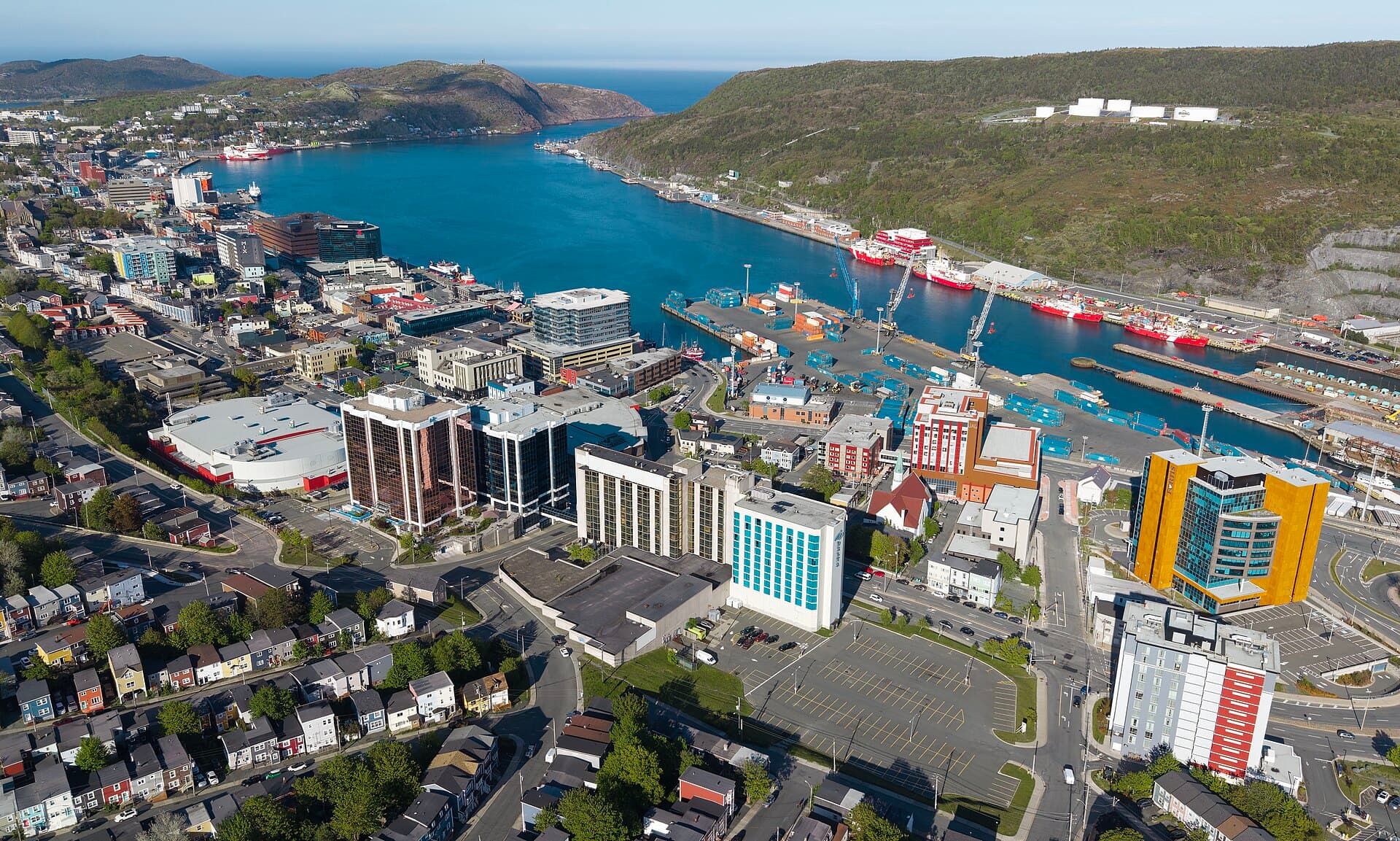
St. John's, the capital of Newfoundland and Labrador, stands as the most easterly city in North America, excluding Greenland. It occupies the eastern tip of the Avalon Peninsula, overlooking a deep, protected harbor called The Narrows. The city offers a compelling blend of historical depth and contemporary culture, marked by its distinctively colored row houses, often called 'Jellybean Row,' and a profound maritime legacy.
With a metropolitan population of approximately 239,316 as of January 2025, St. John's is the second-largest Census Metropolitan Area in Atlantic Canada. Its unique geography means visitors can experience a varied climate, often described as having 'four seasons in one day,' alongside a famously welcoming local culture. The city functions as a significant ocean port and a central point for the provincial fishing fleet and the offshore oil and gas industry.
St. John's possesses one of the longest and most vivid histories in North America, with its harbor drawing European fishermen as early as the 16th century. While the precise date and circumstances are debated, legend attributes the city's name to John Cabot, who supposedly sailed into the harbor on the Feast of St. John the Baptist in 1497. However, maps from the early 1500s, like a Portuguese map from 1519 labeling it 'São João,' suggest Basque or Portuguese fishermen likely gave it the name.
Sir Humphrey Gilbert formally claimed St. John's for England in 1583, marking its official establishment. Despite this, permanent English settlements were initially forbidden by the English government, eager to protect the West Country fishing industry. Nevertheless, permanent habitation was evident by the mid-1620s, and St. John's grew to be the largest settlement on the English shore by the 1670s, evolving into a commercial and administrative center.
Given its strategic location overlooking The Narrows, the sole entrance to the harbor, St. John's was heavily fortified from the mid-17th century onwards. The city was a frequent target during various conflicts, including the Seven Years' War, the American Revolutionary War, and the War of 1812. The Battle of Signal Hill in 1762 was the final battle of the Seven Years' War in North America, resulting in the British capturing St. John's from the French.
St. John's endured several devastating fires throughout its history, notably in 1816–17, 1846, and 1892. The Great Fire of 1892, which began on George Street, consumed most of the east end of the city. This tragedy, however, spurred a significant architectural renewal, giving the city center its distinct Victorian style with mansard roofs and the iconic colorful 'Jellybean Row' houses.
In 1888, St. John's was officially incorporated as a city. The early 20th century brought a pivotal moment in telecommunications history when Guglielmo Marconi received the first transatlantic wireless transmission on Signal Hill in 1901. Today, St. John's continues to flourish as a major economic and cultural hub, balancing its profound historical narrative with a modern, forward-looking perspective.
Begin your exploration at Signal Hill National Historic Site, which offers sweeping views of the city, harbor, and the Atlantic Ocean. Explore Cabot Tower, built in 1898, and learn about Marconi's historic wireless reception. In summer, you can observe the Signal Hill Tattoo, a historical reenactment.
Walk through the lively streets of downtown, particularly Water Street, North America's oldest commercial street, and Duckworth Street, to appreciate the colorful 'Jellybean Row' houses. Visit The Rooms, the provincial museum, art gallery, and archives, which provides insights into Newfoundland and Labrador's history and culture.
Experience the unique fishing village atmosphere of Quidi Vidi, a short walk from downtown. Here, you can visit the Quidi Vidi Brewery, housed in a former fish plant. For a taste of local nightlife, explore George Street, a two-block stretch with a high concentration of pubs and bars in North America.
A short drive from the city is Cape Spear Lighthouse National Historic Site, the easternmost point in North America, featuring the oldest lighthouse in Newfoundland and WWII bunkers. Consider a whale and puffin tour from Bay Bulls to Witless Bay Ecological Reserve, home to North America's largest Atlantic Puffin colony.
The ideal time to visit St. John's for warm-weather activities and festivals is from mid-July to late August, when temperatures are comfortable, averaging between 20°C (68°F) and 23°C (73.4°F). This period also provides opportunities for whale and puffin watching. Late spring (April to May) is excellent for iceberg viewing and fewer crowds, while early autumn (September to October) brings colorful foliage and pleasant temperatures for hiking. Winters are long but surprisingly mild for the latitude, with hotel rates at their lowest from November to March.
St. John's International Airport (YYT) is located just 10 minutes north of downtown and serves as the primary international hub, with flights from across Canada, the US, and the UK. Taxis and rideshares are readily available for airport transfers.
The downtown core, including Water Street and Duckworth Street, is quite walkable, but the city's hilly terrain means comfortable shoes are essential. For exploring beyond downtown, Metrobus provides public transit services throughout St. John's, Mount Pearl, and Paradise, though frequency and coverage may be better suited for residents than time-pressed visitors. Renting a car is advisable if you plan to explore the wider Avalon Peninsula, as many attractions outside the city center are not accessible by public transit.
The official language is English, with almost 97% of the population reporting it as their mother tongue. St. John's operates on Newfoundland Standard Time, which is a half-hour ahead of Atlantic Standard Time. Tipping customs are similar to the rest of North America, with 15-20% being standard for good service.