Diocletian's Palace Cellars
Beneath the active streets of Split's Old Town lies a remarkably preserved Roman secret.
Full story unlocks in the tour
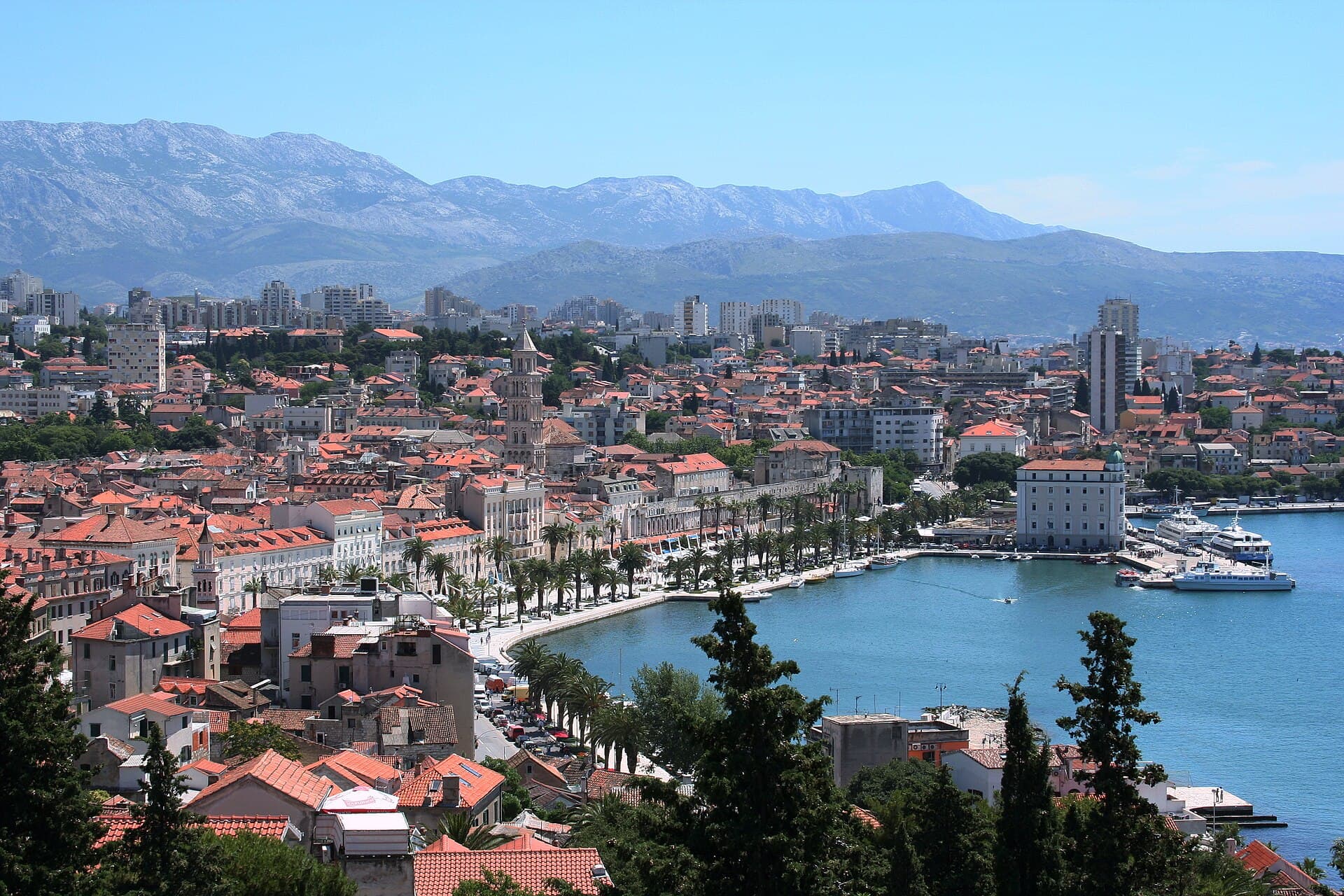 Tatyana Peshkova / CC BY-SA 4.0, via Wikimedia Commons
“Where ancient stones meet the rhythm of contemporary life.”
Not the postcards. The stories even locals don't know — whispered in your ear, right where they happened.
Beneath the active streets of Split's Old Town lies a remarkably preserved Roman secret.
The central cathedral in Split holds a surprising irony regarding its original purpose and its namesake.
You can do your grocery shopping in Split at a UNESCO World Heritage Site.
Discover every secret of Split
Every address, every reveal in full — in your ear, right where it happened.
You pick your stops. You walk. The voice reveals what the others miss.
No tours available yet. Check back soon — we're preparing them.
Split, Croatia's second-largest city, is a compelling fusion of ancient history and contemporary Adriatic coastal living. Its heart is Diocletian's Palace, a UNESCO World Heritage Site that isn't merely a ruin but a living, breathing part of the city, where residents and businesses thrive within its 1,700-year-old walls.
Stroll through a maze of narrow passages, Roman architecture, and various cultural influences, from Romanesque and Gothic to Baroque and Viennese. The city effortlessly balances the energy of an active urban center with the tranquility of its coastal appeal, offering everything from historic wonders to lively markets and expansive sea views.
Split serves as a primary hub for exploring the Dalmatian coast, providing easy access to nearby islands and national parks. Whether you are drawn to its enduring heritage, delicious local cuisine, or the sparkling Adriatic Sea, Split promises a singular and memorable experience.
Split's story begins not with a city, but with a palace. In the late 3rd century CE, Roman Emperor Diocletian, a native of Dalmatia, commissioned the construction of a lavish retirement residence near his birthplace of Salona. This fortified complex, known as Diocletian's Palace, took approximately ten years to build, with construction finishing around 305 CE. About half of the complex was for Diocletian's personal use, while the remainder housed a military garrison.
After Diocletian's death in 305 CE, the Roman Empire began to decline, and the palace's purpose shifted dramatically. In the 7th century, as the nearby Roman capital of Salona was sacked by Avars and Slavs, its citizens sought refuge within the sturdy walls of Diocletian's Palace. This influx of refugees marked the transformation of the imperial residence into an active medieval city, with people adapting the Roman structures for their homes and businesses.
Over the centuries, Split experienced a succession of rulers, including the Byzantines, the Kingdom of Croatia, and the Republic of Venice, which held the city for extended periods. Venetian rule, from 1420 to 1797, saw Split develop as a heavily fortified outpost. The city then passed to the Habsburg monarchy (Austrian rule) until 1918, after which it became part of the Kingdom of Serbs, Croats, and Slovenes, later Yugoslavia. During World War II, Split was occupied by Fascist Italy and later Germany, becoming a center of partisan resistance. Following the war, it was incorporated into Socialist Yugoslavia and experienced significant economic and demographic growth. In 1991, Croatia declared independence from Yugoslavia, and Split, despite some shelling during the subsequent war, emerged relatively unscathed. Today, Diocletian's Palace remains a UNESCO World Heritage Site, a testament to Split's continuous urban life from late antiquity to the present.
The main attraction in Split is Diocletian's Palace, a UNESCO World Heritage site that forms the very core of the Old Town. Wander through its ancient streets and discover the Peristyle, the central square, and the Cathedral of Saint Domnius, originally Diocletian's mausoleum, with its bell tower offering expansive city views.
Beyond the palace walls, explore the charming Varoš neighborhood, one of Split's oldest districts, with its traditional stone houses and narrow streets. Stroll along the Riva, a lively waterfront promenade lined with cafes and restaurants, ideal for observing local life and enjoying views of the Adriatic.
For a dose of nature and sweeping vistas, hike up Marjan Hill, a forested peninsula offering wide views of Split, the harbor, and surrounding islands. History enthusiasts can also venture outside the city to Klis Fortress, a dramatic defensive structure and a Game of Thrones filming location, or explore the Roman ruins of Salona, the ancient capital of Dalmatia.
The best times to visit Split are during the shoulder seasons: late spring (April to June) and early fall (September to October). During these months, the weather is pleasantly warm, ideal for sightseeing and outdoor activities, and the crowds are smaller than in the peak summer months. The sea is also warm enough for swimming by late spring and remains so through early October. Summer (July and August) is the most active but also the hottest and most crowded, with higher prices. Winter (November to March) offers a crowd-free experience with mild temperatures, though some attractions may have limited hours.
Croatia's official currency is the Euro (€). While credit cards are widely accepted, it's advisable to carry some cash for smaller establishments or markets. ATMs are readily available throughout the city. For getting around, Split's Old Town is largely pedestrian-only, making walking the best way to explore its narrow streets. For longer distances or trips outside the center, public buses are available, and rideshare services like Uber operate in the city.
When visiting religious sites, dress modestly, ensuring shoulders and knees are covered. In the Old Town, walking around in swimwear or shirtless is considered inappropriate and can result in fines. Tap water in Split is safe to drink.