Spiez Castle
The stronghold you observe today was not the initial fortification upon this ancient ground.
Full story unlocks in the tour
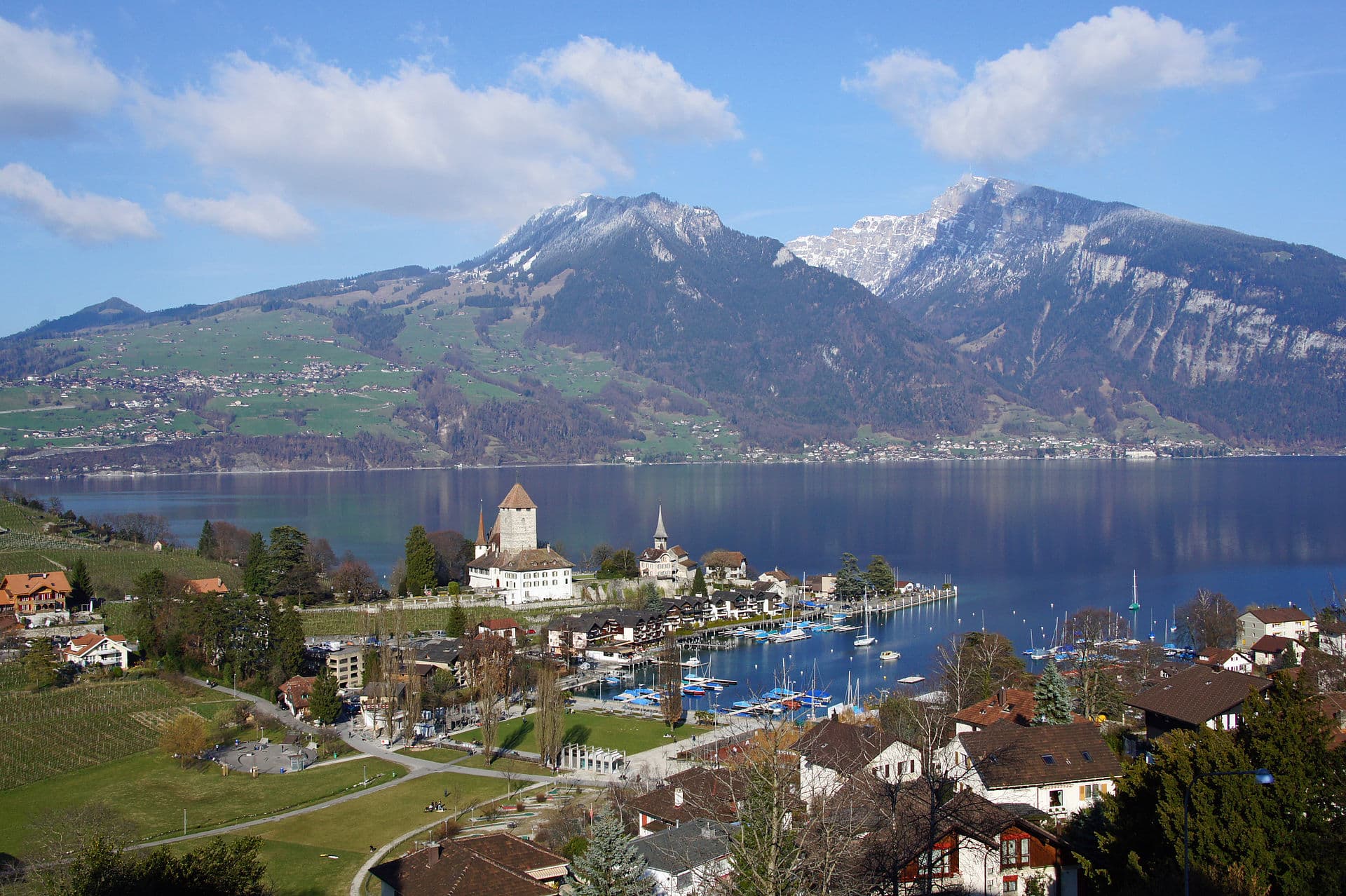 Yesuitus2001 at de.wikipedia / CC BY-SA 2.5, via Wikimedia Commons
“Where glacial meltwater meets ancient stone and alpine vineyards.”
Not the postcards. The stories even locals don't know — whispered in your ear, right where they happened.
The stronghold you observe today was not the initial fortification upon this ancient ground.
Spiez wine possesses a distinctive character, shaped not merely by the alpine climate and the lake's reflection, but also by a surprising historical event.
Spiez functions as a significant railway junction, yet the journey from the train station to the boat station is not always as direct as one might anticipate.
Discover every secret of Spiez
Every address, every reveal in full — in your ear, right where it happened.
You pick your stops. You walk. The voice reveals what the others miss.
No tours available yet. Check back soon — we're preparing them.
Spiez, a town along the southern shore of Lake Thun in the Bernese Oberland of Switzerland, offers a captivating fusion of natural splendor and historical depth. With the pyramid-shaped Niesen mountain forming its backdrop, Spiez is celebrated for its scenic bay, frequently lauded as Europe's most beautiful. The town's prominent landmark is Spiez Castle, which rises from a rocky spur overlooking the lake and its vineyards.
The municipality of Spiez encompasses several smaller settlements, including Einigen, Hondrich, Faulensee, and Spiezwiler. The profound blue waters of Lake Thun provide a central point for numerous activities, from unhurried boat excursions to various water sports. Beyond the lake, the surrounding hillsides are adorned with vineyards and orchards, contributing to the region's allure and providing opportunities for scenic strolls and wine sampling.
The area between the Kander River and Lake Thun, where modern-day Spiez is situated, bears a history of human settlement reaching back to the Bronze and Iron Ages. Archaeological discoveries include three Bronze Age cemeteries containing axes, knives, and cloak pins from 1750 to 1500 BC. The Bürg site, a nearby hill, yielded knives, arrowheads, spearheads, a horse's bridle, and a razor from a slightly later period. The Eggli hilltop appears to have served as a sacred site during both the Bronze and Iron Ages.
Spiez receives its first mention in historical records around 761–62 as "Spiets." According to the Strättliger Chronicle, King Rudolph II of Burgundy erected Spiez Castle in 933. Soon thereafter, the Freiherr von Strättligen established residence in the castle. Portions of the castle's current shield walls and main tower were constructed in the 12th century, and by the 13th century, the town of Spiez had grown beyond the castle walls. By 1280, the castle functioned as an Imperial fief. Ownership of the castle transitioned through several noble families, including the von Strättligen and von Bubenberg families. In 1338, Johann II von Bubenberg acquired the castle, town, church, and surrounding villages.
The von Erlach family assumed ownership of the castle and lands in 1516, governing the town and villages until the French invasion of 1798. Following the French invasion and the establishment of the Helvetic Republic, the von Erlach family relinquished their land rights and jurisdiction but retained ownership of the castle until 1875. The castle underwent several renovations and expansions from the 15th to the 18th centuries, evolving from a fortress to a more residential structure with Renaissance influences. The great hall and northern buildings were expanded and renovated in 1600, and the Baroque "New Castle" was constructed on the south side during the 17th and 18th centuries.
Historically, residents of Spiez cultivated orchards and vineyards along the lake, engaged in fishing, and transported goods by boat. The vineyards, first documented in 1338, were largely devastated by disease around 1900, but a successful initiative to restart wine production commenced in 1927. The construction of the Lake Thun road in 1844 and steamship docks in 1835, 1876, and 1926 opened the town to increased connectivity. Spiez became a favored health and spa town in the 19th century due to its agreeable climate and enhanced transport links. The arrival of railways in the late 1800s and early 1900s, including lines to Thun-Interlaken and the Lötschberg line, significantly boosted tourism. In 1927, the Spiez Castle Foundation was established to preserve the castle complex. Today, Spiez remains a vital railway hub and a favored destination for its scenic beauty and historical sites.
Spiez presents a variety of sights and activities, many centered around its characteristic bay and historical landmarks. Spiez Castle, a Swiss heritage site of national significance, invites exploration. Visitors can wander through its museum, the thousand-year-old castle church, and the surrounding gardens, taking in expansive views of Spiez Bay and the Bernese Alps from the castle tower. The castle complex also includes wine caves where local Spiezer wine is crafted.
Beyond the castle, Spiez Bay itself serves as a central point for repose and recreation. Amble along the lakeside promenade, which extends for kilometers, offering views of Lake Thun and the surrounding mountains. This path is also accessible for wheelchairs and prams, linking Spiez to the nearby village of Faulensee. Lake Thun provides opportunities for water sports such as stand-up paddling, sailing, canoeing, and pedal boat rentals, or simply swimming in its clear waters. Boat excursions on Lake Thun offer a popular way to experience the scenery and visit other lakeside towns.
The Spiez vineyards are among the highest north of the Alps and provide a sensory adventure trail. Visitors can learn about wine production, sample local wines, and enjoy the views of the lake and mountains. For those curious about local history and viticulture, the Heimat- und Rebbaumuseum (Heritage and Winemaking Museum) resides within a 270-year-old chalet. Additionally, the Niesen mountain, often called the "Swiss Pyramid," offers hiking opportunities and sweeping views.
The optimal time to visit Spiez largely depends on your desired activities. For warm-weather pursuits and enjoying the lake, late June to late August is ideal, with July offering the clearest skies. During this peak season, temperatures can reach up to 25.2°C during the day, perfect for swimming, boating, hiking, and cycling. Autumn, from September to November, brings cooler temperatures and vivid foliage, providing a quieter experience and an excellent time to explore the vineyards and taste local wines. While winter (November to February) offers picturesque snow-covered landscapes, it is significantly colder, with temperatures ranging from -6°C to 5°C, and is more suited for winter sports. Spring (March to May) provides a pleasant combination of humidity and rising temperatures, suitable for unhurried strolls.
Spiez is well-connected and readily accessible by various modes of transport. The Spiez railway station is a significant hub, providing direct train connections every half hour from major Swiss cities like Bern, Basel, and Zurich, as well as international trains from destinations such as Milan and Hamburg. For those arriving from Thun or Interlaken, buses and boats on Lake Thun also offer convenient access. The local bus service is an efficient way to navigate the town and nearby villages.
Within Spiez, many points of interest are within walking distance, particularly along the lakeside promenade. For longer distances or to explore the surrounding areas, consider utilizing the local PostBus network, which offers routes to places like Faulensee and Hondrich. Taxis are also available. For a unique sightseeing experience, the nostalgic Spiez Fun Train operates between the train station and Spiez Bay from May to October. When planning your visit, remember that many attractions, including Spiez Castle and its church, operate seasonally, typically from spring to early autumn.