Temple of Poseidon
Lord Byron, the Romantic poet, left his mark here, but not in the way you might expect from a reverent visitor.
Full story unlocks in the tour
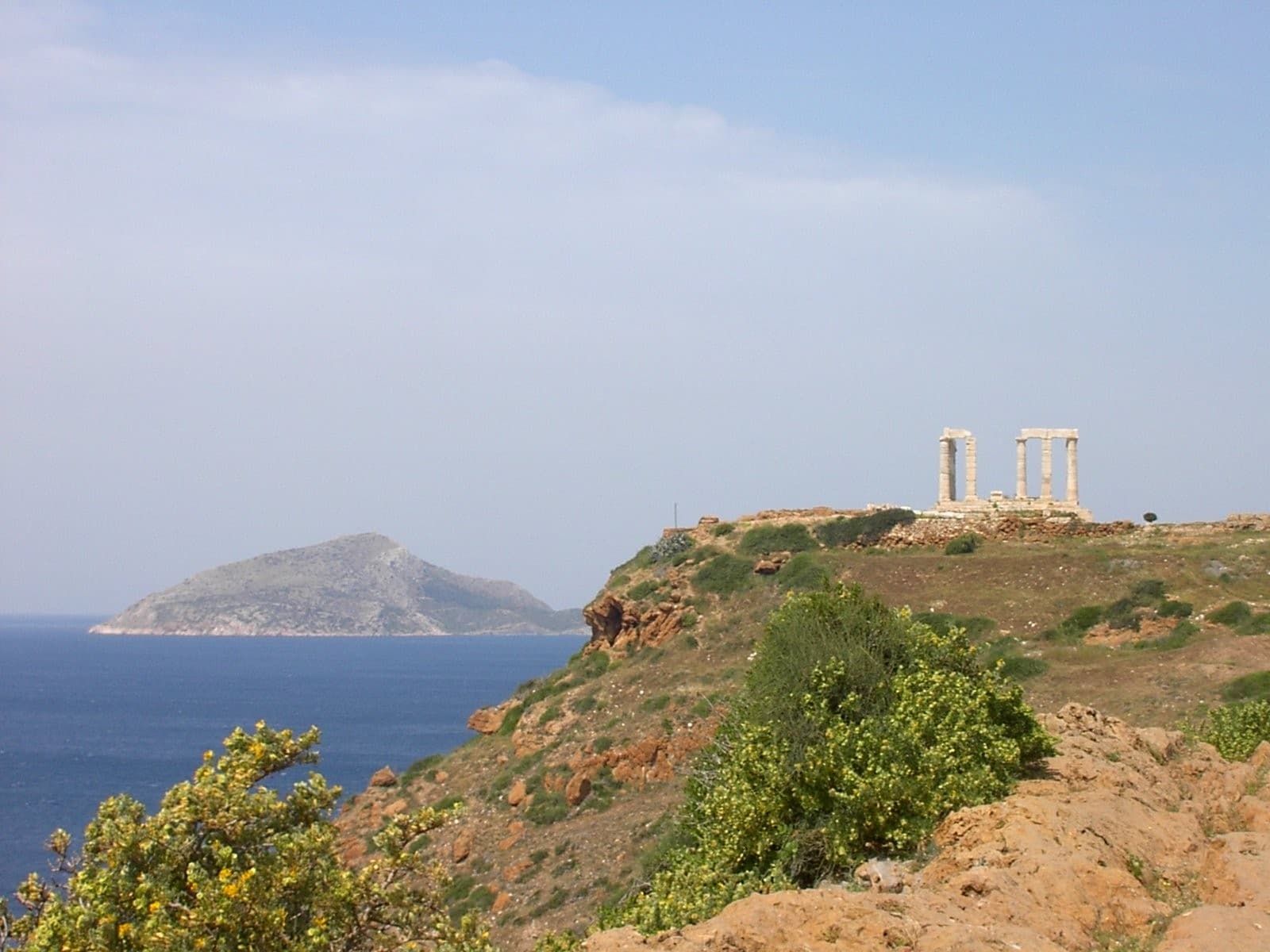 User Adam Carr / CC BY-SA 3.0, via Wikimedia Commons
“Where marble columns meet the Aegean, and ancient myths breathe with the sea.”
Not the postcards. The stories even locals don't know — whispered in your ear, right where they happened.
Lord Byron, the Romantic poet, left his mark here, but not in the way you might expect from a reverent visitor.
The name of the vast Aegean Sea itself is tied to a tragic tale that unfolded right here at Sounion.
The gleaming white columns you see today are only a fraction of what once stood, and the temple had artistic details that have largely vanished.
Discover every secret of Sounion
Every address, every reveal in full — in your ear, right where it happened.
You pick your stops. You walk. The voice reveals what the others miss.
No tours available yet. Check back soon — we're preparing them.
At the southernmost tip of the Attica Peninsula, Sounion is a dramatic headland where the ancient world meets the expanse of the Aegean Sea. This iconic location is dominated by the Temple of Poseidon, a testament to classical Greek architecture and a beacon for sailors for millennia. The site offers sweeping panoramic views that have inspired poets and travelers alike, making it a compelling escape from the bustle of Athens.
Beyond its architectural grandeur, Sounion holds deep mythological and historical significance. It served as a vital strategic point for ancient Athens, controlling sea passages and guarding the nearby silver mines of Lavrion, which fueled the city's power. A visit here is not merely a glimpse into ruins, but an immersion into a landscape where legends were born and the power of the sea god was revered.
Cape Sounion has been a place of worship for thousands of years, with archaeological finds dating back to 700 BC. Homer first referred to Sounion as the 'sacred cape of the Athenians' in the Odyssey. In the 6th century BC, Athenians celebrated a quadrennial festival here, involving leaders sailing to the cape in a sacred boat. The area's proximity to the silver mines of Lavrion made it economically crucial, contributing significantly to Athens' emergence as a leading power in the 5th century BC.
The Temple of Poseidon, as seen today, was constructed between 444 and 440 BC, during the Golden Age of Athens, a period when ambitious building programs also saw the creation of the Parthenon. It was built over the ruins of an earlier temple, which the Persians destroyed in 480 BC. The temple's placement on a 60-meter-high cliff was both religious and strategic, serving as a navigational marker and a fortress guarding against sea threats. After defeating the Persians in the naval Battle of Salamis, the Athenians dedicated an entire captured enemy warship at Cape Sounion to Poseidon.
Sounion is famously linked to the myth of King Aegeus. According to legend, Aegeus awaited his son Theseus's return from Crete, where he had gone to slay the Minotaur. They had agreed that if Theseus succeeded, he would hoist white sails; if he failed, black sails would be flown. When Theseus tragically forgot to change the sails, Aegeus, seeing the black sails, believed his son was dead and leapt from the cliffs into the sea, which was subsequently named the Aegean Sea.
Sounion continued to be strategically important, with fortifications constructed in 414 BCE during the Peloponnesian War. In the 2nd century BCE, it was even the focus of a slave rebellion involving over a thousand slaves from the nearby Lavrion silver mines. However, following the closure of the mines, Sounion experienced a steady decline. The site later captured the imagination of Romantic poets like Lord Byron, who visited in the early 19th century and immortalized 'Sunium's marbled steep' in his poem 'The Isles of Greece.'
The undisputed highlight of Sounion is the Temple of Poseidon, a striking Doric temple built from white marble. Of the original 34 columns, 15 still stand, offering a powerful sense of its former grandeur against the backdrop of the sea. As you explore the ruins, look for the faint inscription of Lord Byron's name on one of the columns.
Beyond the main temple, the archaeological site of Sounion includes the remains of a smaller Temple of Athena Sounias, located nearby. You can also explore the ancient fortifications that once protected this strategic promontory. For those seeking more, the Sounion National Park offers coastal trails and viewpoints, providing opportunities for nature walks and alternative perspectives of the temple and the Aegean. Small, secluded beaches like Paralia Sounio (Agios Petros Beach) and Kape Beach, just below the cliffs, offer clear waters for a refreshing swim with the temple in view.
Sounion is beautiful year-round, but the best time to visit is from April to October. During spring (April-May) and early autumn (September-October), temperatures are comfortable (20-25°C), crowds are smaller, and wildflowers bloom. While summer (July-August) offers longer days and clear sunsets, it can be very hot (35°C+) and crowded. For the most spectacular views, plan your visit for the late afternoon to witness the sunset, which is considered one of the most beautiful in Greece.
Sounion is approximately 70 km (43 miles) southeast of Athens, an easy half-day or full-day trip. The most scenic route is the coastal drive along the Athenian Riviera. Rental cars offer the most flexibility, taking about 1.5 hours. KTEL public buses run from Athens (Mavromateon terminal or near Syntagma Square) to Sounion, taking about 1.5-2 hours and costing around €15 round-trip. Organized tours are also available and can be a relaxed alternative.
The archaeological site is open daily from 9:30 AM until sunset, with last admission 30 minutes before closing. Entrance costs €20 for adults, with reduced fares for seniors (€10) and free admission for EU citizens under 25 and non-EU citizens under 18. Free admission days include March 6, April 18, May 18, the last weekend of September, and October 28. Wear comfortable shoes, bring water, sunscreen, and a hat, as there is little shade. There is a restaurant at the entrance for coffee or a cold drink.