The Roman city of Serdica
Beneath Sofia's busy streets lies an ancient city, a secret revealed by history.
Full story unlocks in the tour
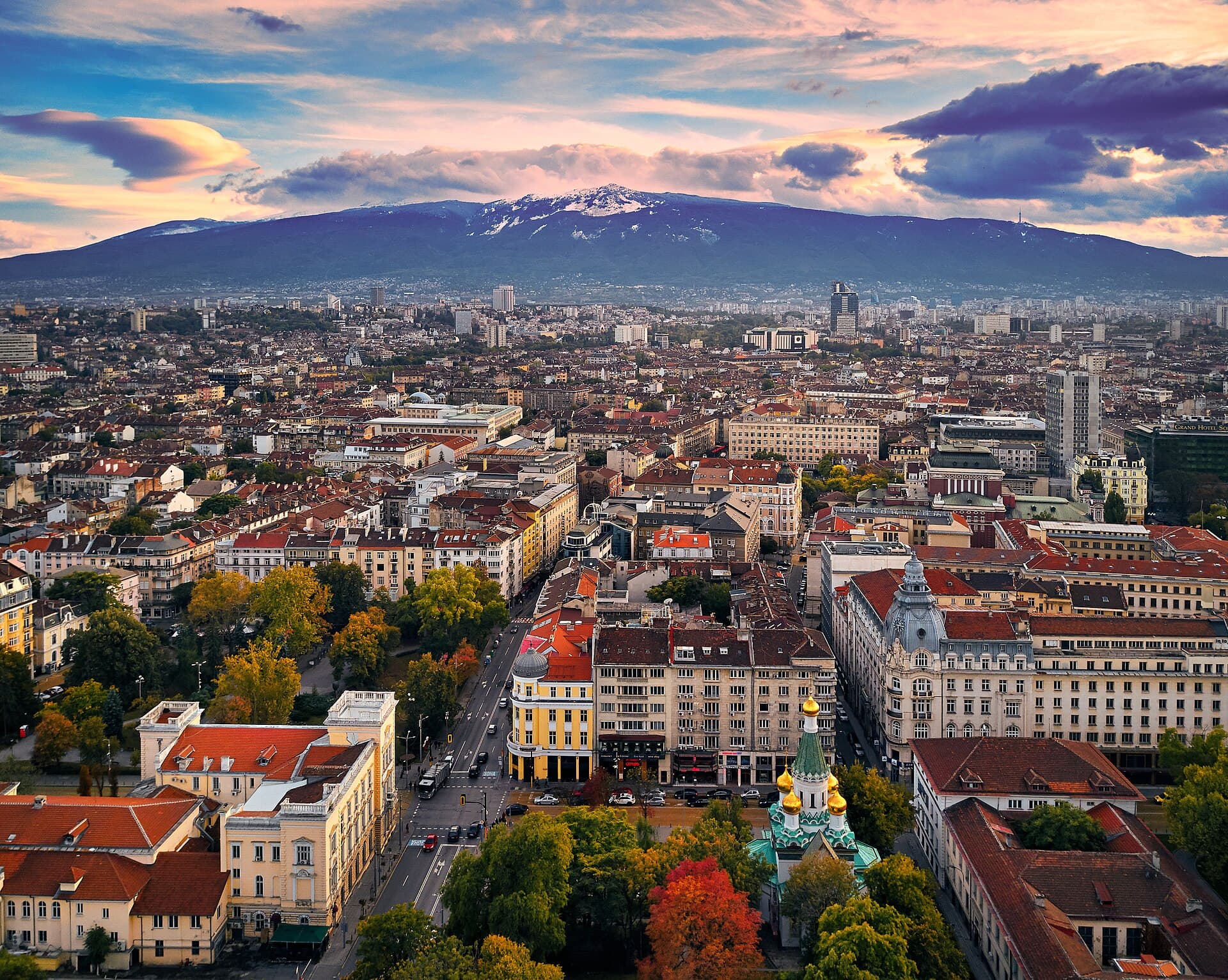 Deensel / CC BY 2.0, via Wikimedia Commons
“Where ancient layers meet contemporary life.”
Not the postcards. The stories even locals don't know — whispered in your ear, right where they happened.
Beneath Sofia's busy streets lies an ancient city, a secret revealed by history.
Sofia is built upon more than 40 mineral springs, but the grand Central Mineral Baths building no longer serves as a public bathhouse.
A distinctive yellow brick road winds through central Sofia, a charming and almost whimsical feature.
Discover every secret of Sofia
Every address, every reveal in full — in your ear, right where it happened.
You pick your stops. You walk. The voice reveals what the others miss.
No tours available yet. Check back soon — we're preparing them.
Sofia, Bulgaria's capital and largest city, offers a captivating blend of ancient history and modern European life. Situated in the Sofia Valley at the foot of Vitosha Mountain, the city's story spans over 7,000 years, making it one of Europe's oldest continuously inhabited settlements. This long history has left visible traces from Thracians, Romans, Byzantines, and Ottomans, creating a layered urban landscape where Roman ruins often appear next to contemporary structures.
Often overlooked in favor of more famous European capitals, Sofia provides a relaxed atmosphere and a unique mix of cultures and architectural styles. From the grandeur of Orthodox cathedrals to remnants of its communist past, the city delivers a genuine and affordable European experience. Its unique location also provides easy access to nature, with Vitosha Mountain offering hiking and skiing just a short drive from the city center.
The area where Sofia now stands has been continuously inhabited for over 7,000 years, with the Thracian tribe Serdi establishing a settlement in the 8th century BCE, giving the city its early name, Serdica. The Romans conquered Serdica in 29 BC, and it flourished under emperors like Trajan and Constantine I the Great, who reportedly called it "my Rome." During this Roman period, the city saw the construction of protective walls, public baths, and an amphitheater.
In 809, the city was incorporated into the First Bulgarian Empire by Khan Krum and was known as Sredets, meaning "middle" or "center," highlighting its strategic position in the Balkans. It was renamed Sofia in the late 14th century, taking its name from the ancient Basilica of Saint Sofia. Sofia fell to the Ottoman Empire in 1382, remaining under their rule for nearly 500 years. During this time, it became an important administrative and trade center, serving as the capital of the Rumelia Eyalet, the Ottoman province that governed the Balkans. The city's population during the 16th and 17th centuries was diverse, including Bulgarians, Jews, Armenians, Greeks, and merchants from Ragusa, and later Albanians and Persians.
Sofia was liberated from Ottoman rule by Russian forces on January 4, 1878, during the Russo-Turkish War. On April 3, 1879, it was designated the capital of the autonomous Principality of Bulgaria, a decision that marked a turning point and initiated a period of rapid urban development and demographic growth. The city's elite aimed to transform Sofia into a modern European capital, leading to a unique architectural blend of its Ottoman past and European aspirations. After World War II, Bulgaria became a Communist-ruled People's Republic, and Sofia's architectural landscape shifted again, with significant industrialization and the construction of socialist-era buildings. The city's population grew dramatically, from around 400,000 to 1.2 million during the communist era.
Today, Sofia continues to evolve, preserving its ancient roots while embracing its role as a modern European capital.
Begin your exploration at the Alexander Nevsky Cathedral, an imposing Orthodox cathedral with golden domes, one of the largest in the world and a prominent symbol of Sofia. Nearby, visit the Church of St. Sofia, which gave the city its modern name. Delve into Roman history at the Ancient Serdica Archaeological Exhibition, where ruins are visible near the Serdika metro station. The St. George Rotunda Church, dating back to the 4th century, is Sofia's oldest preserved building and features ancient frescoes.
Experience Sofia's religious diversity at Tolerance Square, where the Banya Bashi Mosque, Sofia Synagogue, and St. Nedelya Church stand close to each other. Stroll down Vitosha Boulevard, a lively pedestrian street with shops and cafes, and relax in the City Garden in front of the Ivan Vazov National Theatre. For a look into Bulgaria's communist past, visit The Red Flat, a preserved apartment showcasing daily life during that era, or the Museum of Socialist Art. The Regional History Museum, housed in the former Central Mineral Baths, offers insights into Sofia's history.
The best times to visit Sofia are during spring (April-May) or autumn (September-October) for pleasant weather and fewer crowds. Temperatures range from 60°F to 75°F (15°C to 24°C) during these periods, ideal for sightseeing. Summer (June-August) is warm, with average temperatures between 77°F and 95°F (25°C to 35°C), but can be quieter as many locals head to the coast. Winter (December-February) is cold and often snowy, with temperatures averaging around 30°F (-1°C), offering a festive atmosphere and access to nearby ski resorts.
The official currency in Bulgaria is the Bulgarian Lev (BGN), which is divided into 100 stotinki. As of January 1, 2026, the Euro (EUR) is the official currency in Bulgaria. While card payments are widely accepted in urban areas, it's advisable to carry some Lev for smaller shops and local transactions. Tipping is customary; a 10-15% tip is standard for good service in restaurants, and rounding up fares for taxi drivers is appreciated.
Sofia has a comprehensive public transport network, including a metro, buses, trams, and trolleybuses, all managed by the Sofia Urban Mobility Center. The metro is often the fastest option, especially during rush hour, and connects to Sofia Airport. Public transport generally operates from 5:00 AM to midnight, with limited night bus services. Tickets can be purchased from drivers or kiosks, and it's essential to validate them upon boarding. Sofia is considered one of Europe's safer capitals, with violent crime against tourists being rare. However, pickpocketing can occur in crowded areas and on public transport, so remain vigilant.