Skradin Risotto
This regional delicacy is not something one orders without forethought.
Full story unlocks in the tour
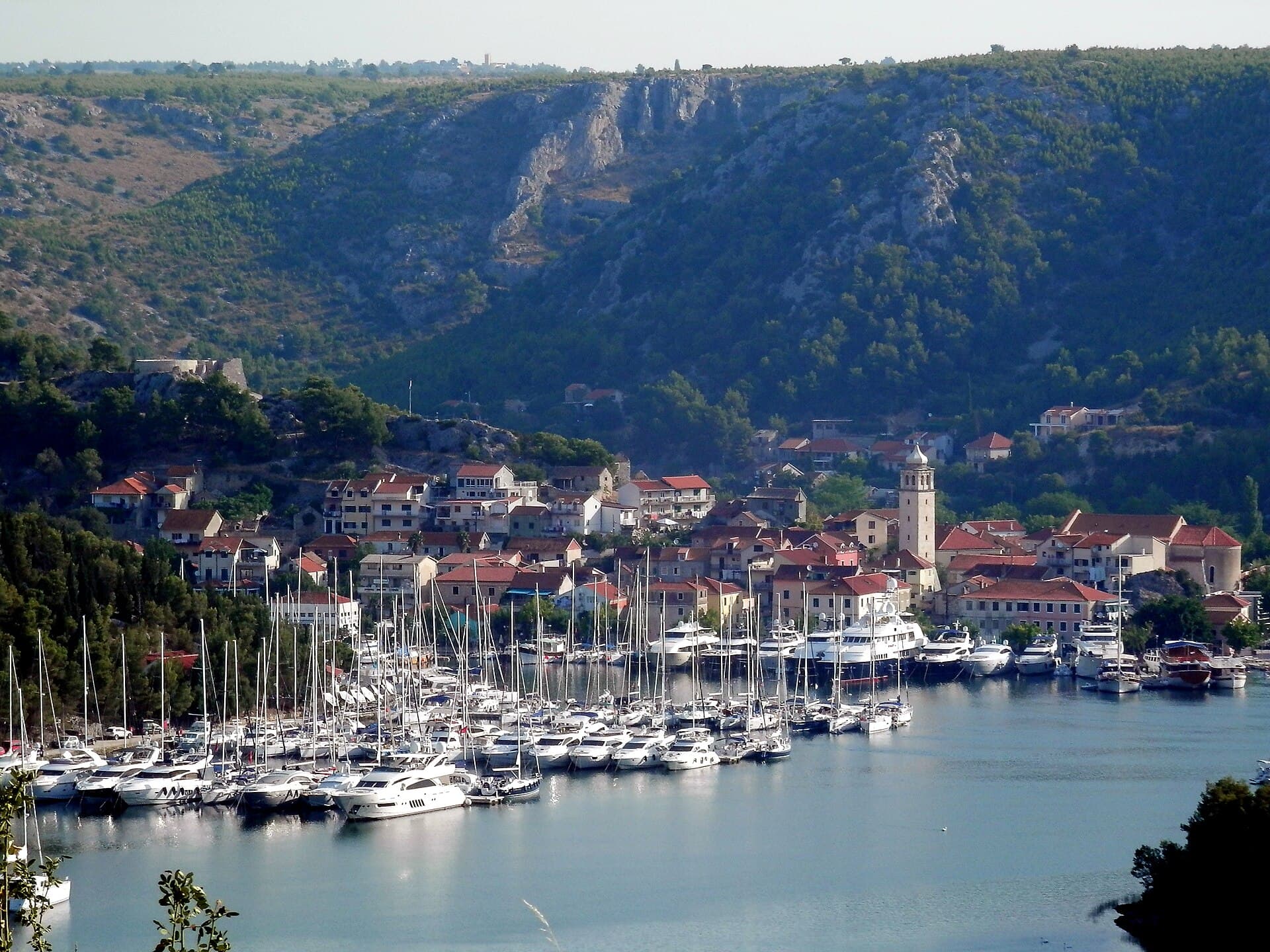 Jozef Kotulič / CC BY-SA 3.0, via Wikimedia Commons
“Where the river meets the sea, ancient stones recount their stories.”
Not the postcards. The stories even locals don't know — whispered in your ear, right where they happened.
This regional delicacy is not something one orders without forethought.
This marina holds an unexpected connection to a distant European capital.
Skradin played an unforeseen role in Europe's early electrical advancements.
Discover every secret of Skradin
Every address, every reveal in full — in your ear, right where it happened.
You pick your stops. You walk. The voice reveals what the others miss.
No tours available yet. Check back soon — we're preparing them.
Skradin, a graceful town in Croatia's Šibenik-Knin County, rests where the Krka River flows into the Adriatic, creating a distinctive convergence of freshwater and saltwater landscapes. Primarily recognized as the principal entrance to Krka National Park, Skradin itself merits exploration, with a lineage extending back millennia. Its appealing stone center, narrow passageways, and lively waterfront offer a glimpse into traditional Dalmatian existence, while its proximity to natural wonders establishes it as a focal point for those who love the outdoors.
The town's strategic position, at the merging of river and sea, has shaped its character throughout time, rendering it a significant port and a convergence of cultures. Visitors can experience a calm atmosphere, particularly during the shoulder seasons, and uncover historical sites, local flavors, and scenic vistas. Whether embarking on a boat trip to the waterfalls of Krka, savoring the regional cuisine, or simply enjoying a walk along the marina, Skradin delivers an authentic Croatian experience.
The area surrounding Skradin has seen continuous settlement for at least 5,500 to 6,000 years, with the town itself tracing its origins to 33 BC. The earliest inhabitants were the Liburnians, an ancient Illyrian tribe celebrated for their naval prowess. They established a strategically significant port on the Krka River, then named Titius, which linked the Adriatic Sea with the interior.
Under Roman dominion, Skradin was known as Scardona and thrived as a primary transit port, with trade playing a crucial role in its development. Archaeological discoveries, including shipwrecks along the Krka River, bear witness to the town's prosperity and importance during this era. Skradin even served as the capital of the Roman province of Liburnia and later became the center of an early Christian diocese. Remnants of the ancient Roman aqueduct are still visible today.
Following the decline of the Roman Empire, the Croats rebuilt the town, retaining the name Skradin. In the 10th century, the town was fortified, and in the 13th and 14th centuries, it rose to prominence as the capital of the Šubić bans, powerful Croatian rulers. During this time, the imposing Turina fortress was constructed on a hill overlooking the town, a testament to Skradin's strategic importance. This period saw Skradin become a free city with its own statute and administration.
Like many parts of Croatia, Skradin experienced a succession of foreign rulers. It was occupied by the Ottomans, Venetians, French, and Austro-Hungarians, each leaving their architectural and cultural imprints on the town. The town center, a protected cultural monument, displays a combination of architectural styles, with many houses dating back to the 18th and 19th centuries, often plastered in a characteristic Venetian manner. During the Ottoman period, there were even four mosques in Skradin.
Despite its tumultuous past, Skradin has consistently rebuilt itself and maintained its distinct allure. The 19th century witnessed the construction of notable landmarks such as the Skradin Clock Tower in 1872, built into the base of a nearby hill. The Orthodox Church of St. Spiridon, constructed in neo-Gothic style in 1876, and the Baroque Catholic Church of the Blessed Virgin Mary, from the 18th century, also stand as significant historical sites.
Today, Skradin is recognized as the primary entrance to Krka National Park, one of Croatia's most celebrated natural attractions. The town's ACI Marina, a modern facility, continues Skradin's enduring tradition as a vital port, drawing yachts and sailors from across the globe.
Skradin offers a combination of historical appeal and natural splendor. Begin your exploration in the Old Town, a protected cultural monument with narrow, winding streets and stone houses reflecting Venetian influences. Ascend to the ruins of the Turina Fortress for sweeping views of Skradin, the Krka River, and the surrounding landscape. The Skradin Clock Tower, dating to 1872, stands as an iconic landmark, uniquely integrated into the hillside.
Admire the Church of the Blessed Virgin Mary (Crkva Male Gospe), an 18th-century Baroque church, and the 19th-century Orthodox Church of St. Spiridon. For a distinctive cultural experience, visit the Old Timer Museum Scardona Park, which houses a collection of antique cars and motorcycles. Walk along the Skradin Riva, the waterfront promenade, lined with cafes and restaurants, offering a peaceful place to observe boats and enjoy the evening light.
Skradin serves as the primary gateway to Krka National Park. From the town, you can take a scenic 25-minute ferry journey upstream to Skradinski Buk, a magnificent sequence of waterfalls. Within the park, you can also visit Visovac Island with its Franciscan monastery and Roški Slap waterfall. For those who prefer to explore on foot or by bicycle, a trail connects Skradin to Skradinski Buk. The town also features a pebble Skradin Beach along the river, suitable for swimming in clear waters.
The optimal time to visit Skradin for general outdoor pursuits spans from mid-May to early October, with a peak in the second week of September, when temperatures are agreeable, ranging from 18°C to 27°C. The shoulder seasons of May-June and September-October offer fewer crowds and often more economical entrance fees to Krka National Park. Autumn, in particular, is ideal for exploring Krka National Park as the waterfalls flow fully, and nature displays warm colors. For hot-weather activities like swimming, late June to late August is best, with July being the sunniest month. Winter brings cooler, wetter conditions, and many establishments may close.
Skradin is approximately 55 kilometers northeast of Split and 11 kilometers north of Šibenik. It is readily accessible by car via the A1 motorway. Regular bus services connect Skradin with Šibenik, and buses from Split and Zadar also pass through. Renting a car is highly advisable for exploring the broader region.
The Krka National Park Ticket Office in Skradin is located near the marina. Ferries to Skradinski Buk depart approximately every hour, with the price included in the park entrance fee. While parking in Skradin is privately owned and requires a fee, parking at the main Lozovac entrance to Krka National Park is free. The ACI Marina Skradin provides 180 berths and services for sailors.