The Valais Wine Museum
You might think a wine museum is all about dusty bottles and forgotten vintages.
Full story unlocks in the tour
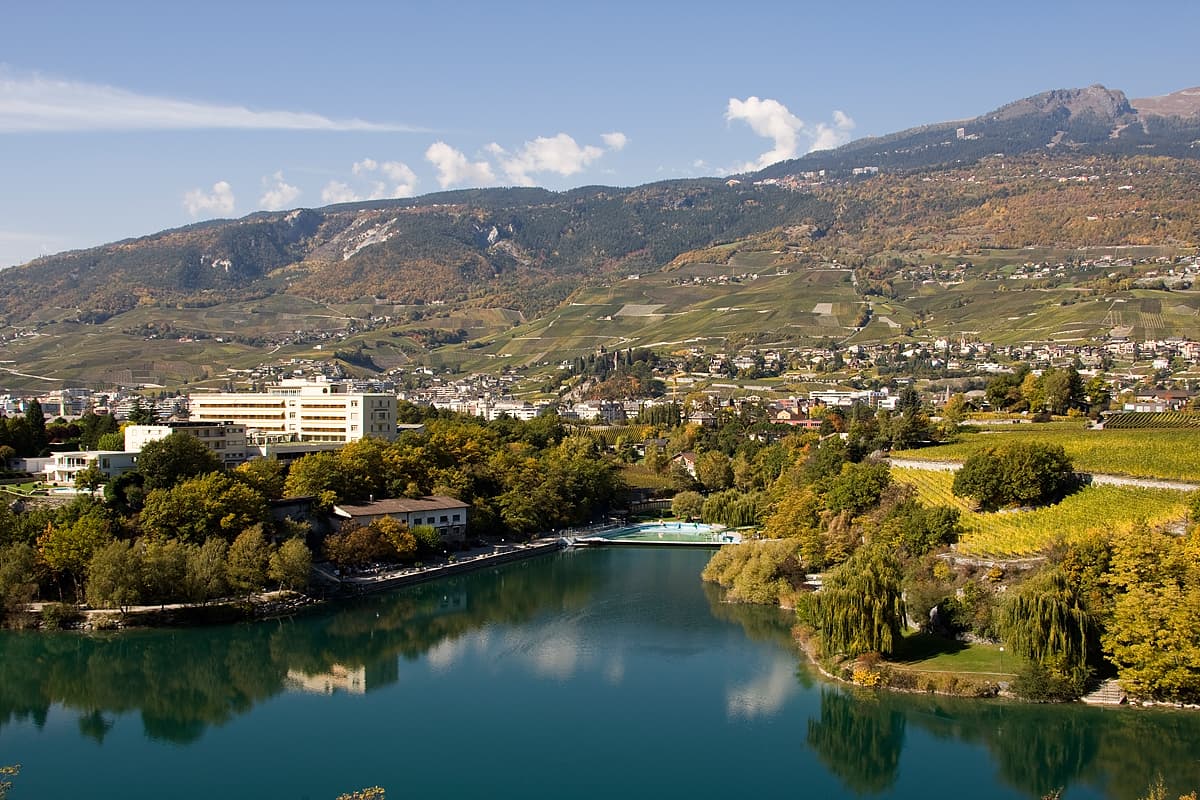 Template:Bild-picswiss / CC BY-SA 3.0, via Wikimedia Commons
“Where the sun ripens the grapes and history lingers in the air.”
Not the postcards. The stories even locals don't know — whispered in your ear, right where they happened.
You might think a wine museum is all about dusty bottles and forgotten vintages.
Travel just a few kilometers east of Sierre, and you'll cross more than just a stream.
Sierre is known as the "City of the Sun," but an older, less common nickname hints at its unique topography.
Discover every secret of Sierre
Every address, every reveal in full — in your ear, right where it happened.
You pick your stops. You walk. The voice reveals what the others miss.
No tours available yet. Check back soon — we're preparing them.
Sierre, often called the "City of the Sun" for its approximately 300 sunny days each year, is a welcoming town in the heart of Switzerland's Valais canton. Situated on the right side of the Rhône river, it serves as a significant hub for winemaking and as a gateway to alpine adventures.
This town offers a unique blend of historical depth, engaging cultural experiences, and open natural landscapes. Sierre is also notable for its position as the last predominantly French-speaking city in Valais before the linguistic border transitions into German-speaking areas.
The history of Sierre stretches back to antiquity, with archaeological evidence pointing to human presence as early as the Neolithic and Bronze Ages on Gerunden hill. Stone tools, Bronze Age weapons and jewelry, and even Roman artifacts have been discovered in the area. Around 515 AD, the Burgundian King Sigismund transferred the lands of Sierre to the Abbey of Saint-Maurice, marking one of the earliest documented mentions of the settlement.
During the Middle Ages, Sierre evolved into a feudal stronghold under the Prince-Bishopric of Sion, which gained temporal authority over Valais in 999 AD. The town's strategic location along trade routes in the Rhône Valley made it an important regional market. Fortified manors and residences, including castles on the hills of Gerunden, Vieux-Sierre, and Plantzette, were built by local noble families and the Bishop's representatives. These structures provided both homes for the elite and safety for the populace. However, many of these castles were destroyed in the mid-1300s during conflicts between the Bishop and powerful local families, with only Goubing Castle surviving.
Sierre's economy was historically rooted in agriculture, particularly winemaking, a tradition that continues to thrive due to the region's abundant sunshine and suitable soils. The arrival of the railway in 1868 significantly boosted Sierre's trade and connectivity, integrating it into the broader Swiss transport network. The early 20th century saw a shift towards industrialization, with the establishment of an aluminum plant in 1908, leveraging the area's hydroelectric power. This transformed Sierre from an agrarian town into a notable industrial center.
In more recent times, Sierre has continued to develop as a cultural and economic hub. It hosts festivals and various community activities, while also embracing innovation with the founding of the Techno-Pôle technology park in 1991. The city also became a key transit point for tourism with the opening of the Sierre-Montana-Crans funicular in 1911, connecting the valley to the mountain resorts.
Begin your exploration in the historic center, specifically along Rue du Bourg, which features historic houses and the parish church of Ste-Catherine. The Hôtel de Ville, originally a 17th-century residence, now serves as the town hall and is worth noting for its architecture. For a deeper dive into the region's viticulture, visit the Valais Wine Museum, which is spread across two locations—one in Sierre and another in Salgesch—connected by a 6 km vineyard trail. The Château de Villa, a medieval castle, houses a well-regarded wine museum and offers wine tastings from over 100 local winemakers.
For those interested in literature, the Fondation Rainer Maria Rilke, located in the Maison Pancrace de Courten, is dedicated to the poet who spent his final years in Sierre. Nature lovers can enjoy Lac de Géronde, a serene lake ideal for a stroll, offering views of the surrounding mountains. The Bisse du Ro Suspension Bridge, part of an ancient irrigation channel, provides scenic views along a steep rock face. Additionally, Sierre is a convenient starting point for excursions to nearby mountain villages like Vercorin and Crans-Montana.
Sierre is most enjoyable during June, July, and August, when temperatures are comfortable, ranging from 16°C to 19°C. This period is ideal for outdoor activities like hiking and exploring the vineyards. While summer offers warm and sunny days, be prepared for significant daily temperature fluctuations, with nights often dropping to 7°C. Spring (March to May) brings blooming landscapes, and autumn (September to November) offers mild weather and beautiful foliage, with fewer crowds.
Sierre is primarily a French-speaking city, though a German-speaking minority accounts for about 8% of the population, and many locals are fluent in both languages. The city is well-connected by train, with the Sierre railway station linking it to the wider Swiss transport network. For local travel, a funicular connects Sierre to the mountain resorts of Crans-Montana. The Tourist Information office at Place de la Gare 10 can provide maps and assistance. Accommodation options range from hotels to vacation rentals. While credit cards are widely accepted, it's always advisable to carry some Swiss Francs for smaller purchases.