The Bridge of Lies
This cast-iron bridge serves not just as a crossing, but as a silent arbiter of truth.
Full story unlocks in the tour
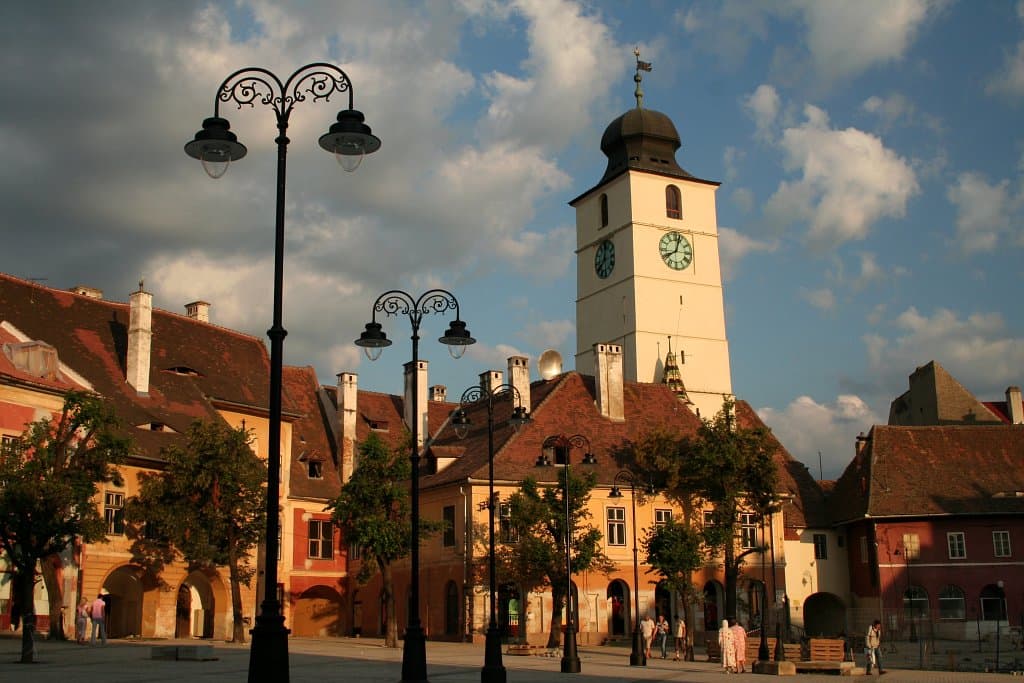 Zubi Travel / Public domain, via Wikimedia Commons
“Where medieval character meets a watchful gaze.”
Not the postcards. The stories even locals don't know — whispered in your ear, right where they happened.
This cast-iron bridge serves not just as a crossing, but as a silent arbiter of truth.
Sibiu once hosted a groundbreaking medical institution in Romania, its earliest form still accessible today.
Wander through the old town, and you might sense a constant, gentle observation.
Discover every secret of Sibiu
Every address, every reveal in full — in your ear, right where it happened.
You pick your stops. You walk. The voice reveals what the others miss.
No tours available yet. Check back soon — we're preparing them.
Sibiu, a city in central Romania's historical Transylvania region, rests along the Cibin River at an elevation of 410–425 meters. Originally a Daco-Roman settlement called Cedonia, it was refounded by Saxon colonists in the 12th century as Hermannsdorf, later Hermannstadt. This city, which twice served as the capital of the Principality of Transylvania, is celebrated for its well-preserved medieval architecture and lively cultural landscape.
Often known as 'The Town with Eyes' due to the distinctive dormer windows on many of its ancient buildings, Sibiu is a favored destination, recognized for its culture, past, cuisine, and architecture. Its old medieval town divides into two distinct sections: the upper town, constructed on a raised terrace, and the lower town, situated along the banks of the Cibin River. These two areas are linked by slender, stone-paved alleys and ascending stairways.
## From Roman Outpost to Saxon Stronghold Sibiu's origins trace back to a Daco-Roman city named Cedonia, later called Cibinium. In the 12th century, Hungarian kings extended an invitation to Saxon (German) colonists to settle in Transylvania, and these settlers re-established the city as Hermannsdorf. By 1191, Sibiu received official recognition in Vatican church documents as Cibinium, a name derived from the Cibin River. The city's strategic placement and the privileges granted to the Transylvanian Saxons, including provisional autonomy, fueled its expansion.
## Medieval Fortifications and Guild Power The Tatar invasion of 1241 brought devastation to Sibiu, prompting extensive fortification efforts that continued into the 15th century. These formidable brick walls earned the upper town the moniker 'Red Town' and successfully repelled several Turkish assaults. By the 14th century, Sibiu had grown into an important trade hub, with 19 guilds established by 1376, representing 25 distinct crafts. These guilds played a pivotal role in the city's prosperity and the construction of its impressive buildings and defenses.
## Capital of Transylvania and Cultural Hub Sibiu became the military heart of Transylvania and, on two occasions (1703–1791 and 1849–1865), functioned as its capital. Throughout the 18th and 19th centuries, it emerged as a significant center for Transylvanian Romanians, hosting the first Romanian-owned bank and the ASTRA (Transylvanian Association for Romanian Literature and Romanian's People Culture). The city also pioneered several social and cultural institutions in Romania, including the first hospital in 1292, the first documented city school in 1380, and the first permanent theater in Transylvania in 1788. In 1817, the Brukenthal National Museum, the oldest museum in Romania, opened its doors to the public.
## Modern Recognition In 2007, Sibiu was designated a European Capital of Culture, leading to a significant restoration of its historic core. More recently, in 2019, it was named the European Region of Gastronomy and hosted a European Union summit. In 2021, Sibiu also hosted the European Wandering Capital event, a prominent gathering for hiking and eco-tourism.
Start your exploration in the Grand Square (Piața Mare), the central gathering place since the 15th century, encircled by important historical structures like the Brukenthal National Museum and the Holy Trinity Roman Catholic Church. Ascend the Council Tower for sweeping views of Sibiu's squares and rooftops. From there, stroll to the Little Square (Piața Mică), home to more cafes and an entrance to the Council Tower.
A brief walk will lead you to the Bridge of Lies, Romania's first cast-iron bridge, imbued with local legends. Explore the remnants of the city walls along Strada Cetății, where you will discover several towers named after the guilds that once guarded them, such as the Carpenters' Tower and Potters' Tower. Be sure to visit the Holy Trinity Orthodox Cathedral, a striking 20th-century church adorned with vivid interior murals. For a deeper immersion into history, visit the Pharmacy Museum, situated in a 16th-century building that once housed Romania's oldest pharmacy.
Sibiu offers a distinct experience throughout the year. For warm weather activities, the best time to visit extends from mid-May to mid-September, when temperatures are mild and sunny. July and August are the warmest months, with daytime highs around 25-26°C, perfect for walking and sightseeing. However, be prepared for potentially cool evenings even in summer. Late spring and early summer (May and June) see the most rainfall, so an umbrella could be useful. If you appreciate a festive atmosphere, the Sibiu Christmas Market, held from late November to early January in the Grand Square, is widely considered Romania's most iconic. Autumn, particularly September and October, provides dry, stable weather with comfortable temperatures, making it excellent for a relaxed sightseeing holiday.
Sibiu is a city easily explored on foot, particularly its old center. Most significant attractions are readily accessible by walking. If you arrive by car, be aware of parking options near the historic areas. Public transportation is available, with bus lines serving various parts of the city. Sibiu is a relatively compact city, and most visitors find that two to three days are sufficient to explore its primary sights. It can also be visited as a day trip from other Transylvanian cities like Brașov. The local currency is the Romanian Leu (RON). Prices for food and drink are generally reasonable. Sibiu has its own airport, and it is approximately a 3.5-hour drive from Bucharest.