Plaza de España
Examine the statue of Aníbal González, the architect of the grand Plaza de España, and you'll find an unexpected detail on his rain gear.
Full story unlocks in the tour
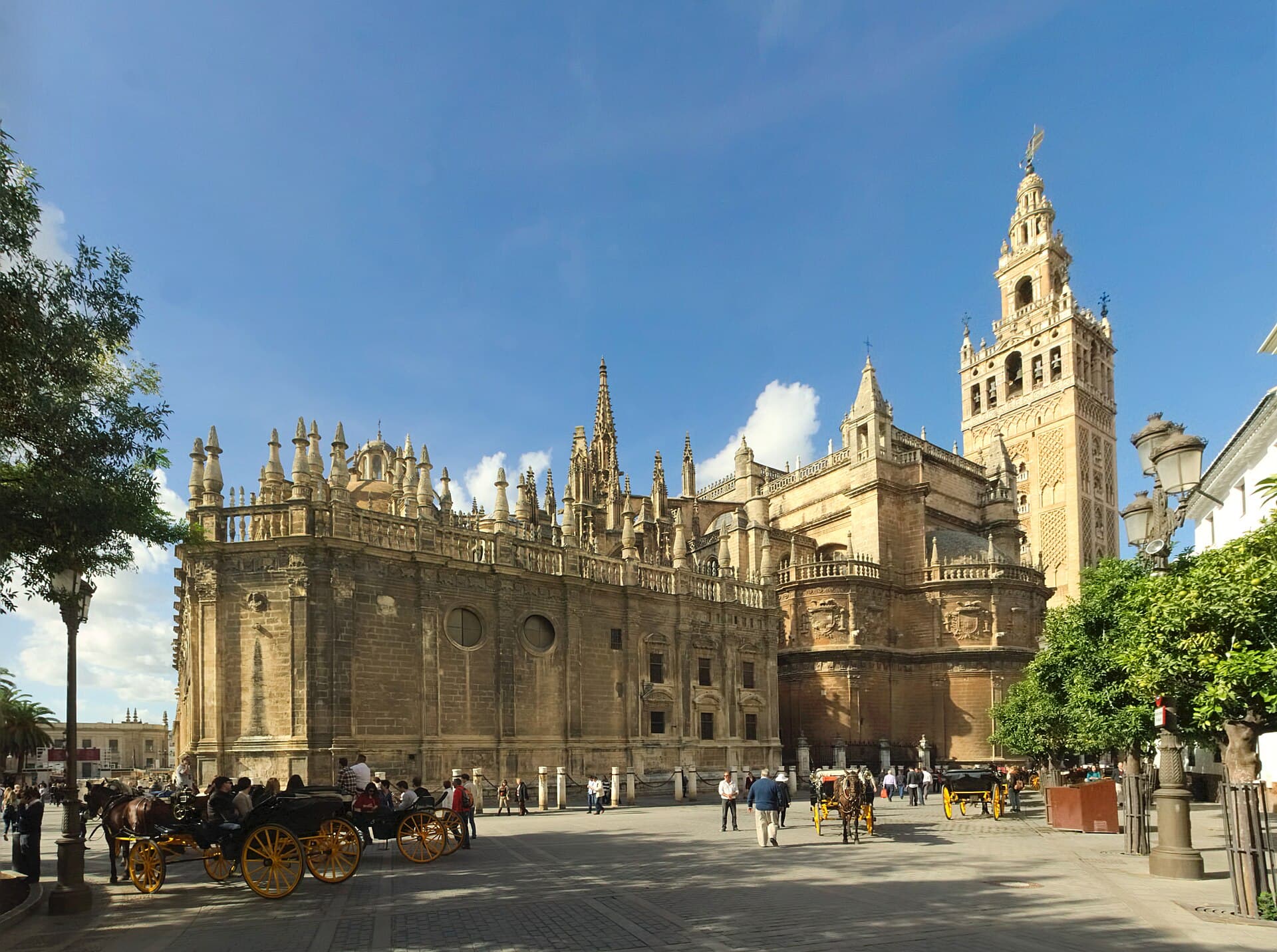 Ingo Mehling / CC BY-SA 4.0, via Wikimedia Commons
“Seville: Where ancient stones meet the scent of orange blossoms and flamenco's pulse.”
Not the postcards. The stories even locals don't know — whispered in your ear, right where they happened.
Examine the statue of Aníbal González, the architect of the grand Plaza de España, and you'll find an unexpected detail on his rain gear.
The world's largest Gothic cathedral, a UNESCO World Heritage site, holds a fundamental secret that clarifies its unusual form.
For a taste of traditional Seville, seek out the Convent of San Leandro, where a distinct exchange occurs for a local sweet.
Discover every secret of Seville
Every address, every reveal in full — in your ear, right where it happened.
You pick your stops. You walk. The voice reveals what the others miss.
No tours available yet. Check back soon — we're preparing them.
Seville, the capital of Andalusia, is a city that enchants with its blend of enduring history, lively culture, and architectural splendor. Situated along the lower reaches of the Guadalquivir River, it is a place where the perfume of orange blossoms often drifts through the air, and the rhythmic sounds of flamenco resonate. With a municipal population exceeding 686,000, it stands as Andalusia's largest city and Spain's fifth-largest.
The city's character is a compelling mix of its varied past, from ancient Roman origins to centuries of Islamic governance and its crucial role in Spain's Golden Age. This profound heritage is evident in its UNESCO World Heritage sites: the Alcázar palace complex, the Cathedral, and the General Archive of the Indies. Seville invites exploration, whether through its intricate streets, grand plazas, or the animated atmosphere of its traditional neighborhoods.
Beyond its well-known landmarks, Seville possesses a particular allure, a sensation that permeates its sun-drenched squares and shaded courtyards. It is a city to be experienced, not merely observed, where every turn reveals a narrative and every moment offers a glimpse into its soulful essence.
Seville's beginnings stretch back to the 8th century BC, with archaeological discoveries beneath the Real Alcázar dating to this era. Legend attributes the city's founding to Hercules, on an islet within the Guadalquivir River. Known as Hispalis by the Romans after their conquest in 206 BC, it grew into an important city in the province of Hispania Baetica. Nearby Itálica, established around the same time, was the birthplace of Roman emperors Trajan and Hadrian, and its well-preserved ruins provide a window into the Roman presence in the region.
Following the Islamic conquest in 711 AD, Hispalis became Ishbiliyah, flourishing as the center of the independent Taifa of Seville in the early 11th century. It later served as the capital of the Almohad Empire in the 12th century, a period of significant architectural and cultural advancement, leaving behind structures like the Giralda (originally a minaret) and the Torre del Oro. In 1248, King Ferdinand III of Castile incorporated Seville into the Crown of Castile, marking the end of over 500 years of Muslim rule.
The discovery of the Americas in 1492 propelled Seville into a Golden Age. Its port on the Guadalquivir River became the sole conduit for trade with the New World, making Seville the economic heart of the Spanish Empire and one of Western Europe's largest and most prosperous cities in the 16th century. The Casa de Contratación (House of Trade) managed this extensive trans-oceanic commerce, and the General Archive of the Indies was established to house invaluable historical documents. This period saw a surge in royal palaces, noble residences, churches, and convents.
By the early 18th century, however, navigation of the Guadalquivir became increasingly challenging, and the trade monopoly shifted to Cádiz, leading to a gradual economic decline for Seville. The city saw renewed vigor in the 19th and 20th centuries, marked by industrialization, the construction of rail connections, and significant events like the Ibero-American Exposition of 1929 and Expo '92, which modernized its infrastructure and reconfirmed its status as the capital of Andalusia.
Seville offers a wealth of sights, each narrating a part of its layered story. The Seville Cathedral, the world's largest Gothic cathedral, is a vital stop, containing the tomb of Christopher Columbus and offering sweeping views from its recognizable Giralda bell tower. Next to the cathedral stands the Real Alcázar de Sevilla, Europe's oldest royal palace still in use, displaying a striking blend of Mudéjar, Gothic, Renaissance, and Baroque architectural styles across its magnificent rooms and verdant gardens.
Plaza de España, constructed for the 1929 Ibero-American Exposition, is a grand semi-circular plaza adorned with colorful ceramic tiles depicting Spain's provinces, a canal where boats can be rented, and a commanding architectural presence. Be sure to explore the Barrio de Santa Cruz, the city's former Jewish quarter, with its meandering streets, charming squares, and traditional Andalusian architecture. The contemporary Metropol Parasol, affectionately known as 'Las Setas' (The Mushrooms), stands as the world's largest wooden structure and provides distinct city views from its elevated walkways. For a glimpse into local life, wander through the Mercado de Triana in the historic Triana neighborhood, or experience a fervent flamenco show, as Seville is considered its genesis.
The most pleasant times to visit Seville are during spring (March to May) and early autumn (September to October). In these periods, the weather is agreeably warm, with comfortable temperatures ideal for exploring the city's attractions and enjoying outdoor pursuits. Spring is especially lovely, with orange blossoms perfuming the air and the city animated by festivals like Semana Santa (Holy Week) and Feria de Abril. Autumn brings milder temperatures and generally fewer crowds than the peak summer months.
While summer (July and August) can be very hot, with temperatures often exceeding 40°C (104°F), the city's design with shaded streets and air-conditioned hotels can make it manageable for budget travelers seeking lower prices. Winter (December to February) is mild, offering fewer crowds and hotel deals, with sunny days and temperatures ranging from 40s to 60s Fahrenheit.
Seville is a city easily explored on foot, with many attractions grouped closely together, making comfortable walking shoes essential. Consider forgoing a car for your visit, as narrow streets, one-way systems, and limited parking can make driving a bother in the historic center. For sights further afield, bicycles or e-scooters are good alternatives.
Booking tickets for major attractions like the Real Alcázar and Seville Cathedral in advance online is highly recommended to save time and avoid long queues, particularly during busy seasons. Regarding dining, embrace the local rhythm: lunch is typically around 2 PM, and dinner often begins around 9 or 10 PM. While credit and debit cards are widely accepted, carrying some cash for smaller purchases, local markets, or traditional bars is a wise choice. Tipping is not obligatory as service charges are included. Tap water in Seville is safe to drink.