Fort Siloso
Before it became a military museum, Fort Siloso held a surprising secret for British forces.
Full story unlocks in the tour
 Chensiyuan / CC BY-SA 4.0, via Wikimedia Commons
“Where history's echoes meet endless horizons.”
Not the postcards. The stories even locals don't know — whispered in your ear, right where they happened.
Before it became a military museum, Fort Siloso held a surprising secret for British forces.
This cluster of attractions wasn't always known by its current name, and a significant portion of it vanished.
The 'Southernmost Point of Continental Asia' here has a geographical twist.
Discover every secret of Sentosa
Every address, every reveal in full — in your ear, right where it happened.
You pick your stops. You walk. The voice reveals what the others miss.
No tours available yet. Check back soon — we're preparing them.
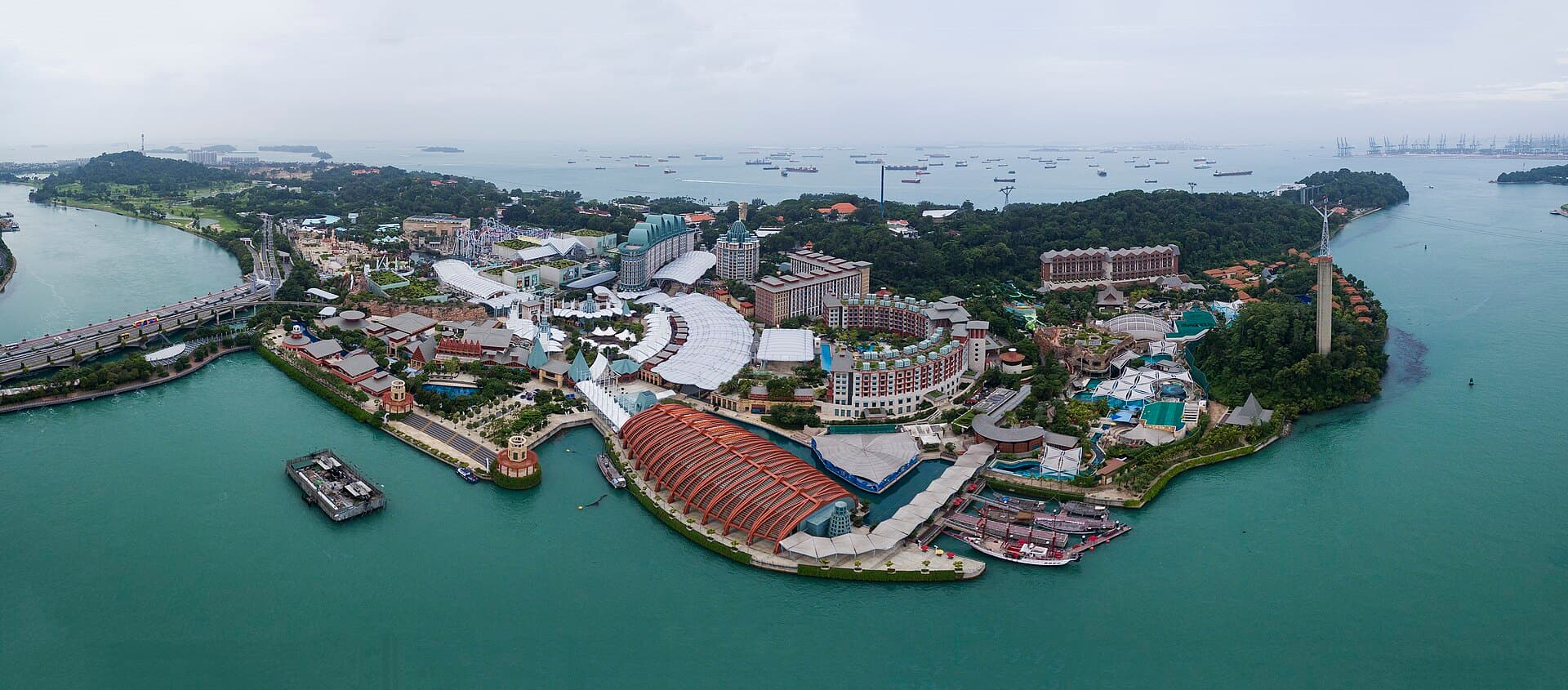
Sentosa, an island resort off Singapore's southern coast, is a destination where leisure and history intertwine. Once known ominously as Pulau Blakang Mati, or 'the island behind which lies death,' it has been transformed into a lively playground.
Today, Sentosa welcomes millions of visitors annually, offering a diverse array of attractions from thrilling theme parks and expansive aquariums to serene beaches and verdant rainforests. Connected to mainland Singapore by a causeway, monorail, cable car, and even a pedestrian boardwalk, Sentosa is easily accessible. The island's 500 hectares are home to world-class resorts, entertainment complexes, and natural landscapes, providing a comprehensive escape for families, adventure seekers, and those simply looking for tranquility.
## From 'Island of Death' to 'Isle of Tranquility' Sentosa's past is a dramatic narrative, a stark contrast to its present-day image. Historically known as Pulau Blakang Mati, a name that translates to 'the island behind which lies death,' its origins are shrouded in theories ranging from brutal pirate battles and mysterious epidemics to the island's unique geographical position creating 'dead water' that stranded sailing vessels. Early maps from as far back as 1604 identify an island as 'Blacan Mati,' though it was sometimes combined with the adjacent Pulau Brani.
During the colonial era, the island served as a British military base, crucial for defending Singapore's strategic Keppel Harbour. Forts like Siloso, Serapong, and Connaught, along with the Mount Imbiah Battery, were constructed in the 1870s and 1880s to guard against sea invasions. These fortifications were upgraded in the 1930s with advanced guns capable of piercing armored ships. However, during World War II, when the Japanese invaded from the north, the guns of Fort Siloso were famously turned 180 degrees inland to fire at advancing ground troops, though they were armed with less effective armor-piercing ammunition. Following Singapore's fall in 1942, the island was used as a Japanese prisoner-of-war camp.
The transformation began in the 1970s. With the withdrawal of British forces, the island was handed over to the Singapore Armed Forces in 1967. In 1972, the Tourist Promotion Board launched a naming contest to rebrand the site, and 'Sentosa,' meaning 'peace and tranquility' in Malay, was chosen. The Sentosa Development Corporation was established to oversee its metamorphosis into a resort destination, with significant state and private investment. Early developments included a cable car system in 1974, Fort Siloso opening as a military museum, and attractions like Underwater World Singapore and the Musical Fountain in the 1980s. The 1990s saw further infrastructural improvements and new attractions, and in the 2000s, the island hosted popular beach dance parties and launched Sentosa Cove, a residential enclave. The opening of Resorts World Sentosa in 2010, featuring Universal Studios Singapore and one of Singapore's first casinos, cemented Sentosa's status as a premier entertainment hub.
Sentosa offers a spectrum of experiences, from adrenaline-pumping rides to tranquil beach escapes. Universal Studios Singapore, a centerpiece of Resorts World Sentosa, features themed zones with rides and shows, including the Battlestar Galactica dueling coasters. Nearby, the S.E.A. Aquarium, one of the world's largest, showcases over 100,000 marine animals across 49 habitats, including a massive viewing panel. For water enthusiasts, Adventure Cove Waterpark provides thrilling slides and aquatic encounters like snorkeling with tropical fish.
Sentosa's three main beaches—Siloso, Palawan, and Tanjong—offer distinct atmospheres. Siloso Beach is known for its beach bars and a younger crowd, while Palawan Beach is family-friendly, featuring a suspension bridge to a small islet. Tanjong Beach provides a quieter, more secluded atmosphere. Beyond the modern attractions, Fort Siloso, Singapore's only fully restored coastal fort, serves as a military museum with original gun pits, underground magazines, and a skywalk offering expansive views. Imbiah Lookout, another cluster of attractions, includes Madame Tussauds Singapore and the Mega Adventure Park.
Sentosa is a year-round destination due to Singapore's tropical climate. However, the dry season, from February to April, offers pleasant weather with less rain, ideal for outdoor activities and beaches. May and June can be slightly hotter and more humid. December is the wettest month, but it also brings festive events like Christmas at Resorts World and New Year fireworks. To avoid larger crowds, consider visiting on weekday mornings or during the shoulder seasons (May-June and August-October).
Sentosa is easily accessible from mainland Singapore. The most common ways to reach the island include the Sentosa Express monorail from VivoCity shopping center (Level 3, near HarbourFront MRT station), a scenic cable car ride from Mount Faber, or by walking across the Sentosa Boardwalk. Buses and taxis also provide direct access. Island entry via the Sentosa Express typically costs around SGD 4, while walking across the boardwalk is often free. Once on the island, internal transportation via the Sentosa Bus, Sentosa Express, and Beach Trams is free.
Operating hours for the island itself are generally 24/7, though individual attractions have specific opening and closing times. For Universal Studios, it's advisable to arrive early (around 10 AM) to avoid queues, especially for popular rides. Dress in light, loose-fitting clothing due to the warm weather. Pre-booking tickets for attractions online can often lead to savings and help avoid long lines.