Ölfusárbrú Bridge
The current bridge over the Ölfusá River is not the first, nor even the second, to stand at this vital crossing.
Full story unlocks in the tour
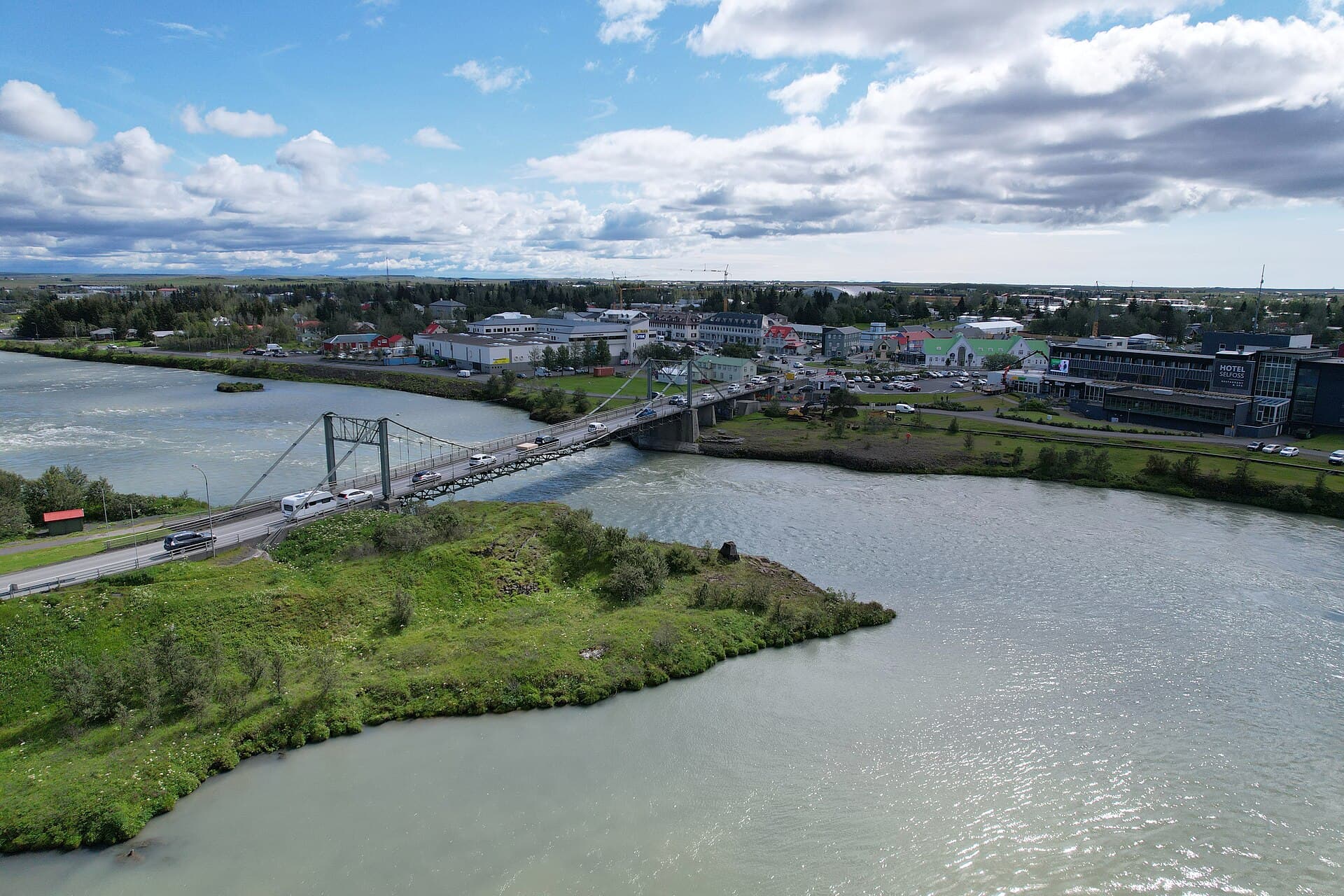 Steinninn / CC BY 4.0, via Wikimedia Commons
“Where the past is rebuilt, and the present flows with the Ölfusá.”
Not the postcards. The stories even locals don't know — whispered in your ear, right where they happened.
The current bridge over the Ölfusá River is not the first, nor even the second, to stand at this vital crossing.
This lively food hall once served as a groundbreaking industrial center for Iceland's dairy sector.
Despite its name, which translates to 'waterfall' in Icelandic, you will not encounter a dramatic cascade within the town itself.
Discover every secret of Selfoss
Every address, every reveal in full — in your ear, right where it happened.
You pick your stops. You walk. The voice reveals what the others miss.
No tours available yet. Check back soon — we're preparing them.
Selfoss, the largest town in South Iceland, functions as a dynamic center where agricultural foundations meet contemporary renewal. Positioned on the southwest bank of the Ölfusá River, one of Iceland's most voluminous waterways, the town serves as an essential service and trade point for the surrounding fertile farmlands.
Beyond its practical function, Selfoss has undergone a significant transformation with its "New Old Town" project, an ambitious redevelopment that has meticulously recreated historic Icelandic buildings. This initiative has infused new vitality into the town center, cultivating a lively atmosphere with shops, eateries, and cultural venues. It provides a convenient departure point for exploring South Iceland's iconic attractions, including the Golden Circle and the dramatic South Coast.
## From Viking Wintering to Modern Hub Selfoss's narrative reaches back to the 9th century, with records suggesting that Ingólfur Arnarson, thought to be Iceland's first permanent settler, spent a winter in the area around 873-874, camping beneath the Ingólfsfjall mountain. However, a permanent settlement did not arrive until the 11th century, as documented in the medieval Icelandic book, Landnámabók (the "Book of Settlements"). For centuries, agriculture formed the backbone of the community.
### The Bridge that Shaped a Town The true catalyst for Selfoss's expansion into a significant town was the construction of a bridge over the Ölfusá River in 1891. This bridge dramatically improved connectivity, linking the agricultural south to Reykjavík and facilitating commerce. Following its completion, a school, bank, and hotel quickly emerged around the new crossing.
### Wartime Significance and Reconstruction The bridge's strategic importance was emphasized during World War II when British troops were stationed in Selfoss to safeguard it. In 1944, the original bridge tragically collapsed under the weight of two heavy trucks. A new suspension bridge was rapidly erected and opened in 1945, a testament to Icelandic resilience. The current bridge, 84 meters long, continues to serve as a vital link for both vehicles and pedestrians.
### A New Old Town and a Shaking Past In recent decades, Selfoss has experienced considerable growth, with its population reaching approximately 10,000. A major redevelopment project, the "New Old Town," commenced in 2018, meticulously reconstructing over thirty historic buildings from across Iceland that had been lost to fire or demolition. This ambitious undertaking has revitalized the town center, merging historical appeal with contemporary amenities. While generally tranquil, the region is seismically active. In May 2008, Selfoss was near the epicenter of a 6.3 magnitude doublet earthquake that caused damage to buildings and injured around 30 people, though there were no fatalities.
Selfoss offers a combination of cultural experiences and serves as a doorway to Iceland's natural wonders. Begin your exploration in the Selfoss New Old Town, where reconstructed historic buildings house a variety of shops, cafes, and restaurants. The Old Dairy Food Hall (Mjólkurbúið) is a highlight, presenting diverse cuisines from eight vendors and an exhibition on the history of skyr, Iceland's unique superfood. For a taste of history, dine at Tryggvaskáli, the oldest building in Selfoss, originally constructed in 1890 to house bridge workers. You can also visit Selfosskirkja, the town's distinctive white church.
Walk along the banks of the Ölfusá River, Iceland's most voluminous, and cross the Ölfusárbrú suspension bridge for vistas of the town and surrounding landscape. The Bobby Fischer Center honors the life and career of the former World Chess Champion, who is interred nearby. For nature enthusiasts, the Hellisskógur city park contains remnants of ancient volcanic eruptions, with caves and lava formations. Selfoss is also an excellent base for day trips to the Golden Circle, including Þingvellir National Park, Gullfoss waterfall, and the Geysir geothermal area, all less than an hour's drive away. The Kerið volcanic crater and the Reykjadalur "steam valley" with its natural hot spring river are also readily accessible.
Selfoss is a year-round destination, each season presenting distinct experiences. Summer (June to August) offers extended daylight hours and milder weather, ideal for outdoor pursuits and exploring the natural landscapes. The average high temperature in July is 57°F (14°C). Winter (November to February) provides opportunities to observe the Northern Lights and experience a snow-covered Iceland. Spring and autumn are considered shoulder seasons, with varying temperatures and rainfall, suitable for indoor attractions like museums and galleries.
Selfoss is conveniently situated on Route 1, Iceland's Ring Road, approximately 45-50 minutes southeast of Reykjavík by car. Public buses also connect Selfoss to Reykjavík and other southern towns, though renting a car offers greater flexibility for exploring the region. The town provides all essential services, including supermarkets, a post office, banks, gas stations, and a swimming pool complex with hot tubs and saunas. The Selfoss Information Office, located in Árborg's town hall, offers maps and assistance to visitors. Accommodation options range from hotels and guesthouses to camping sites. The cost of living in Selfoss, like much of Iceland, is considered high.