Seekirchl (Church of the Holy Cross)
This iconic church, often seen as Seefeld's symbol, wasn't always surrounded by dry land.
Full story unlocks in the tour
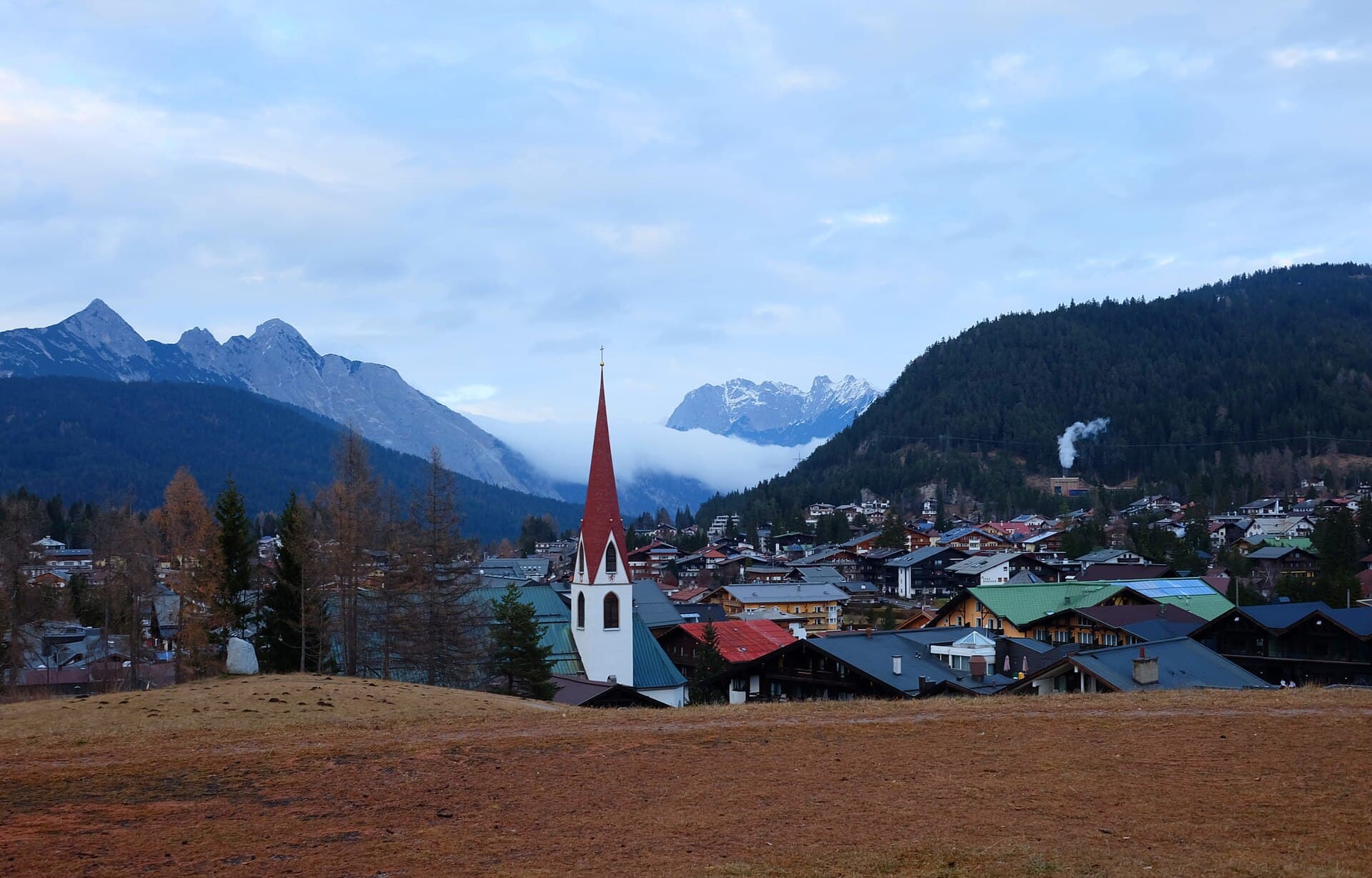 Jeff Croisé / CC BY-SA 3.0, via Wikimedia Commons
“Where Alpine history and Olympic spirit converge on a sun-drenched plateau.”
Not the postcards. The stories even locals don't know — whispered in your ear, right where they happened.
This iconic church, often seen as Seefeld's symbol, wasn't always surrounded by dry land.
One of Seefeld's most luxurious hotels has a past that is far from ordinary.
The ski jumps bearing the name of local legend Toni Seelos honor a man whose Olympic dreams were unexpectedly cut short.
Discover every secret of Seefeld
Every address, every reveal in full — in your ear, right where it happened.
You pick your stops. You walk. The voice reveals what the others miss.
No tours available yet. Check back soon — we're preparing them.
Seefeld in Tirol, a village in the Austrian state of Tyrol, rests on a high plateau at approximately 1,200 meters above sea level. This location, cradled between the Wetterstein and Karwendel mountains, provides a picturesque backdrop for a destination that gracefully blends outdoor activity with Tyrolean character. With a population of around 3,000 to 3,500, Seefeld maintains a welcoming atmosphere while offering extensive infrastructure for visitors.
Recognized as a year-round resort, Seefeld draws a considerable number of tourists in both summer and winter, making it one of Austria's most sought-after destinations. Its pedestrian zone is considered one of Tyrol's most inviting, featuring shops, traditional cafés, and restaurants serving regional cuisine. Beyond its village center, Seefeld serves as a gateway to a vast network of trails and slopes, catering to hikers, cyclists, and skiers alike.
The Seefeld Plateau's history extends back to prehistoric times, gaining early importance with the construction of a Roman military road that linked the Po Valley to present-day Augsburg. The settlement, initially called 'Sevelt,' was first documented in 1022 or 1077.
A pivotal moment in Seefeld's development was the 'Miracle of the Host' in 1384, which transformed the Parish Church of St. Oswald into a revered pilgrimage site in Tyrol. This religious prominence, coupled with its strategic location as a trading stop between Augsburg and Venice, spurred economic growth and the establishment of inns. Duke Sigmund the Coin-rich, a patron from 1446 to 1490, further supported the community, allowing it to retain its revenues for its own parish. Emperor Maximilian I also held the area in high regard, utilizing the Karwendel Mountains for his hunting grounds.
The Thirty Years' War brought economic decline, impacting both pilgrimage and trade. Later, Emperor Joseph II's dissolution of monasteries, including Seefeld's, led to its sale into private ownership. However, the 20th century marked a resurgence. The opening of the Karwendel railway in 1912 connected Seefeld with Innsbruck and Munich, ushering in an era of widespread tourism. By the 1920s, Seefeld began to be promoted as a vacation village, and its tourist infrastructure expanded significantly in the 1950s.
Seefeld's reputation as a winter sports center solidified in the 1930s, and it has since become a prominent venue for international competitions. The Olympic flame has burned in Seefeld three times, as it hosted the Nordic events for the Winter Olympic Games in Innsbruck in 1964 and 1976, and the Youth Olympic Winter Games in 2012. The town has also hosted the FIS Nordic World Ski Championships in 1985 and 2019, reinforcing its status as a leading destination for Nordic winter sports. Today, Seefeld balances its modern amenities with its preserved traditional character, evident in its architecture and customary events.
Seefeld offers a range of sights and activities for visitors. The Seekirchl (Church of the Holy Cross), an octagonal Baroque church completed in 1666, stands as a prominent landmark. For those seeking relaxation and aquatic fun, the Olympia-Erlebnisbad Seefeld features indoor and outdoor pools, water slides, and a 2,000 square meter spa area with saunas and a Blue Grotto.
Nature enthusiasts can explore Wildsee Lake, located at the southern end of the town. It is suitable for swimming in summer, with two bathing establishments, and a nature conservation area on its southern shore. A trail encircles the lake, offering an easy walk for all abilities. The Seefeld Way of the Cross presents a distinctive religious route, with 14 stations represented by large boulders leading up to Pfarrhügel hill. From Parish Hill, visitors can enjoy expansive views of the town and surrounding mountains.
For a change of scenery, nearby excursions include the charming town of Mittenwald in Bavaria, known for its historic painted houses and violin-making museum. The Ghost Valley (Geisterklamm) in Leutasch offers a mythical trail through a gorge. Additionally, Swarovski Crystal Worlds in Wattens, a 30-minute drive away, provides an immersive experience with crystal installations.
Seefeld is a year-round destination, with particular appeal in both summer and winter. For warm-weather activities like hiking, cycling, and swimming in Wildsee Lake, the best time to visit is from early July to mid-August, when average high temperatures are around 68°F and skies are often clearest. However, precipitation is also highest in July. Spring and autumn offer milder, drier weather, ideal for walks.
Winter transforms Seefeld into a snowy landscape, perfect for skiing and cross-country skiing. The skiing season typically runs from December to mid-April, with good snow conditions from late December to late March. January and the second half of March are generally quieter on the slopes.
Seefeld is easily accessible, situated approximately 17 to 21 kilometers northwest of Innsbruck. Innsbruck International Airport is about 30 minutes away, and Munich Airport is less than two hours by car. The village is also well-connected by train and bus services to Innsbruck and other major cities.
The village center features a car-free pedestrian zone, making it pleasant for strolling. Seefeld offers a range of accommodations, including a high concentration of four and five-star hotels. Many hotels provide easy access to train stations and bus routes. The local currency is the Euro. British citizens do not require a visa to enter Austria.