Schwerin Castle
The castle's most famous resident is not a duke or duchess, but a playful spirit.
Full story unlocks in the tour
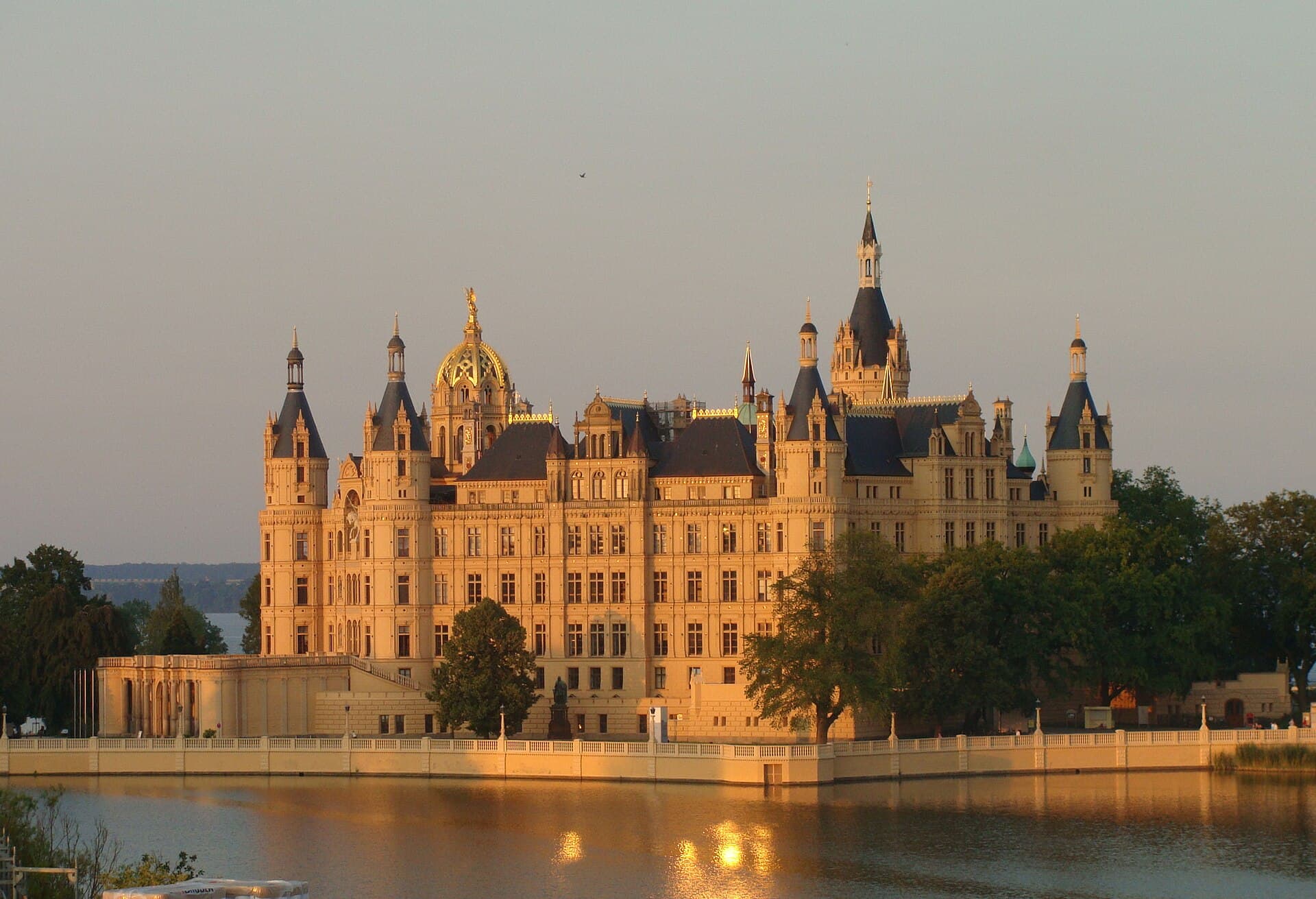 Christoph Heiling / CC BY-SA 3.0, via Wikimedia Commons
“Where storybook towers meet placid waters.”
Not the postcards. The stories even locals don't know — whispered in your ear, right where they happened.
The castle's most famous resident is not a duke or duchess, but a playful spirit.
This grand Gothic cathedral safeguards a relic that once drew pilgrims from distant lands.
A monument here recounts a spirited tale about the city's founder.
Discover every secret of Schwerin
Every address, every reveal in full — in your ear, right where it happened.
You pick your stops. You walk. The voice reveals what the others miss.
No tours available yet. Check back soon — we're preparing them.
Schwerin, the capital of Mecklenburg-Vorpommern, is a city where water and magnificent architecture intertwine. Often referred to as the "City of Seven Lakes" (though it actually encompasses twelve within its boundaries), Schwerin presents a singular fusion of natural splendor and historical refinement. Its most recognizable landmark, Schwerin Castle, emerges from an island in Lake Schwerin, resembling a creation from a storybook with its turrets and intricate details.
This city, home to approximately 96,000 inhabitants, maintains an intimate and serene atmosphere, offering a refreshing contrast to larger German destinations. Schwerin's allure lies in its unhurried pace, inviting visitors to wander its stone pathways, historic squares, and verdant gardens. It is a place where history feels palpable, with centuries of ducal influence evident in its grand structures and cultural institutions.
Schwerin is an ideal destination for those seeking an authentic German experience removed from well-trodden tourist routes, providing a tranquil escape where nature and history exist in perfect accord.
## From Slavic Stronghold to Ducal Seat Schwerin's narrative begins long before German settlement, with evidence of a Slavic fortress on an island in Lake Schwerin dating back to 942 CE. The Slavic tribe, the Obotrites, named their settlement "Zuarin," a term meaning "region of many animals," which is the origin of Schwerin's name. This early fortification underscored the area's strategic importance.
In 1160, Henry the Lion, Duke of Saxony, conquered the territory, establishing German dominion and transforming the tribal fortress into a medieval town. This year is considered Schwerin's official founding date, and it was granted city rights. A bishopric was established around 1170, further solidifying its regional significance.
The city's prosperous era commenced in 1352 when it became the seat of the Dukes of Mecklenburg. For over five centuries, these rulers shaped Schwerin's character, commissioning grand buildings and cultivating arts and culture. The castle on the island evolved from a defensive fort into a palace, undergoing significant alterations under John Albert I between the 15th and 18th centuries, incorporating Renaissance elements.
## The Fairytale Transformation and Modern Era The most visible legacy of the Mecklenburg dukes is Schwerin Castle, which was largely reconstructed in its current Romantic Historicist style between 1845 and 1857. This transformation, guided by architects such as Gottfried Semper and Friedrich August Stüler, resulted in the castle's distinctive appearance, often compared to Bavaria's Neuschwanstein. In 1857, the court of the Grand Duchy of Mecklenburg-Schwerin moved into the newly completed castle.
Unlike many German cities, Schwerin emerged relatively undamaged from World War II, preserving much of its historic architecture. During the East German period (1945–1990), it served as a regional administrative center. Following German reunification, Schwerin reasserted its position as the state capital of Mecklenburg-Western Pomerania. In 2024, the Schwerin Residence Ensemble, including the castle and surrounding structures, was officially designated a UNESCO World Heritage Site.
The undisputed heart of Schwerin is its splendid Schwerin Castle (Schweriner Schloss), a neo-Renaissance marvel rising from an island in Lake Schwerin. Visitors can explore its lavish rooms, including the throne room with Carrara marble columns, and admire extensive art collections. The surrounding Schlossgarten (Castle Garden), designed in the English garden style, offers tranquil walking paths, grottoes, arcades, and terraces.
Dominating the Old Town skyline is Schwerin Cathedral (Schweriner Dom), a striking example of North German Brick Gothic architecture. Ascend its 117-meter tower for sweeping views of the city, the palace, and the surrounding lake district. Inside, you will discover significant medieval art, including a bronze baptismal font from 1335.
Wander through Schwerin's Old Town (Altstadt) with its stone pathways and charming preserved buildings. The Market Square (Marktplatz), with the Old Town Hall and the columned façade of the New Town Hall, serves as a central point. Do not overlook the Staatliches Museum Schwerin (State Museum), home to one of Germany's most important collections of 17th-century Dutch and Flemish painting, featuring works by Rembrandt and Rubens.
For a different perspective, embark on a boat tour on Lake Schwerin to view the castle and the scenic landscapes from the water. The Pfaffenteich, a smaller lake in the heart of the Old Town, is a pleasant spot for a leisurely walk or to observe the sunset from its southern shore staircase.
The most agreeable time to visit Schwerin for pleasant weather and outdoor pursuits is between May and September. During these warmer months, the lakes are ideal for swimming, and the city awakens with open-air concerts and boat tours. Summer, particularly from late June to early September, offers the most lively atmosphere, though it is also the busiest tourist season. For a calmer experience with comfortable temperatures and autumn foliage, consider visiting in early autumn (September and October). Even in winter, Schwerin holds its appeal, with a festive Christmas market considered one of northern Germany's most atmospheric.
Schwerin is readily accessible by train and road. It is approximately 1 hour and 20 minutes by train from Hamburg and 2 to 2.5 hours from Berlin. For those driving, the A24 motorway connects Hamburg and Berlin with Schwerin via the A14. The nearest major international airport is Hamburg Airport, with rail connections to Schwerin.
Once in Schwerin, many attractions within the compact Old Town are walkable. For longer distances or excursions to the surrounding lakes and the zoo, the local public transport system, NVS (Nahverkehr Schwerin), offers trams and buses. Trams run frequently and connect key areas with the city center. Consider the Schwerin Ticket for free public transportation and discounts on attractions.
While many places accept card payments, it is advisable to carry some cash, as cashless options can be limited in certain establishments.