Registan Square
The name 'Registan' literally means 'sandy place,' yet today, the square is anything but.
Full story unlocks in the tour
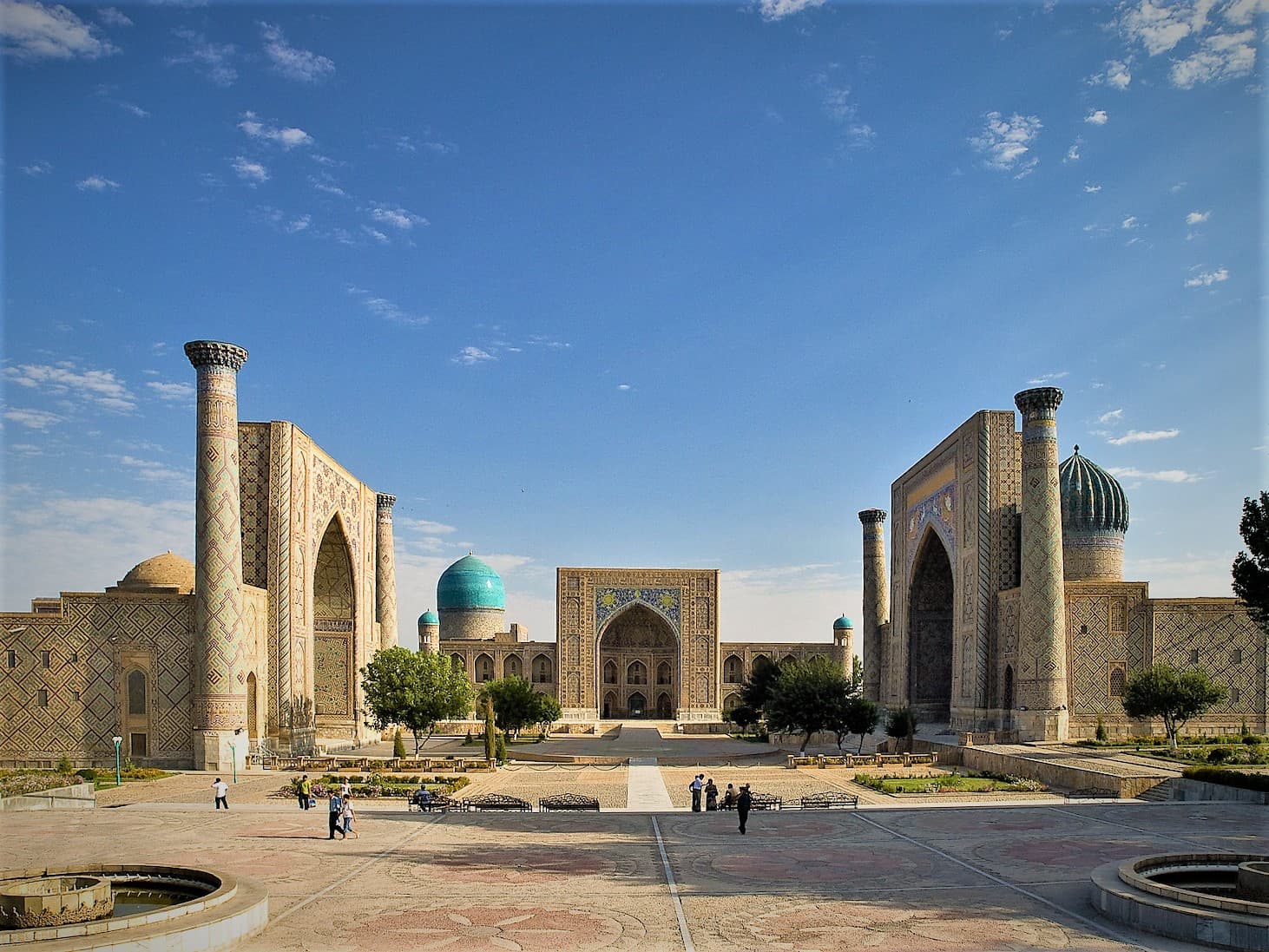 Registan_-_Gusjer.jpg: Gustavo Jeronimo from Aranjuez, Spain derivative work: MrPanyGoff / CC BY 2.0, via Wikimedia Commons
“Where ancient Silk Road echoes meet dazzling turquoise domes.”
Not the postcards. The stories even locals don't know — whispered in your ear, right where they happened.
The name 'Registan' literally means 'sandy place,' yet today, the square is anything but.
Legend says disturbing Timur's tomb unleashes disaster.
There's a staircase here where you can test your sinfulness.
Discover every secret of Samarcande
Every address, every reveal in full — in your ear, right where it happened.
You pick your stops. You walk. The voice reveals what the others miss.
No tours available yet. Check back soon — we're preparing them.
Samarkand, one of Central Asia's oldest continuously inhabited cities, has been a pivotal urban center of Iranian (Persian-Tajik) civilization and a crucial node in the Silk Road's cultural and commercial networks for millennia. Evidence of human activity in the area dates back 40,000 years to the Upper Paleolithic, with the city's founding theorized to be between the 8th and 7th centuries BC.
Conquered by Alexander the Great in 329 BC, when it was known as Maracanda, Samarkand later flourished under various Iranian and Turkic rulers. Its fortunes soared during the 14th century when Timur (Tamerlane) made it the capital of his vast empire, transforming it into a nexus of economic and cultural significance. Today, Samarkand is a UNESCO World Heritage site, celebrated for its extraordinary architectural monuments, particularly those from the Timurid era, which exhibit intricate mosaics and grand domes.
## Ancient Origins and Silk Road Significance Samarkand's roots stretch back to the late Paleolithic era, with archaeological findings suggesting human activity 40,000 years ago. While the exact founding date is debated, researchers place it around 700 BC. Known as Maracanda, it served as the capital of Sogdiana, a prosperous province of Iran, and a vital source of lapis lazuli traded along the Silk Road. Its strategic location at the crossroads of trade routes between China, Persia, and Europe allowed it to flourish, becoming one of Central Asia's largest cities at various points in history.
## Conquests and Cultural Shifts The city's desirability led to a succession of conquests. Alexander the Great captured Maracanda in 329 BC. Over subsequent centuries, it was ruled by Central Asian Turks, Arabs, the Samanids of Iran, and various Turkic peoples, each leaving their cultural imprint. In the early 8th century, the Arabs made Samarkand a center of Islamic culture. However, a devastating blow came in 1220 when Genghis Khan and the Mongols conquered and largely destroyed the city.
## The Timurid Renaissance Samarkand experienced a remarkable resurgence under Timur, who made it the capital of his empire in 1370 after a revolt against Mongol rule. For the next 35 years, Timur meticulously rebuilt the city, bringing in artisans and craftsmen from across his vast empire. This period marked the Timurid Renaissance, a golden age of Islamic scholarly study and architectural innovation. Timur's grandson, Ulugh Beg, a renowned astronomer and mathematician, further contributed to Samarkand's intellectual and architectural legacy in the 15th century, establishing an observatory that was a marvel of its time.
## Decline and Modern Revival After the collapse of the Timurid Empire, Samarkand was conquered by Uzbeks in 1500 and became part of the Khanate of Bukhara. The city faced a period of decline in the 18th century, even becoming uninhabited for several decades. Its economic recovery began in 1887 when it became a provincial capital of the Russian Empire and a crucial railroad center. Samarkand briefly served as the capital of the Uzbek Soviet Socialist Republic from 1924 to 1936 before Tashkent assumed the role. Today, Samarkand stands as Uzbekistan's third-largest city, a lively testament to its layered past and enduring cultural significance.
Samarkand's architectural wonders are concentrated, making many sites accessible on foot. Begin at Registan Square, the city's historic heart, framed by three grand madrasahs: the Ulugh Beg, Sher-Dor, and Tilya-Kori. The Ulugh Beg Madrasah, dating to 1417, is the oldest. The Sher-Dor Madrasah is notable for its facade depicting tigers with a rising sun, a rare artistic choice in Islamic architecture. The Tilya-Kori Madrasah, completed in 1660, functioned as both a theological school and the city's main mosque, with a dazzling gilded interior. Consider visiting at dawn for fewer crowds and again at dusk for the illuminated light show.
A short walk from Registan leads to the Bibi-Khanym Mosque, one of the largest mosques ever built by Timur, intended to rival the grandest in the Islamic world. Nearby is the bustling Siab Bazaar, Samarkand's oldest and largest market, offering a glimpse into local life and a chance to sample regional delicacies like spices, nuts, dried fruits, and the famous Samarkand flatbreads.
Continue to the Shah-i-Zinda Necropolis, an enchanting avenue of mausoleums adorned with intricate blue tiles, spanning architectural styles from the 11th to 19th centuries. This complex is believed to house the tomb of Qusam ibn Abbas, a cousin of the Prophet Muhammad.
The Gur-e-Amir Mausoleum, meaning 'Tomb of the Ruler,' is the final resting place of Timur, his sons, and his grandson Ulugh Beg. Its fluted turquoise dome and gilded interior are a testament to Timurid artistry.
For a deeper dive into Samarkand's ancient past, visit the Afrasiab site, the ruins of the original city destroyed by Genghis Khan. The Afrasiab Museum displays archaeological finds, including unique 7th-century wall paintings from a palace complex. Finally, the Ulugbek Observatory showcases the scientific brilliance of Timur's grandson, with the remains of his giant sextant still visible.
The ideal times to visit Samarkand are during spring (April to early June) and autumn (mid-September to late October). During these periods, you'll experience warm, dry days with pleasant temperatures, perfect for exploring the city's outdoor sites without the intense summer heat. Spring brings blooming landscapes and the Nowruz (Persian New Year) celebrations in March. Autumn offers clear skies and soft light that enhances the vivid tilework of the monuments. Summers (June-August) are extremely hot, often exceeding 38°C (100°F). Winter (December-February) is cold, with temperatures dropping below freezing, but offers fewer crowds and lower prices.
Samarkand is generally considered very safe for travelers. Tourist police are visible at major sites and often speak some English. The local currency is the Uzbekistani Som (UZS). While cards are accepted at many hotels and restaurants in major cities, it's advisable to carry cash for bazaars and smaller shops. ATMs are readily available in Samarkand.
Getting around Samarkand is convenient. Many of the main attractions, including Registan Square, Gur-e-Amir Mausoleum, and Bibi-Khanym Mosque, are within walking distance of each other. For longer distances, taxis are a good option; ride-sharing apps like Yandex Taxi also operate. It's wise to negotiate fares before starting your journey if not using an app. Buses and shared minivans (marshrutkas) are also available for local transport.
Uzbekistan's train network is efficient, with high-speed Afrosiyob trains connecting Samarkand to Tashkent and Bukhara. It's recommended to book train tickets in advance, especially during peak season. Samarkand also has an international airport with flights to various destinations.
Dress modestly when visiting religious sites, ensuring shoulders and knees are covered. Women may find it useful to carry a scarf. Comfortable walking shoes are essential due to cobblestones and extensive walking at historical complexes.