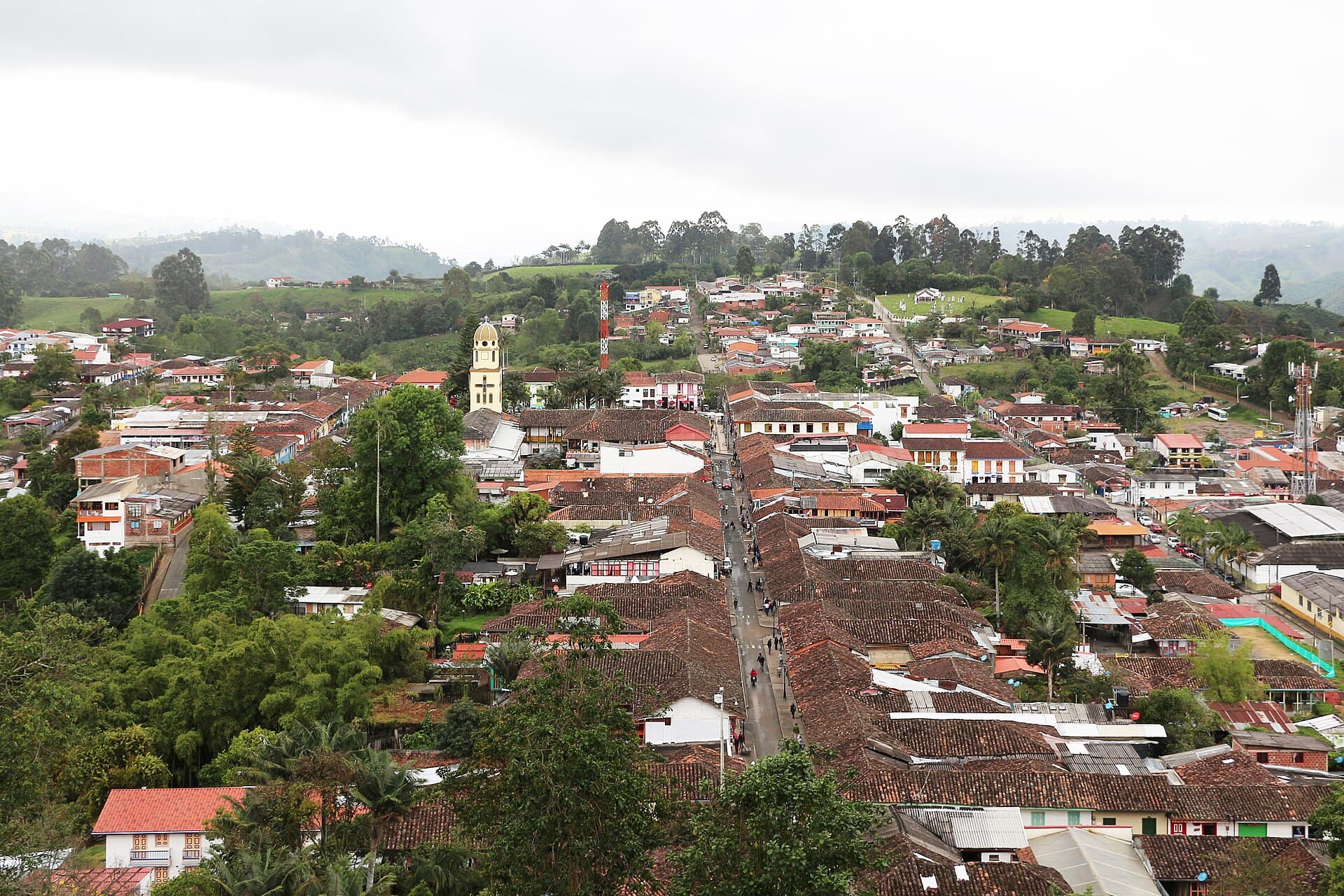
Calle Real
The colorful facades of Salento's main street conceal more than meets the eye.
Full story unlocks in the tour
 Bernard Gagnon / CC BY-SA 4.0, via Wikimedia Commons
“Where towering palms meet lively facades and the aroma of coffee fills the air.”
Not the postcards. The stories even locals don't know — whispered in your ear, right where they happened.
The colorful facades of Salento's main street conceal more than meets the eye.
The iconic wax palms of Cocora Valley are not the only giants in this landscape.
The town of Salento has a surprising origin story that began with conflict.
Discover every secret of Salento
Every address, every reveal in full — in your ear, right where it happened.
You pick your stops. You walk. The voice reveals what the others miss.
No tours available yet. Check back soon — we're preparing them.
Salento, a captivating town at the core of Colombia's Coffee Cultural Landscape, enthralls visitors with its distinctive architecture, verdant surroundings, and the ever-present scent of coffee. As the oldest municipality in the department of Quindío, Salento opens onto the dramatic landscapes of the Cocora Valley, home to the world's tallest wax palms. Its colorful buildings, many adorned with balconies overflowing with flowers, reflect the traditional bahareque style—a blend of cane, wood, and earth.
This tranquil mountain town, often called "El Padre del Quindío" (The Father of Quindío), offers a relaxed pace of life, inviting exploration of its artisan shops, cozy cafes, and lively main square. Salento serves as a perfect base for outdoor adventures, from hiking among towering palms to touring coffee farms and discovering diverse birdlife.
## From Penal Colony to Coffee Capital Salento's story begins not with coffee, but with conflict. In the early 19th century, the main route connecting Popayán to Bogotá traversed the challenging Quindío Pass. Simón Bolívar himself ordered upgrades to this strategically important, yet poorly maintained, road in 1830.
The town's official founding on January 5, 1842, emerged from the aftermath of the Guerra de los Supremos. Political prisoners from various Colombian regions were sent to the area, then known as Barcinales, to work on improving and maintaining this vital road. Upon completing their sentences, these individuals were granted plots of land, laying the groundwork for the settlement.
Initially, the primary settlement was in the valley at Boquía. However, a devastating flood of the Quindío River around 1854 forced the survivors to rebuild their homes in Barcinales, which they then renamed Boquía. This new settlement, now Salento, slowly grew, and by 1864, a census recorded 581 inhabitants.
A significant turning point for Salento's unique character was the diversion of the main Popayán-Bogotá route. This isolation, while initially perceived as a setback, allowed Salento to retain more of its traditional colonial bahareque architecture than many other towns in the Eje Cafetero (Coffee Axis). This architectural preservation, combined with its serene atmosphere, ultimately contributed to its recognition as a major tourist destination. In 2011, the historic center of Salento, with its distinctive building style, was inscribed on the UNESCO World Heritage List as part of the "Coffee Cultural Landscape."
The main square, Plaza de Bolívar, is a lively hub with the Nuestra Señora del Carmen church, restaurants, shops, and cafes. From here, the famed Calle Real (Carrera Sexta) extends, a pedestrian-friendly street lined with artisan shops selling local handicrafts, jewelry, and coffee products.
At the end of Calle Real, a steep staircase ascends to the Mirador Alto de la Cruz, offering expansive views of the town's colorful rooftops and the surrounding hills. A short walk from there leads to Mirador de Salento, providing a different vantage point over the Quindío River.
A visit to the Cocora Valley is essential, where the majestic Quindío wax palms, Colombia's national tree and the tallest palm trees in the world, punctuate a verdant landscape. Hiking trails wind through this unique valley, and horseback riding tours are also available. Exploring a local coffee finca (farm) is another memorable experience, offering insights into the coffee production process from seed to cup, often concluding with a tasting.
Salento enjoys a tropical mountain climate, often described as a perpetual "Eternal Spring," with an average annual temperature of 17°C (62°F). The defining seasonal variations are dictated by rainfall rather than temperature. The drier periods, offering more reliable sunshine and less muddy trails, are from December to February and July to August. January is statistically the brightest month. However, even during these drier months, occasional showers can occur, so a rain jacket is always a good idea. To avoid crowds, it's advisable to steer clear of January, Easter week, and national holidays, as Salento is a popular destination for Colombian vacationers.
The official currency in Salento, and throughout Colombia, is the Colombian Peso (COP). While ATMs are available in town, they can sometimes have long lines or run out of cash, so it's wise to carry some Colombian pesos, as many smaller establishments are cash-only. It's generally recommended to exchange currency at banks or authorized exchange houses rather than airports or hotels, which often offer less favorable rates. Most banks in Colombia do not exchange money.
Salento is considered a very safe town, particularly in tourist areas. Walking within the town is easy, though some streets are hilly. For getting to attractions outside the town, such as the Cocora Valley or coffee farms, shared Willy jeeps depart regularly from the main square. Public buses also connect Salento to nearby cities like Armenia and Pereira. Tap water in Salento is generally safe to drink.