Aître Saint-Maclou
This former plague cemetery holds a surprising, mummified resident within its walls.
Full story unlocks in the tour
 Herbert Frank from Wien (Vienna), AT / CC BY 2.0, via Wikimedia Commons
“Where medieval timber, the legacy of a martyr, and the shifting light of the Impressionists define the spirit of Normandy.”
Not the postcards. The stories even locals don't know — whispered in your ear, right where they happened.
This former plague cemetery holds a surprising, mummified resident within its walls.
The city's iconic astronomical clock once played a role beyond just telling time.
The soaring spire of Rouen Cathedral once held a surprising global record.
Discover every secret of Rouen
Every address, every reveal in full — in your ear, right where it happened.
You pick your stops. You walk. The voice reveals what the others miss.
No tours available yet. Check back soon — we're preparing them.
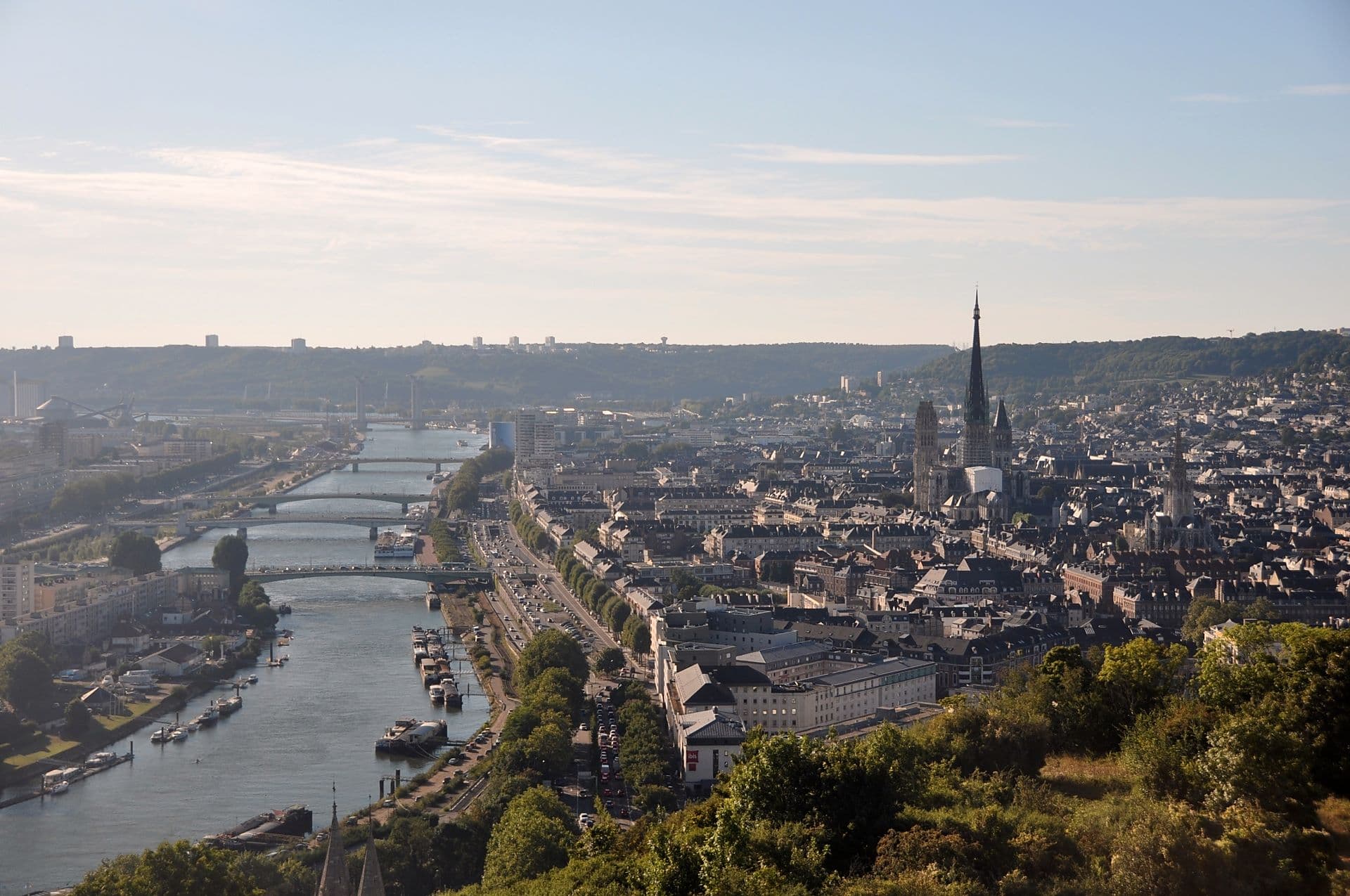
Rouen, the historic capital of Normandy, is a city where centuries of human endeavor are etched into its medieval streets and Gothic architecture. Situated on the right bank of the Seine River, approximately 80 miles northwest of Paris, Rouen offers a captivating journey through time. Often referred to as "the city of a hundred spires" by Victor Hugo, its skyline is dominated by impressive churches and half-timbered houses that evoke a bygone era.
Despite suffering significant damage during World War II, Rouen has meticulously restored its historic core, creating a harmonious blend of ancient character and lively modern life. It is a city that invites exploration, from tracing the footsteps of Joan of Arc to admiring the very cathedral that inspired Claude Monet's famous series of paintings. Rouen's deep cultural roots extend to its renowned gastronomy, making it a destination that engages every faculty.
## From Roman Settlement to Norman Capital Rouen's origins stretch back to the Gaulish tribe of the Veliocasses, who named their settlement Ratumacos. The Romans later called it Rotomagus, and it grew to become the second most important city in Gallia Lugdunensis. In the 3rd century CE, Christianity was introduced, and by the 5th century, Rouen became the seat of a bishopric.
## Viking Incursions and the Duchy of Normandy The city's strategic location on the Seine made it vulnerable to Viking incursions. From their first raids in 841, the Normans eventually overran Rouen. In 912, the Viking chieftain Rollo was nominated count of Rouen, and the city became the capital of the Duchy of Normandy, a title it held until William the Conqueror moved his residence to Caen. Rouen received its founding charter, permitting self-government, in 1150.
## Medieval Prosperity and English Rule From the 13th century onwards, Rouen experienced a remarkable economic boom, largely due to its thriving textile and wool trade. Its importance as a port city on the Seine was central to its development. However, its strategic value also made it a battleground during conflicts like the Hundred Years' War. The city was captured by Henry V of England in 1419.
## The Fate of Joan of Arc Rouen holds a poignant place in French history as the site of Joan of Arc's trial and execution. In 1430, Joan was captured by Burgundians and sold to the English. She was brought to Rouen and, despite her defense, was found guilty of heresy and burned at the stake in the Place du Vieux Marché on May 30, 1431. Her ashes were reportedly scattered into the Seine River. Twenty-five years later, her conviction was overturned in a retrial held in the Archbishop's palace.
## From Decline to Restoration Rouen was recaptured by the French in 1449 and became a significant cultural center. The city suffered during the French Wars of Religion in the late 16th century, and a significant portion of its population emigrated after the revocation of the Edict of Nantes in 1685. The city and port experienced a decline until the 19th century, when the textile trade brought renewed prosperity. During both the Franco-Prussian War and the World Wars, Rouen faced occupation and significant damage, particularly from Allied bombing in 1944. Despite this, the city has been painstakingly restored, preserving its unique architectural heritage.
Begin your exploration at the Cathédrale Notre-Dame de Rouen, a magnificent Gothic masterpiece that captivated Claude Monet. Its intricate façade, a blend of various Gothic styles built over centuries, is a testament to architectural evolution. Inside, admire the stained-glass windows and the tomb of Richard the Lionheart.
Walk along the pedestrianized Rue du Gros Horloge to encounter the Gros Horloge, an ornate 14th-century astronomical clock set within a Renaissance archway. You can venture inside the belfry to see the ancient clock mechanism and enjoy wide views of the city.
The Place du Vieux Marché is a site of profound historical significance, marking the spot where Joan of Arc was executed. Today, it is a lively square framed by colorful half-timbered houses, cafés, and the modern Church of Saint Joan of Arc, whose roof symbolically rises like flames.
For a truly unique experience, visit the Aître Saint-Maclou, a former ossuary and plague cemetery from the Middle Ages. Its timber-framed galleries are adorned with macabre carvings of skulls and bones, offering a somber yet fascinating glimpse into the past.
Art enthusiasts should not miss the Musée des Beaux-Arts, which houses one of France's most significant public art collections outside of Paris, featuring works by renowned artists such as Monet, Renoir, and Caravaggio.
Consider a walk along the River Seine to appreciate Rouen's port city heritage and enjoy views of the urban landscape. For a broader perspective, head to Panorama Sainte-Catherine (Sainte-Catherine Hill) for sweeping views of Rouen, the cathedral, and the Seine, especially beautiful at sunset.
The best time to visit Rouen is during the spring (April to June) and early autumn (September to October). During these months, the weather is mild and pleasant, and there are generally fewer crowds, allowing for a more relaxed exploration of the city's historical sites and museums.
Summer (July and August) brings warmer temperatures and a lively atmosphere with festivals and events, but also larger crowds and higher prices. Winter (November to February) is quieter and cooler, with a festive charm, particularly during the holiday season. While outdoor activities are limited, it is an ideal time for peaceful sightseeing and enjoying cozy indoor attractions.
Rouen is a highly walkable city, with most major attractions concentrated in the old center, eliminating the need for a car to explore the city itself. Public transportation, including buses and the metro, is available for getting around.
If arriving by train, Rouen's main station, Gare de Rouen-Rive-Droite, is located just north of the historic center. Direct trains from Paris Saint-Lazare typically take 1 hour 15 minutes to 1 hour 30 minutes. The city center is a short downhill walk or easily accessible by local buses or taxis from the station.
For those driving, public parking lots are available in the city center, and Rue du Gros Horloge is a pedestrian thoroughfare. French is the primary language, but English is often spoken in tourist areas. Comfortable shoes are recommended for navigating the ancient streets. Most establishments accept debit/credit cards.