The Town Hall Tower
From the summit of Rothenburg's Town Hall Tower, a vast panorama unfolds beyond mere rooftops.
Full story unlocks in the tour
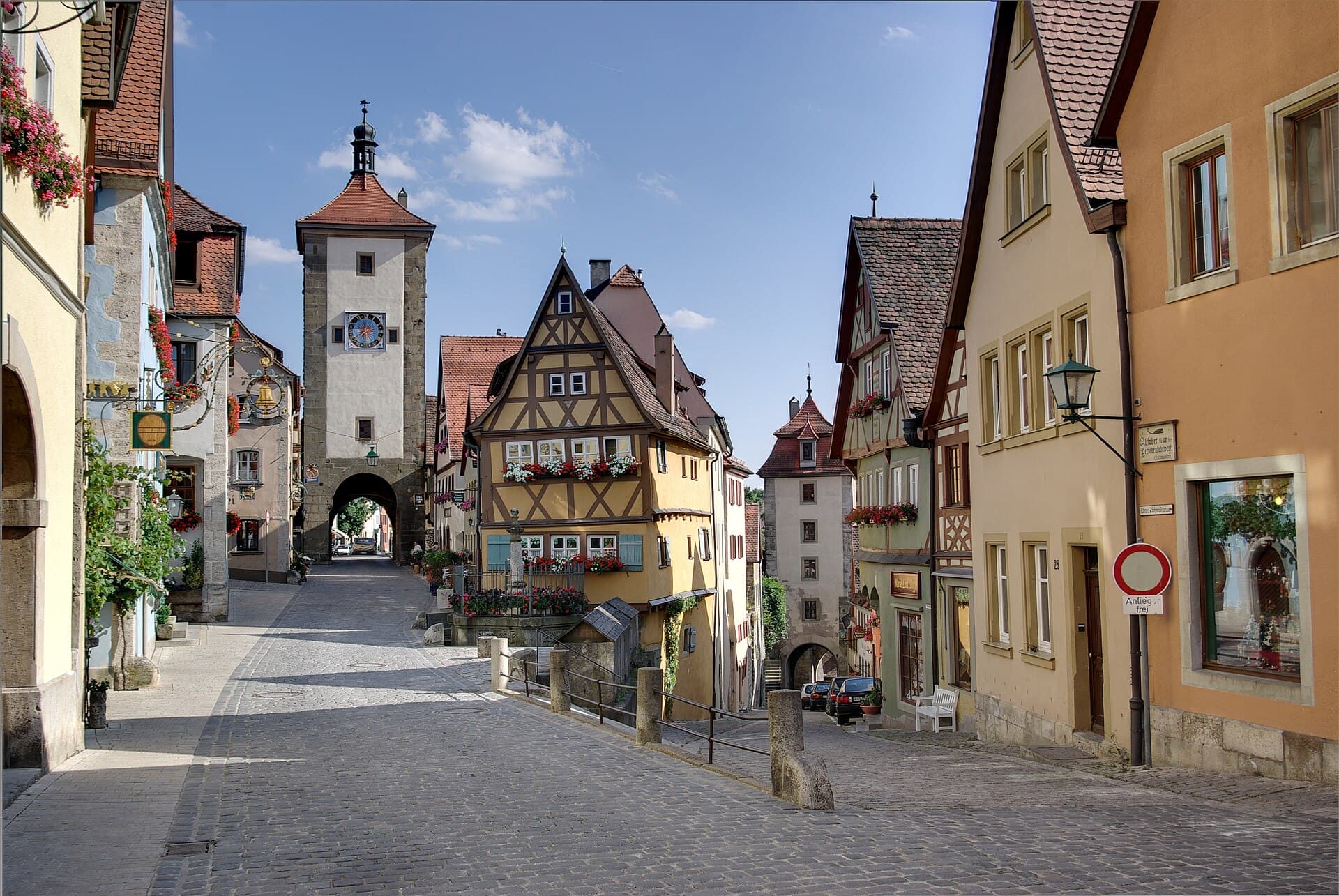 Berthold Werner / Public domain, via Wikimedia Commons
“Enter a storybook realm, where ancient walls stand sentinel over centuries of narratives.”
Not the postcards. The stories even locals don't know — whispered in your ear, right where they happened.
From the summit of Rothenburg's Town Hall Tower, a vast panorama unfolds beyond mere rooftops.
The distinctive architecture of Rothenburg's Double Bridge serves more than just visual appeal.
A stroll along Rothenburg's city walls uncovers a striking detail about its post-war reconstruction.
Discover every secret of Rothenburg ob der Tauber
Every address, every reveal in full — in your ear, right where it happened.
You pick your stops. You walk. The voice reveals what the others miss.
No tours available yet. Check back soon — we're preparing them.
Rothenburg ob der Tauber, a name signifying "Red castle above the Tauber," is a town in Germany's Franconia region, set within Bavaria. It is celebrated for its remarkably preserved medieval old town. This evocative destination, often likened to a real-life fairytale, draws visitors from across the globe with its winding lanes, colorful half-timbered dwellings, and intact fortifications. It remains one of only four German towns to retain completely encircling city walls.
Walking through Rothenburg feels like stepping into a living chronicle, where every turn presents a compelling piece of the past. The absence of cars within the old town encourages exploration on foot, fostering a deeper appreciation for its centuries-old character. From its memorable Plönlein square to the imposing Town Hall, Rothenburg offers an absorbing journey through time.
## From Roman Outpost to Imperial City Evidence of settlement in the Rothenburg area extends to the 9th century, with possible earlier Celtic inhabitants. The town's official narrative often begins in the 10th century with the construction of a castle. Around 950 AD, the name "Rotinbure" first appeared in records. In 1070, the counts of Comburg-Rothenburg erected a castle overlooking the Tauber River, establishing the foundation for the Rothenburg we experience today.
By 1170, the city of Rothenburg was formally established with the creation of the marketplace and St. James' Church. The town's initial defenses, including the White Tower and Markus Tower, were constructed in the 13th century. A pivotal moment arrived in 1274 when Emperor Rudolph I bestowed upon Rothenburg the designation of a "Free Imperial City." This status granted considerable autonomy and independence within the Holy Roman Empire, ushering in a period of thriving trade and prosperity between the 13th and 16th centuries. During this era, many of the enduring structures, such as the Gothic Town Hall and the Plönlein lookout tower, took shape.
## The Thirty Years' War and Rediscovery Rothenburg became a center of Protestantism during the Reformation in the 16th century. The town endured the destructive Thirty Years' War (1618-1648), notably suffering a siege in 1631. A well-known legend, "The Master Draught," recounts how the town avoided complete destruction when former mayor Nusch successfully consumed an immense quantity of wine in one gulp, a challenge posed by the Catholic general Tilly. Following the war, Rothenburg gradually receded from prominence, entering a period of quietude.
It was in the 19th century that Rothenburg's well-preserved medieval architecture and historical allure began to attract visitors, leading to its reawakening. However, the town sustained damage during World War II. In March 1945, bombs destroyed a significant portion of the town, claiming 37 lives and damaging homes and sections of the wall. Fortunately, due to the intervention of U.S. Assistant Secretary of War John J. McCloy, a planned artillery assault was averted, and the town was meticulously restored. Today, Rothenburg ob der Tauber is celebrated as one of Germany's most carefully preserved medieval towns.
Rothenburg's compact dimensions make it ideal for exploration on foot, with numerous points of interest within a short walk of each other. Begin at the Marktplatz (Market Square), the city's central gathering place, surrounded by colorful half-timbered buildings and home to the striking Town Hall with its grand stairs and Renaissance facade. Ascend the Town Hall Tower for expansive views of the walled city and the Tauber Valley.
A visit is incomplete without experiencing Plönlein, arguably Rothenburg's most recognizable and photographed location, featuring a charming crooked yellow timber-frame house framed by two towers of the old city wall. Walk the City Walls (Tower Trail), a 4-kilometer circuit punctuated by 42 towers and six gates, offering distinct perspectives of the town and surrounding countryside. Explore the Castle Garden (Burggarten), a romantic setting providing splendid views of the Tauber Valley, despite the original castle no longer standing.
Delve into the past at the Medieval Crime Museum, housed in the former executioner's residence, displaying artifacts related to medieval justice. For those who cherish the holiday season, the Käthe Wohlfahrt Christmas Village and the German Christmas Museum are open year-round. Consider joining a Night Watchman's Tour for an evening walk filled with historical narratives.
Rothenburg ob der Tauber extends a welcome throughout the year, with each season presenting a unique atmosphere. For temperate weather and blossoming landscapes, late spring and early fall are excellent choices, though summer also offers pleasant conditions, albeit with larger crowds. Autumn brings vivid foliage, enhancing the town's hilltop setting. To avoid the busiest times, consider visiting in the early mornings or evenings, after day-trippers have departed. December is particularly captivating due to its celebrated Christmas market, the Reiterlesmarkt, which transforms the town into a festive wonderland, though with increased visitors. Winter months generally see fewer crowds and potentially lower hotel prices, and the town can appear especially magical under a blanket of snow.
Rothenburg ob der Tauber is best explored on foot due to its compact size and the limited vehicle access within the old town. Comfortable footwear is advisable for navigating the winding lanes. The town is situated along the A7 and A6 motorways, allowing for easy access by car, with ample parking available outside the city walls. If staying overnight, inquire about hotel parking, as spaces within the walls are scarce.
For train travel, ensure your destination is "Rothenburg ob der Tauber" to prevent confusion with other towns sharing the same name. The train station is conveniently located near the old town. While a day trip is feasible, an overnight stay or two is highly recommended to experience the town without the daytime crowds and savor its tranquil evenings. Most shops in Bavaria, including Rothenburg, observe Sunday closures.