Roscommon Abbey
Among the weathered stones of Roscommon Abbey, a carved effigy tells a silent story of power and devotion.
Full story unlocks in the tour
 瑞丽江的河水 / CC BY-SA 4.0, via Wikimedia Commons
“Where ancient myths intertwine with resilient history.”
Not the postcards. The stories even locals don't know — whispered in your ear, right where they happened.
Among the weathered stones of Roscommon Abbey, a carved effigy tells a silent story of power and devotion.
This formidable Norman fortress, though now a ruin, holds a secret that influenced castle design far beyond Ireland's shores.
Within the walls of what is now a hospital, a stark reminder of Ireland's Great Famine reveals a deeply personal struggle for survival.
Discover every secret of Roscommon
Every address, every reveal in full — in your ear, right where it happened.
You pick your stops. You walk. The voice reveals what the others miss.
No tours available yet. Check back soon — we're preparing them.
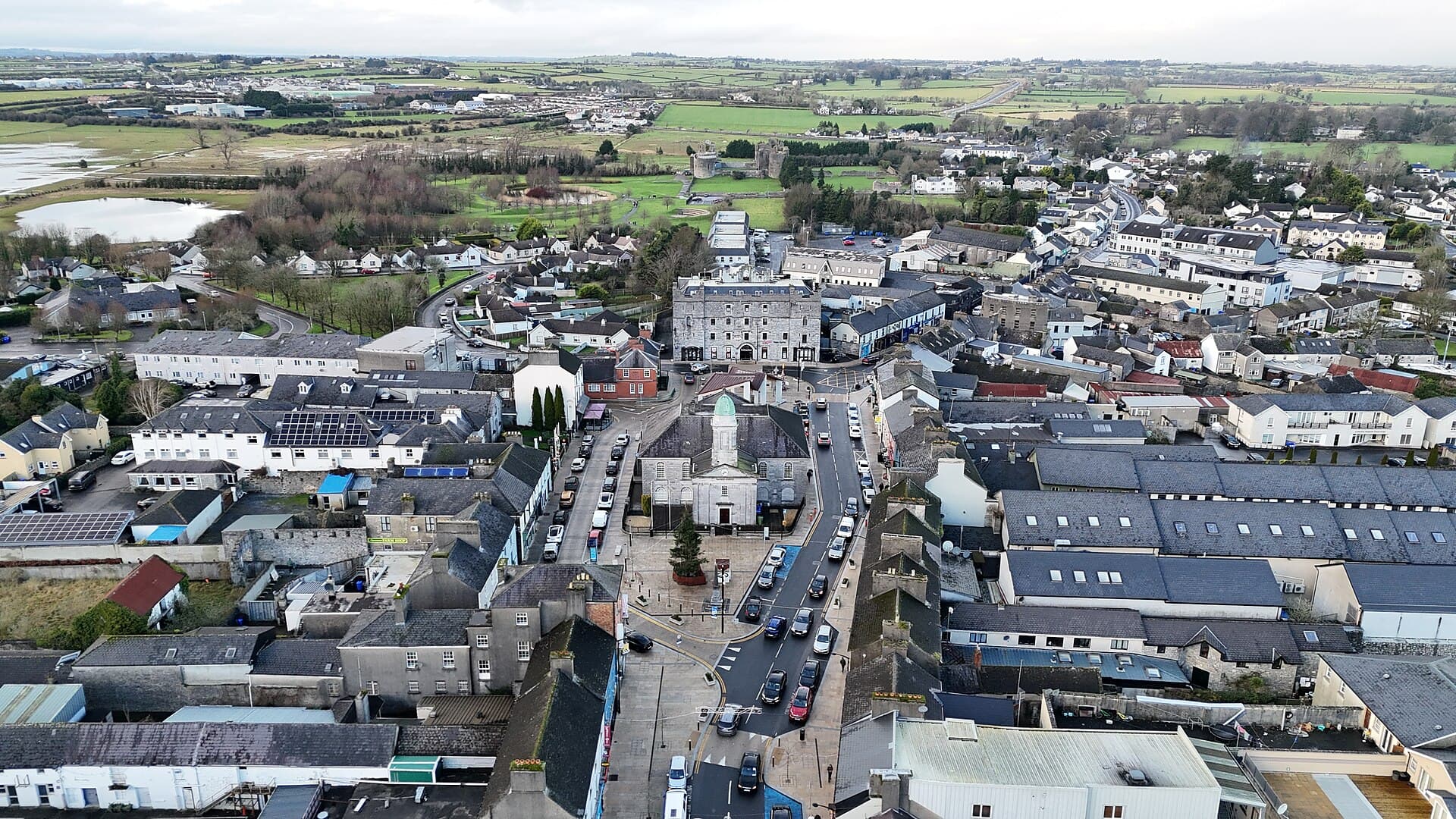
Roscommon, a county town at the core of Ireland, offers a journey through layers of time and a landscape defined by meandering waterways and gentle, tree-lined hills. The very name, 'Ros Comáin,' signifies 'St. Coman's Wood,' honoring the 5th-century saint who established a monastery here. While often considered a passage rather than a primary destination, Roscommon unveils a compelling narrative for those who pause to explore its ancient sites and natural splendor.
County Roscommon is the 11th largest county in Ireland by area, yet it is among the least populated, providing a peaceful, pastoral experience with more sheep than people. This quiet allure, combined with a wealth of archaeological and historical locations, makes it a rewarding stop for travelers seeking a deeper connection to Ireland's past. From mythological royal grounds to medieval ruins and poignant famine history, Roscommon provides a unique perspective on the island's enduring heritage.
## From Mythical Kingdoms to Norman Strongholds Roscommon's history extends back to mythological Ireland, with Rathcroghan, near the village of Tulsk, serving as the ancient seat of Queen Medb and the Kings of Connacht. This archaeological site, with over 240 monuments, dates back 5,500 years and is linked to the epic tale of the Táin Bó Cúailnge.
The county's Christian heritage commenced in the 5th century with St. Comán, who established a monastery, giving the town its name. By the 8th century, the O'Connor (Ó Conchobhair) dynasty emerged as the dominant Gaelic family, maintaining a stronghold in Roscommon despite increasing English influence.
In 1269, Robert de Ufford, Justiciar of Ireland, began constructing Roscommon Castle on lands seized from an Augustinian Priory. The castle endured a turbulent existence, repeatedly attacked and changing hands between English garrisons and the O'Connors, who held it for over two centuries from 1340. It was later transformed into a fortified Elizabethan house in 1578 by Sir Nicholas Malby before being burned down in 1690 and falling into ruin.
Roscommon Abbey, a Dominican priory, was founded in 1253 by Felim O'Conor, King of Connacht. It was an important medieval religious house, though it also faced destruction by fire and lightning. The county also played a role in the War of Independence and is notable as the birthplace of Douglas Hyde, Ireland's first President. The 19th century brought the devastating Great Famine, a period profoundly impacting Roscommon, as evidenced by sites like the National Famine Museum at Strokestown Park.
Roscommon offers a range of sites that speak to its layered past. Explore the imposing ruins of Roscommon Castle, a 13th-century Norman fortress that witnessed centuries of conflict. Adjacent to the castle is Loughnaneane Park, a 14-acre recreational area with diverse flora and fauna. Just a short walk away, the serene ruins of Roscommon Abbey, a 13th-century Dominican priory, invite contemplation.
For a deeper dive into ancient history, visit the Rathcroghan Royal Site near Tulsk. This archaeological complex, spanning millennia, is rooted in Irish mythology and features burial mounds, ringforts, and the intriguing Oweynagat (Cave of the Cats), sometimes referred to as the 'Gate to Hell.' To understand a more recent, yet equally impactful, period of Irish history, Strokestown Park House and the National Famine Museum provide a poignant look at the Great Famine through the lens of a historic estate.
Beyond the town, Lough Key Forest and Activity Park offers 350 hectares of woodland, islands, and a tree canopy walk, providing opportunities for outdoor activities like kayaking, canoeing, and zip-lining. Another unique attraction is the Arigna Mining Experience, where you can explore underground tunnels and learn about 400 years of coal mining history.
The best time to visit Roscommon for warm-weather activities is from late June to late August. During these months, average daytime temperatures range from 18°C to 20°C (64-68°F), offering pleasant conditions for exploring outdoor sites. July is typically the warmest month, with clearer skies. While rainfall is common throughout the year, the summer months generally experience slightly less precipitation.
Roscommon town is centrally positioned in Ireland, accessible by road via the N60, N61, and N63. From Dublin, take the M4 to Kinnegad, then continue on the M6 to Athlone and the N61 for Roscommon. For the northern part of the county, exit onto the N4. While Roscommon town itself does not have a direct train service, you can connect via Athlone. Bus Éireann provides services from Dublin Airport and Busáras to towns like Carrick-on-Shannon and Boyle, with connections to Roscommon.
Within the town, many historical sites are within walking distance or a short drive. Car rental is recommended for exploring the wider county and its many attractions. Accommodation options range from hotels to guesthouses. The local currency is the Euro.