The Cat House
Observe the turrets of a building on Meistaru iela, and you will discern two felines with a rather displeased demeanor. Their posture is more than a whimsical design.
Full story unlocks in the tour
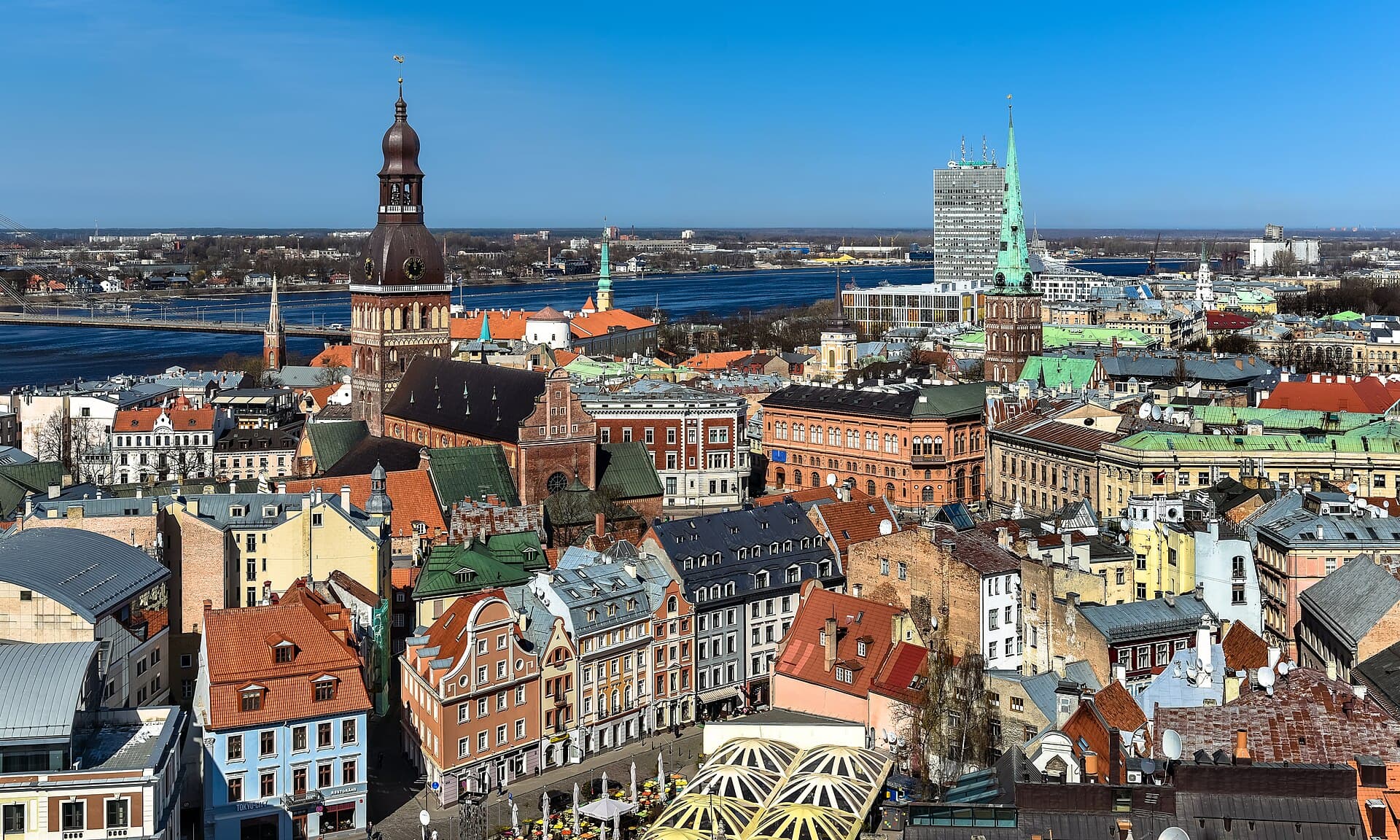 Jorge Franganillo from Barcelona, Spain / CC BY 2.0, via Wikimedia Commons
“Riga: Where medieval echoes meet Art Nouveau visions.”
Not the postcards. The stories even locals don't know — whispered in your ear, right where they happened.
Observe the turrets of a building on Meistaru iela, and you will discern two felines with a rather displeased demeanor. Their posture is more than a whimsical design.
The expansive Riga Central Market offers more than fresh produce; its primary pavilions possess an unexpected past that once ascended into the skies.
Riga features one of the tallest constructions in the European Union, a television tower that occasionally lays claim to an even more remarkable distinction.
Discover every secret of Riga
Every address, every reveal in full — in your ear, right where it happened.
You pick your stops. You walk. The voice reveals what the others miss.
No tours available yet. Check back soon — we're preparing them.
Riga, Latvia's capital, rests at the mouth of the Daugava River on the Gulf of Riga, a strategic position that has shaped its character for centuries. Established in 1201, it swiftly became a vital trading post and a prominent member of the Hanseatic League, a medieval commercial and defensive confederation of merchant guilds and market towns across Central and Northern Europe. Today, Riga stands as Latvia's largest city, home to nearly a third of the nation's population, and a significant cultural and economic center in the Baltic States.
The city's historical core is a UNESCO World Heritage Site, celebrated for its well-preserved medieval architecture and an exceptional concentration of Art Nouveau buildings. Beyond its architectural splendor, Riga presents a lively contemporary scene, from bustling marketplaces to a developing craft beer culture. Its fusion of historical depth and modern vitality makes it a compelling destination for those seeking to uncover the unique spirit of the Baltics.
The Daugava River has served as a crucial trade route since ancient times, utilized by Vikings on their journeys to Byzantium. The sheltered natural harbor where Riga now stands was identified as early as the 2nd century. By the early Middle Ages, it had become a center for Viking trade, with inhabitants engaged in fishing, animal husbandry, and crafts such as bone, wood, amber, and iron working.
Riga was formally established in 1201 by Albert of Buxhoevden, who designated it as the seat of his bishopric and a base for conquering the surrounding Livonian territories. The city's strategic location fostered its growth into a leading trade center on the Baltic Sea's eastern shore, leading to its inclusion in the Hanseatic League in 1282.
After the decline of the Livonian Order, Riga experienced a period as a free imperial city before falling under the influence of the Polish-Lithuanian Commonwealth in 1581. In 1621, during the Polish-Swedish War, Riga was captured by King Gustavus Adolphus, becoming the largest city in the Swedish Empire for nearly a century. This era of Swedish control concluded in 1710 when Tsar Peter the Great's Russian forces besieged and captured the city, making it the capital of the Governorate of Riga.
Under Russian administration, Riga continued to flourish as a mercantile base, largely retaining its privileges. By the late 18th century, it had become a nexus of Enlightenment thought, and by 1897, it was the sixth-largest city in the Russian Empire. The city's rapid industrialization in the late 19th and early 20th centuries, coupled with the emergence of a Latvian bourgeoisie, fueled the Latvian National Awakening. This period also saw the construction of the elaborate Art Nouveau buildings that Riga is known for today.
Latvia, with Riga as its capital, declared independence on November 18, 1918, after more than 700 years of foreign rule. The interwar period witnessed Riga's focus shifting towards Western Europe. However, this independence was tragically interrupted by Soviet occupation in 1940, followed by Nazi German occupation during World War II, and then a return to Soviet rule until 1991. During the Soviet era, large numbers of Russian settlers relocated to Riga, significantly altering the city's demographic composition.
Since regaining independence in 1991, Riga has experienced considerable economic growth, particularly after joining the European Union in 2004. The city was designated a UNESCO World Heritage site in 1997, acknowledging its medieval architecture and Art Nouveau district. In 2014, Riga served as a European Capital of Culture, further underscoring its lively cultural landscape.
Begin your exploration in Riga's Old Town (Vecrīga), a UNESCO World Heritage site with winding streets and a blend of Gothic, Romanesque, Baroque, and Art Nouveau architecture. Here, you will discover the Riga Cathedral, with construction commencing in 1211, and its renowned 1884 organ. The House of the Blackheads, a grand and richly adorned building in Town Hall Square, stands as another architectural highlight.
Just beyond the Old Town, explore the Art Nouveau district, which contains over 800 buildings in this distinctive architectural style. Albert Street is particularly celebrated for its elaborate facades. For a sweeping view of the city, ascend St. Peter's Church Tower, offering 360-degree panoramas of the Old Town's rooftops and the Daugava River. The Freedom Monument, a 42.7-meter tall granite and copper artwork, symbolizes Latvia's independence.
Immerse yourself in local life at the Riga Central Market, one of Europe's largest markets, housed in repurposed Zeppelin hangars. Here, you can sample local cheeses, fresh produce, smoked fish, and traditional Latvian snacks. For a deeper understanding of Latvian history, visit the Museum of the Occupation of Latvia or the Riga Ghetto and Holocaust Museum. The Latvian National Museum of Art displays the country's visual arts from the 18th to the late 20th century.
The most favorable time to visit Riga is during the summer months, from June to August, when the weather is mildest, with average temperatures ranging from 17°C to 25°C (63°F to 77°F). This period offers agreeable conditions for outdoor activities and cultural events, though humidity can be present and rainy days are possible, particularly in July and August. The shoulder seasons of May–June and September–October also provide pleasant weather with fewer crowds and more accessible prices. May brings blossoming parks and extended daylight hours, while September offers comfortable temperatures and beautiful autumn colors. Winter, from December to February, is cold and snowy, with temperatures often falling below freezing. However, December is popular for its festive Christmas markets.
Riga International Airport (RIX) is the largest and busiest airport in the Baltic States, situated approximately 10 km west of the city center. The most economical way to reach the city center from the airport is via bus route 22, which takes about 25-35 minutes. A ticket purchased from a machine costs around 1.50 euros, while buying it from the driver (card payment only) is about 1.81 euros. Taxis and ride-hailing services are also available, with fares typically ranging from 15 to 25 euros for a 15-20 minute journey.
Within Riga, the Old Town and city center are compact and easily explored on foot, though sturdy shoes are recommended due to the presence of cobblestones. For longer distances, Riga's public transport system includes buses, trams, and trolleybuses, operating daily from approximately 5:00 AM to shortly before midnight. Tickets can be purchased at Narvesen kiosks, ticket machines, or through the Mobilly mobile application. Tipping in Riga is customary but not required. In restaurants, a 5-10% gratuity for good service is appreciated, and rounding up the bill in cafes or taxis is common. The official currency is the Euro.