City Garden
A stroll through Ryazan's City Garden might bring you face to face with a playful sculpture, more than mere decoration.
Full story unlocks in the tour
 Ted.ns / CC BY-SA 4.0, via Wikimedia Commons
“Where the whispers of antiquity rise from carved wood and a poetic countryside.”
Not the postcards. The stories even locals don't know — whispered in your ear, right where they happened.
A stroll through Ryazan's City Garden might bring you face to face with a playful sculpture, more than mere decoration.
Among Ryazan's most exquisite wooden structures, the Summer Club of the Noble Assembly, shares an unexpected link with a master of the Renaissance.
Discover every secret of Riazan
Every address, every reveal in full — in your ear, right where it happened.
You pick your stops. You walk. The voice reveals what the others miss.
No tours available yet. Check back soon — we're preparing them.
Ryazan, an ancient city, rests on the elevated right bank of the Oka River, approximately 180 kilometers southeast of Moscow. It presents a compelling fusion of profound history and contemporary existence. Its origins trace back to 1095, when it was initially known as Pereyaslavl-Ryazansky, serving as a frontier stronghold. Today, Ryazan operates as a significant administrative, industrial, and cultural center within the Ryazan Oblast, home to approximately 537,000 people.
This city extends an invitation for discovery, from its notable Ryazan Kremlin, an open-air historical and architectural museum-reserve, to its inviting pedestrian thoroughfares and verdant expanses. Ryazan's cultural identity is also deeply interwoven with the cherished Russian poet Sergei Yesenin; his birthplace in the nearby village of Konstantinovo remains a popular pilgrimage. Whether drawn to ancient structures, tranquil parks, or the authentic spirit of a Russian provincial city, Ryazan offers a distinctive journey through time and culture.
The city's strategic placement on the Oka River historically fostered economic expansion and trade, contributing to its enduring importance. Ryazan's commitment to preserving its heritage is clear in its numerous museums, theaters, and historical locations, offering visitors a chance to immerse themselves in its past and present.
The narrative of Ryazan often unfolds as a story of two distinct cities. The current city, established in 1095, was originally named Pereyaslavl-Ryazansky. It was strategically positioned on a high elevation at the confluence of the Trubezh and Lybed rivers, close to the Oka, functioning as a vital frontier fortification. For a considerable duration, it existed overshadowed by its 'elder sister,' the original capital of the Ryazan Principality, now known as Old Ryazan (Staraya Ryazan), located some 50-60 km distant.
The region's destiny dramatically shifted in December 1237, when Old Ryazan was utterly devastated during the Mongol invasion led by Batu Khan. The city endured a siege for nearly a week before succumbing on December 21, with most inhabitants, including Prince Yuri Igorevich, perishing. Old Ryazan was never reconstructed, and the political, spiritual, and economic heart of the principality gradually migrated to Pereyaslavl-Ryazansky, which formally became the new capital in the 14th century.
In 1521, the Ryazan Principality was absorbed into the unified Russian state, and Pereyaslavl-Ryazansky relinquished its standing as an independent capital. A pivotal moment arrived in 1778 when Empress Catherine II decreed that Pereyaslavl-Ryazansky be renamed Ryazan, thus inheriting the appellation of the ancient capital. In 1780, the city's initial comprehensive development plan received approval, establishing the ordered street configuration that largely defines its historical core today. The 19th century witnessed industrial expansion, particularly with the construction of the Moscow-Ryazan railway, transforming the city into a crucial transportation nexus.
During the Patriotic War of 1812, Ryazan became a sanctuary for many fleeing French-occupied territories, and its citizens actively contributed to the war effort. A significant fire in 1837 consumed many wooden structures, initiating a period of vigorous stone construction. In the 20th century, Ryazan continued its development, becoming the administrative center of the newly formed Ryazan Oblast in 1937. During World War II, it held strategic importance due to roadways connecting Moscow with central and eastern regions. Following the war, Ryazan experienced rapid expansion, evolving into a major industrial, scientific, and military center, particularly recognized as the primary training ground for the Soviet Airborne Forces.
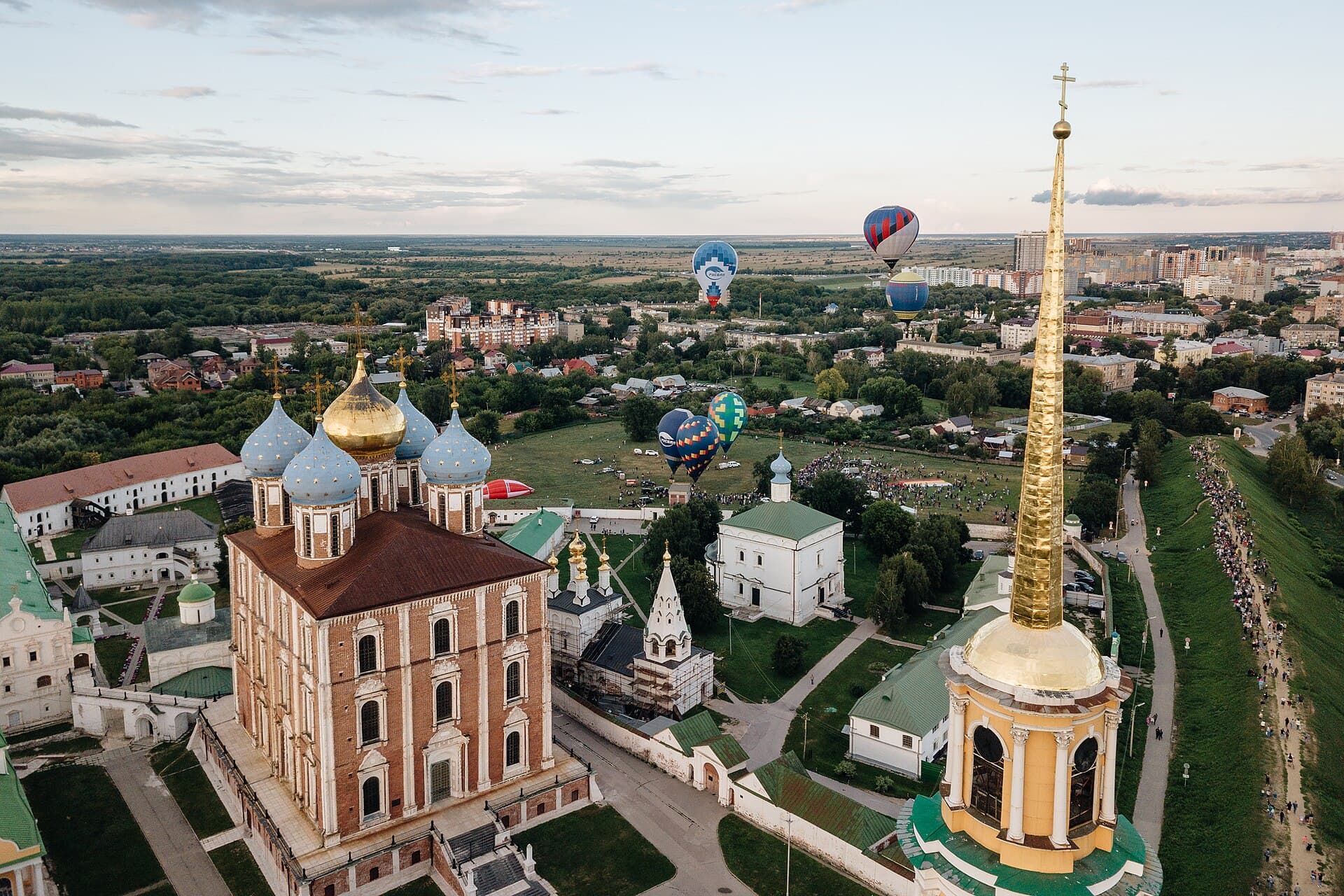
Commence your exploration at the Ryazan Kremlin, the city's most significant architectural marvel. This open-air museum-reserve showcases the striking late 17th-century Dormition Cathedral, admired for its Baroque design and white stone carvings, and the Nativity of Christ Cathedral, among the oldest stone constructions in the area. The Palace of Oleg, a grand civil edifice built over the 17th-19th centuries, also stands within the Kremlin grounds. Ascend the ancient earthen rampart for sweeping views of the Kremlin, its bell tower, and the Trubezh River.
Walk along Lybedsky Boulevard, a pedestrian green corridor that once followed the course of the Lybed River. Here, you will encounter sculptural compositions, including an equestrian monument to Yevpaty Kolovrat, a legendary defender of Ryazan. Nearby, Pochtovaya Street invites a pleasant stroll among historic 18th-century buildings and numerous eateries serving traditional Russian fare. Do not overlook the City Garden, another central pedestrian zone featuring garden sculptures, including the playful 'In Ryazan, Mushrooms Have Eyes' artwork.
For a deeper understanding of local history, visit the I. P. Pavlov Museum-Estate, the childhood home of the Nobel laureate Ivan Pavlov. This preserved 19th-century noble estate offers insights into his life and scientific endeavors. Consider a journey to Konstantinovo, approximately 40 km from Ryazan, the birthplace of the renowned poet Sergei Yesenin, offering scenic vistas of the Oka River. The Airborne Forces History Museum stands as a singular attraction, being the world's only museum dedicated to the history of these forces.
The most agreeable period to experience Ryazan's outdoor offerings spans from May through September, when temperatures are moderate, typically between 18°C and 26°C. During these months, the city is verdant, creating an ideal setting for relaxed walks and boat excursions on the Oka River. Summer, particularly from mid-June to late August, provides the most favorable conditions for general outdoor tourist pursuits, with temperatures peaking in late July. While some precipitation may occur, it generally remains mild. For those seeking a classic Russian winter tableau and indoor cultural discoveries, the cold and snowy winter months also provide a distinct experience.
Traveling to Ryazan from Moscow is straightforward, with high-speed suburban trains departing regularly from Moscow's Kazansky Railway Station, completing the journey in approximately 2 hours and 25 minutes. Alternatively, buses are available from several Moscow bus terminals, though travel time can extend to 3-4 hours depending on traffic. Within Ryazan, public transport options include buses and trolleybuses, and taxis are readily accessible.
While major credit cards are accepted in larger hotels and dining establishments, it is prudent to carry Russian Rubles (RUB) in cash, especially for smaller businesses and markets. ATMs are widely distributed throughout the city. Ryazan's climate is humid continental, characterized by warm summers and cold, snowy winters. Pack light attire for summer, but include long sleeves for cooler evenings. For winter visits, a substantial jacket, hat, gloves, and scarf are essential. Comfortable walking shoes are recommended year-round for exploring the city's attractions.