Aðalstræti 10
Reykjavík's oldest timber house holds a secret, linking it directly to the city's origins and a visionary leader.
Full story unlocks in the tour
 Olga Ernst / CC BY-SA 4.0, via Wikimedia Commons
“Where geothermal power shapes urban existence.”
Not the postcards. The stories even locals don't know — whispered in your ear, right where they happened.
Reykjavík's oldest timber house holds a secret, linking it directly to the city's origins and a visionary leader.
This distant lighthouse offers a remarkable winter spectacle, drawing both residents and visitors.
The city's efficient heating system has a compelling and unexpected origin, rooted in resourcefulness during a period of scarcity.
Discover every secret of Reykjavik
Every address, every reveal in full — in your ear, right where it happened.
You pick your stops. You walk. The voice reveals what the others miss.
No tours available yet. Check back soon — we're preparing them.
Reykjavík, the world's northernmost capital of a sovereign state, rests at 64°08′ N on the southern shore of Faxaflói bay in southwest Iceland. Despite its modest size, with a population of around 140,000, the city serves as a center of cultural, economic, and governmental activity, embodying a singular fusion of natural wonder and urban life.
The city's name, meaning 'Smoky Bay' in Old Norse, was inspired by the steam rising from its abundant hot springs, a testament to the geothermal activity that defines much of Iceland. Reykjavík is recognized for being one of the cleanest, safest, and most environmentally conscious cities globally. It provides an excellent starting point for exploring Iceland's dramatic landscapes, from spouting geysers and falling waterfalls to volcanic beaches and geothermal spas.
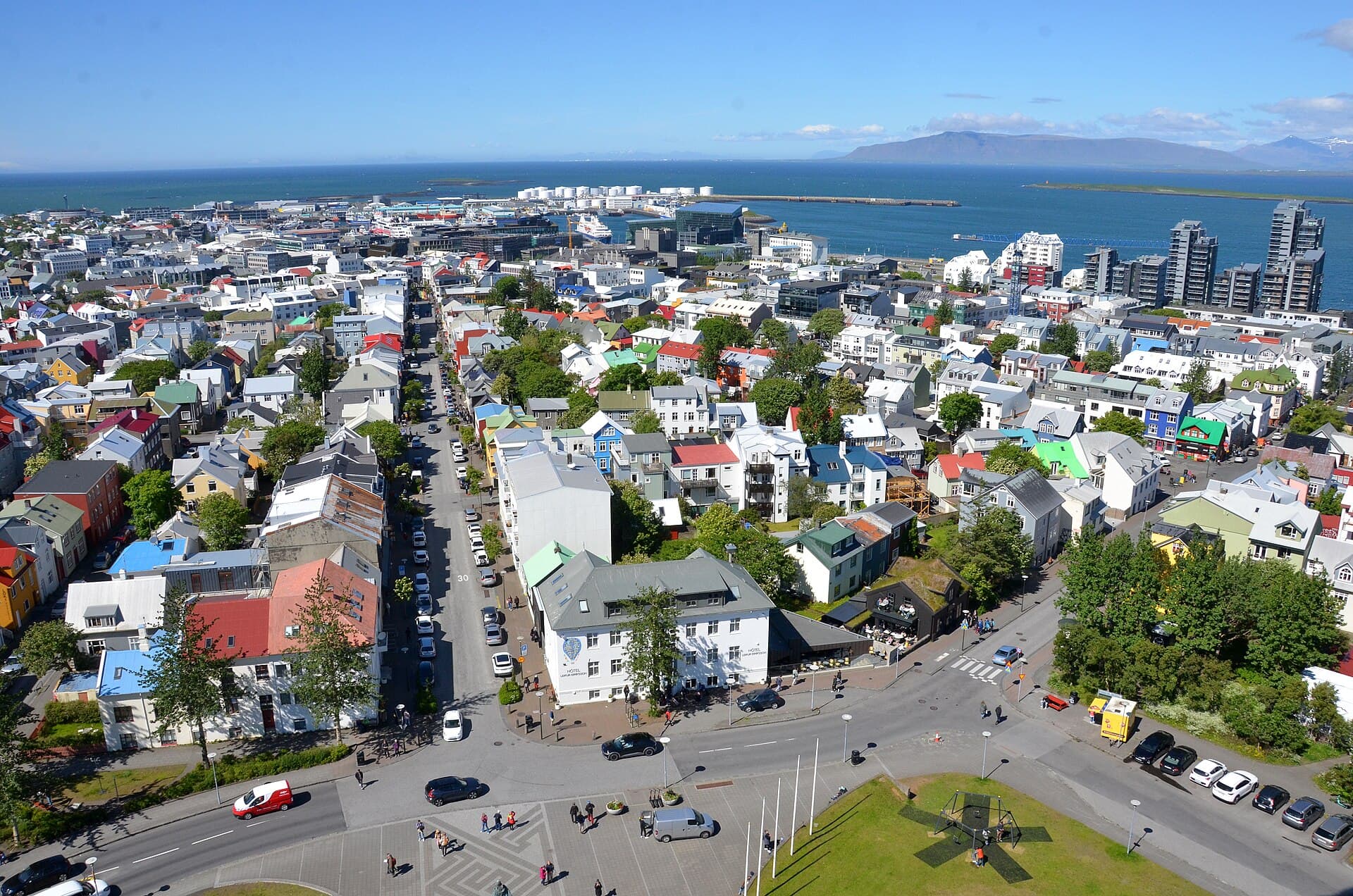
Reykjavík's urban area is characterized by low-density suburbs and widely spaced houses, with colorful buildings ascending along its peninsula. The city presents a dynamic cultural and design scene, with diverse dining, active nightlife, and a flourishing music community, making it an engaging destination throughout the year.
Reykjavík's narrative begins around 870 AD, when Ingólfr Arnarson, a Norseman, established Iceland's first permanent settlement. According to lore, Ingólfr selected the location by casting his high seat pillars overboard, vowing to settle where the gods brought them ashore. His slaves eventually found them in the bay, which he named Reykjavík, or 'Smoky Bay,' due to the steam from the geothermal springs.
For over 900 years, Reykjavík remained little more than farmland. Urban development commenced in the 18th century, largely driven by Danish entrepreneur Skúli Magnússon. In the 1750s, Magnússon established wool workshops and other industries, aiming to stimulate the Icelandic economy under Danish rule. This initiative led to the construction of several houses, making the wool industry Reykjavík's primary employer for decades. In 1786, the Danish Crown abolished its trade monopoly and granted Reykjavík a permanent trading charter, marking the city's official founding.
The 19th century witnessed a surge in Icelandic nationalist sentiments. In 1845, the Alþingi, Iceland's general assembly, was re-established in Reykjavík after being suspended decades earlier. This relocation effectively established Reykjavík as Iceland's capital. By 1874, Iceland received a constitution, granting the Alþingi limited legislative powers. In 1918, Iceland became a sovereign kingdom in personal union with Denmark, with Reykjavík as its capital.
World War II brought significant transformations. Following the German occupation of Denmark and Norway in 1940, British and then US forces occupied Iceland to secure transatlantic sea routes. This influx of foreign soldiers and money boosted Reykjavík's economy and accelerated its expansion. On June 17, 1944, Iceland declared full independence, solidifying Reykjavík's status as the capital of the new republic. The post-war years brought swift economic progress, transforming Reykjavík into the modern city it is today. Since the 1980s, the city and its suburbs have grown to house about two-thirds of Iceland's total population.
Reykjavík, a city where urban appeal meets dramatic natural backdrops, presents a variety of sights. The distinctive Hallgrímskirkja church, with its unique architecture, rises on a hill downtown and offers expansive city views from its observation deck. Before the church stands a statue of Leif Erikson, the Icelandic Viking credited with discovering America.
Along the waterfront, the Harpa Concert Hall and Conference Centre is a modern architectural creation, its glass panels mirroring the city's beauty. Nearby, the Sun Voyager sculpture, a striking steel artwork, symbolizes adventure and provides scenic views of Mount Esja and the bay. For a different perspective, Perlan, located on Öskjuhlíð Hill, combines science and nature with an observation deck and exhibits like an artificial ice cave.
The city's heart beats along Laugavegur, Bankastræti, and Austurstræti streets, an active area for shopping, dining, and evening entertainment. You can also explore the Old Harbour, lined with colorful seafood restaurants and cafes, where many whale and puffin watching excursions begin. For a touch of calm, Tjörnin pond in central Reykjavík is a tranquil spot to observe various bird species.
Beyond the city center, consider a visit to the Blue Lagoon or Sky Lagoon for a geothermal spa experience. Many day excursions also depart from Reykjavík to explore the Golden Circle, which includes Þingvellir National Park, Gullfoss waterfall, and the Strokkur geyser.
Reykjavík welcomes visitors throughout the year, with the ideal time depending on your interests. Summer (June to August) offers the mildest weather and continuous daylight due to the midnight sun, making it perfect for hiking, road trips, and puffin sightings. However, this is also the busiest tourist season, so anticipate larger crowds and higher prices.
For those seeking the Northern Lights, winter (September to March) provides the darkest skies, with the best chances of sightings between November and February. Winter also offers opportunities for ice cave exploration and a magical, snow-covered landscape, though daylight hours are significantly shorter. The shoulder seasons of May and September offer a balance of fewer crowds, milder temperatures, and occasional good weather, with September bringing the possibility of early Northern Lights.
Most international visitors arrive at Keflavík International Airport (KEF), located about 50 kilometers from Reykjavík. The most economical way to reach the city center is via Flybus or Airport Direct shuttles, as taxis are expensive. Reykjavík is a compact and walkable city, with many main attractions within a 20-minute walk of each other. Public buses (Strætó) are available, and the Reykjavík City Card offers free admission to several museums, public buses, and local pools, along with discounts.
Iceland's weather is famously unpredictable, often changing rapidly, so dressing in layers and packing waterproof gear is essential, regardless of the season. Umbrellas are rarely used due to the wind, making a raincoat a better choice. Reykjavík is considered one of the safest cities in the world, with minimal crime. Tipping is not required as service and VAT are included in prices, but it is welcomed as a compliment. For dining, booking a table at popular restaurants is advisable, especially on weekends and during summer.