Palais du Parlement de Bretagne
The grand Parliament building in Rennes safeguards a secluded chamber, rarely glimpsed.
Full story unlocks in the tour
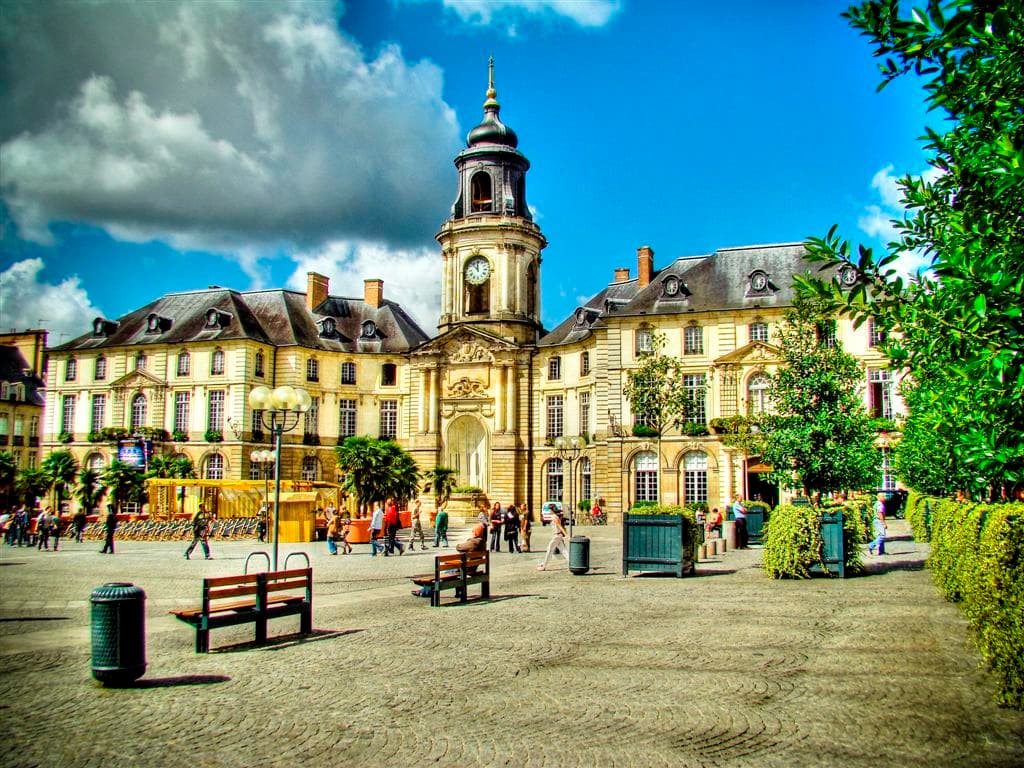 Unknown author / CC BY-SA 3.0, via Wikimedia Commons
“Rennes: Where ancient timber frames meet the pulse of modern Breton life.”
Not the postcards. The stories even locals don't know — whispered in your ear, right where they happened.
The grand Parliament building in Rennes safeguards a secluded chamber, rarely glimpsed.
A particular street in Rennes carries a rather parched moniker.
One unassuming bakery in Rennes has been perfecting its craft for centuries.
Discover every secret of Rennes
Every address, every reveal in full — in your ear, right where it happened.
You pick your stops. You walk. The voice reveals what the others miss.
No tours available yet. Check back soon — we're preparing them.
Rennes, the capital of Brittany, is a city where over 2,000 years of existence are etched into its very fabric, yet it pulses with a youthful, dynamic energy. Situated at the confluence of the Ille and Vilaine rivers, this northwestern French city offers a captivating blend of medieval character and modern ingenuity. It's a place where winding lanes pass hundreds of colorful half-timbered houses, creating an almost storybook atmosphere, while contemporary art installations and a thriving digital industry point to its forward-looking spirit.
Often cited as one of France's most livable cities, Rennes is also a significant university town, with a substantial student population contributing to its lively cultural scene and active nightlife. From bustling markets overflowing with local produce to serene gardens and a profound gastronomic tradition, Rennes invites exploration. It's a city that proudly embraces its Breton identity, offering visitors an authentic glimpse into the heart of this singular French region.
Rennes' story begins over two millennia ago as "Condate," a small Gallic village established by the Celtic tribe of the Redones in the 2nd century BC. Its strategic location at the confluence of the Ille and Vilaine rivers was crucial to its early development. Under Roman rule, it became known as Condate Riedonum and served as an important administrative and communication center in the province of Armorica.
Throughout the Middle Ages, Rennes grew in significance, competing with Nantes and Vannes to be a major city of the Duchy of Brittany. After Brittany's annexation to France in 1532, Rennes became the seat of the regional Parliament, solidifying its administrative influence. The magnificent Palais du Parlement de Bretagne, constructed between 1618 and 1655, stands as a testament to this era.
A pivotal moment in Rennes' existence was the devastating fire of December 1720. Starting in a carpenter's workshop, the blaze raged for six days, destroying nearly 900 timber-framed houses and 40% of the city center. Miraculously, the stone Parliament building was spared. The subsequent reconstruction, led by royal architect Jacques Gabriel, transformed much of the medieval core into a more classical urban landscape with wide, straight streets and harmonious stone facades. This period saw the creation of iconic structures like the Rennes City Hall and the Opera House, carefully designed to complement each other across Place de la Mairie.
While largely rural until World War II, Rennes experienced significant growth in the 20th century. Post-1950s, it developed into a modern industrial hub, particularly in the automotive and later, high-tech sectors. The city became a significant digital innovation center, even being the smallest city in the world to operate a metro system from 2002 to 2008. Today, Rennes continues to evolve, balancing its preserved medieval and classical heritage with a dynamic and contemporary identity.
Begin your exploration in the historic center, where over 280 colorful half-timbered houses from the 15th to 17th centuries line narrow lanes such as Rue Saint-Michel, Rue du Chapitre, and Place du Champ-Jacquet. These leaning facades offer a glimpse into Rennes' medieval past. The Palais du Parlement de Bretagne is a monumental 17th-century building that now houses the Court of Appeal; guided tours are available. Nearby, the Rennes City Hall and the Opéra de Rennes create a striking architectural ensemble on Place de la Mairie.
Do not miss the Portes Mordelaises, a 15th-century city gate that was once the primary entrance to the town. For a breath of fresh air, wander through Parc du Thabor, a sprawling 10-hectare green space featuring French and English gardens, a rose garden with over 2,000 varieties, and an aviary. The Marché des Lices, held every Saturday morning, is one of France's largest markets and a lively place to experience local life and taste Breton specialties. For cultural immersion, Les Champs Libres houses the Museum of Brittany, a science center, and a library.
The best time to visit Rennes for warm-weather activities is from mid-June to mid-September, when temperatures are comfortable and skies are clearer. July and August are generally the warmest months. Spring and early autumn offer a good balance of active streets, pleasant weather, and fewer crowds, making them ideal for cultural exploration and nightlife without peak season disorganization. While rain can occur at any time of year, August typically sees the lowest precipitation.
Rennes is well-connected and easy to navigate. High-speed TGV trains link Rennes to Paris in approximately 1.5 hours. The city center is compact and best explored on foot, especially the medieval quarter with its narrow streets. Rennes also has a metro system, which efficiently connects different parts of the city. Public transportation, including buses and the metro (STAR network), allows for easy movement, and self-service bicycles are available for hire. If you're driving, consider using park-and-ride facilities. For a convenient start to your visit, the Rennes Tourist Office is located in the former Saint-Yves chapel. The city offers a range of accommodation options, including hotels in the center at reasonable rates. If you need to store luggage, Les Champs Libres cultural center, near the train station, offers free lockers.