King Henry I chose Reading Abbey as his final resting place, a grand gesture for one of medieval England's most influential monasteries. But his burial was not as straightforward as one might assume.
Smuconlaw. / CC BY-SA 4.0, via Wikimedia CommonsReading
“Where ancient ruins meet modern rhythms, Reading holds more stories than its tranquil rivers let on.”
Reading, as no one tells it.
Not the postcards. The stories even locals don't know — whispered in your ear, right where they happened.
The imposing Victorian walls of Reading Gaol once held a literary giant, whose time within its confines inspired one of his most poignant works.
For a century, Reading was synonymous with a beloved everyday item, a global brand that even supplied royalty.
Discover every secret of Reading
Every address, every reveal in full — in your ear, right where it happened.
You pick your stops. You walk. The voice reveals what the others miss.
How long do you have in Reading?
No tours available yet. Check back soon — we're preparing them.
The story of Reading
Reading, a lively town in Berkshire, England, offers a compelling blend of historical depth and contemporary energy. Situated at the confluence of the River Thames and River Kennet, it has been a significant settlement since the 8th century. While often overshadowed by its larger neighbours like London and Oxford, Reading provides a unique and rewarding experience for visitors, seamlessly merging ancient structures with modern architecture.
Today, Reading is a major commercial hub, particularly for information technology and insurance, and a regional retail centre with extensive shopping options like The Oracle and Broad Street Mall. It is also home to the University of Reading and hosts the renowned Reading Festival, one of England's largest music events. Despite its size and population, Reading remains a town, not a city, as it lacks a cathedral—a historical requirement for city status in the UK.
The town's riverside setting on the Thames and Kennet offers opportunities for tranquil walks and boat trips, providing a peaceful contrast to the bustling town centre. Reading's appeal lies in its ability to cater to diverse interests, from history enthusiasts and festival-goers to shoppers and food lovers, making it an appealing destination for a day trip or a longer stay.
## From Saxon Settlement to Medieval Powerhouse Reading's origins trace back to the 8th century, with the earliest written record appearing in 870 AD when an army of Danes invaded Wessex and set up camp there. In 871, King Ethelred and Alfred the Great unsuccessfully attempted to breach the Danish defenses in the first Battle of Reading. The town's name, 'Readingas,' is believed to derive from an Anglo-Saxon tribe, meaning 'Reada's people.'
Reading's prominence grew significantly in the Middle Ages, largely due to Reading Abbey, founded in 1121 by King Henry I. This Benedictine monastery became one of the largest and wealthiest in medieval England, serving as a major pilgrimage destination and holding royal connections. The abbey's influence was so profound that it shaped the town's layout and economy, even dictating the establishment of a new weekly market. By 1525, Reading was the largest town in Berkshire and the tenth wealthiest in England.
## Civil War and Industrial Transformation The English Civil War in the 17th century severely impacted Reading. Royalist forces occupied the town in 1642, using the abbey ruins for fortifications. A subsequent siege by Parliamentary forces in 1643 led to its capture, damaging the town's cloth trade and economy. However, Reading played a pivotal role in the Glorious Revolution of 1688, hosting its only significant military action.
The 18th century saw the rise of a major ironworks and the growth of the brewing trade. The 19th century marked Reading's rapid expansion as a manufacturing centre, famously known for its 'Three Bs': beer (Simonds Brewery), bulbs (Suttons Seeds), and biscuits (Huntley & Palmers). Huntley & Palmers, in particular, became a global brand, making Reading the world's largest biscuit manufacturer by 1900.
## Modern Reading: A Hub of Innovation and Culture The arrival of the Great Western Railway in 1841 further solidified Reading's position as a key transport hub. While traditional manufacturing declined in the 20th century, Reading reinvented itself. Today, it is recognized as a major commercial centre, often referred to as the "Silicon Valley of the Thames" due to its concentration of technology and insurance companies. The town continues to evolve, blending its enduring past with a forward-looking identity, hosting international music festivals and fostering a thriving arts and culture scene.
Begin your exploration at the Reading Abbey Quarter, where the impressive ruins of Reading Abbey, founded by King Henry I, stand as a testament to the town's medieval significance. Adjacent to the ruins are the serene Forbury Gardens, a Victorian park featuring the striking Maiwand Lion monument. You can also see the Abbey Gateway, which once housed the Reading Ladies Boarding School, attended by a young Jane Austen.
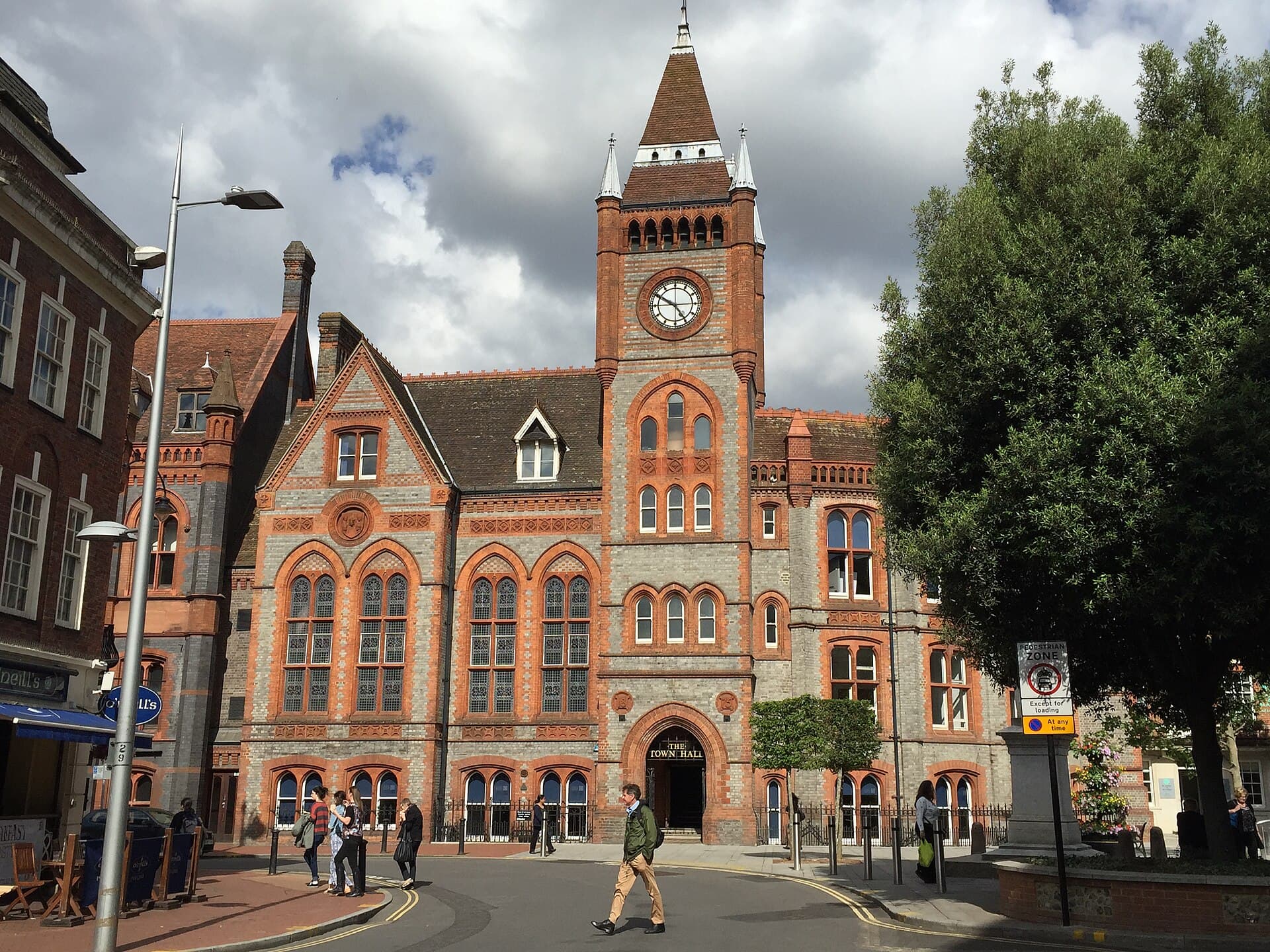
Delve deeper into Reading's past at the Reading Museum, housed within the eclectic Reading Town Hall. Here, you'll find a full-size replica of the Bayeux Tapestry and exhibits detailing the town's 'Three Bs' industries, particularly the legacy of Huntley & Palmers biscuits. For a different perspective, consider a leisurely boat trip along the River Thames or the Kennet & Avon Canal, offering scenic views and a chance to relax by the water.
Architectural enthusiasts will appreciate the well-preserved Victorian architecture throughout the town, with works by notable architects like Alfred Waterhouse. The Oracle Shopping Centre provides a modern retail experience, while the pedestrianized Broad Street offers a mix of high-street and independent shops. For those interested in local history, the Minster Church of St. Mary the Virgin, Reading's oldest religious building, and the 12th-century St. Laurence Church are also worth a visit.
Reading is an enjoyable destination throughout the year, but the period from late spring to early autumn (May to September) offers the mildest weather and is ideal for outdoor activities. July and August are the warmest months, with average daytime temperatures ranging from 20°C to 22°C (68°F to 72°F), perfect for riverside walks and exploring the Abbey Ruins. This period also coincides with the famous Reading Festival in August, which draws large crowds. If you prefer fewer crowds and cooler, yet pleasant, weather, May and September are excellent choices, often featuring various local festivals. Rainfall is distributed fairly evenly throughout the year, so it's always wise to be prepared for light showers.
Reading is exceptionally well-connected, making it easy to reach by various modes of transport. The town's main train station is centrally located, offering direct links to London (a journey of approximately 22 minutes) and serving as the western terminus of the Elizabeth Line. Local bus services, operated by Reading Buses, cover the entire region, providing a convenient way to navigate the town and its surroundings. Contactless payment is accepted on buses and for train travel between Reading and London Paddington.
For those arriving by car, Reading is situated on the M4 corridor, with three junctions serving the borough. Park and Ride services are available to help avoid city centre traffic and parking costs. London Heathrow Airport is just a 25-minute drive away, with express RailAir bus services also connecting directly to Reading. London Gatwick is also accessible by direct train. Taxis are readily available at Reading Station.
- What is Reading, UK, known for?
- Reading is known for its extensive past, including the medieval Reading Abbey, and its significant role during the English Civil War. It was historically famous for its 'Three Bs': beer, bulbs, and biscuits, particularly the global success of Huntley & Palmers. Today, it's a major commercial and technology hub, often called the "Silicon Valley of the Thames," and hosts the renowned Reading Festival.
- Is Reading, UK, worth visiting?
- Yes, Reading is worth visiting for its blend of historical places like the Abbey Ruins, its lively cultural scene, excellent shopping, and picturesque riverside locations. It offers a less tourist-heavy, yet authentic, UK experience with plenty to see and do.
- What can I do for free in Reading?
- You can explore the Reading Abbey Ruins and the Forbury Gardens, stroll along the Thames Path and Kennet & Avon Canal, and browse the Reading Museum (though some special exhibitions may have a fee). Many local festivals also offer free entry or activities.
- What is the best way to get around Reading?
- Reading has excellent public transport. The town centre is walkable, and Reading Buses provide extensive local services. The train station offers connections within the town and to nearby areas. Cycling is also a viable option.
- What is the climate like in Reading?
- Reading has a temperate maritime climate with moderate temperatures year-round. Summers (June-August) are generally warm and pleasant, with average highs around 20-22°C (68-72°F). Winters (December-February) are mild and cool, with temperatures rarely dropping significantly below freezing. Rainfall is distributed fairly evenly throughout the year.
- What famous people are associated with Reading?
- Reading has connections to several famous individuals. King Henry I is buried at Reading Abbey. Oscar Wilde was imprisoned at Reading Gaol. Novelist Jane Austen attended school at the Abbey Gateway. More recently, Kate Middleton, the Duchess of Cambridge, was born in Reading, and actor Ricky Gervais is also from the town.