Villa Rufolo
Richard Wagner found inspiration here for a famous opera.
Full story unlocks in the tour
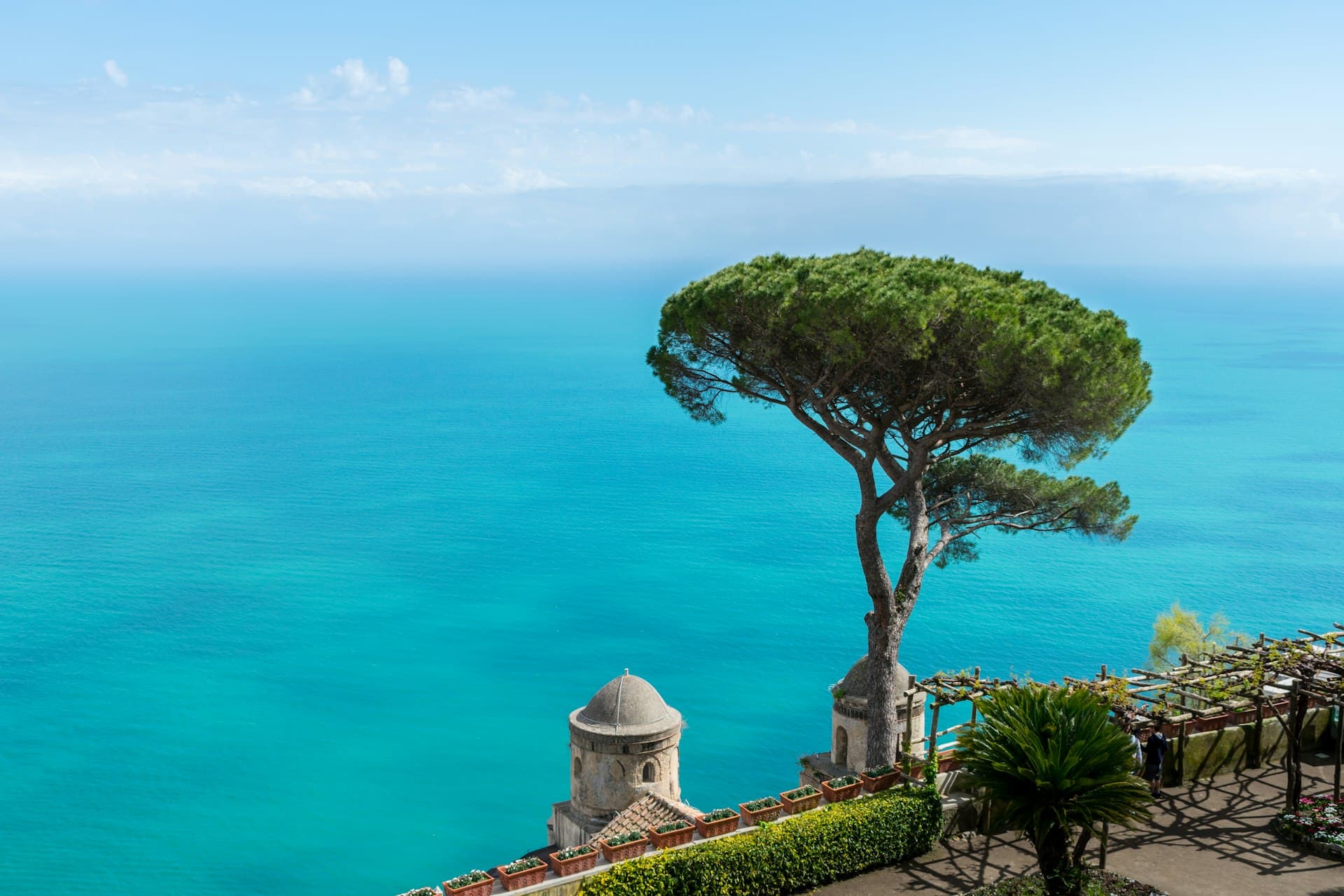 Photo: Kevin McMahon / Unsplash
“Where the sky meets the gardens, and music fills the air.”
Not the postcards. The stories even locals don't know — whispered in your ear, right where they happened.
Richard Wagner found inspiration here for a famous opera.
The cathedral's bronze doors tell a story beyond their biblical scenes.
A legend of buried treasure led to a dark discovery within its walls.
Discover every secret of Ravello
Every address, every reveal in full — in your ear, right where it happened.
You pick your stops. You walk. The voice reveals what the others miss.
No tours available yet. Check back soon — we're preparing them.
Ravello rests high above the Amalfi Coast, offering wide views of the Tyrrhenian Sea from its elevation of approximately 350-365 meters (1,150-1,200 feet) above sea level. Unlike some of the busier coastal towns like Positano or Amalfi, Ravello is known for its quiet atmosphere, historic villas, and lush gardens. It has long been a sanctuary for artists, writers, and musicians seeking inspiration from its dramatic scenery.
Often called the "City of Music," Ravello hosts the Ravello Festival, an international classical music event held annually in the gardens of Villa Rufolo. The town's pedestrian-only narrow lanes, bougainvillea, and ancient gardens contribute to its enchanting character. Ravello provides a quieter, more elegant experience for those visiting the Amalfi Coast.
## From Roman Refuge to Medieval Powerhouse Ravello's origins trace back to the 5th century AD, when it was founded as a sanctuary for Roman colonists seeking refuge from barbarian invasions that marked the decline of the Western Roman Empire. By the 9th century, Ravello had become an important town within the maritime Republic of Amalfi.
Around the year 1000, a group of aristocrats, fleeing the authority of Amalfi's ruler, settled in Ravello. Under their leadership, the town flourished, becoming a significant center for the production of a specific type of woolen cloth known as Celendra. During the 11th century, the inhabitants of Ravello, known as Ravellesi, sought independence from Amalfi. They fortified the town with walls and began constructing patrician villas, some of which still stand today. Ravello's growing importance was recognized when it was granted a bishopric, directly accountable to Rome, in 1086, a move by the Normans to counterbalance Amalfi's increasing power.
At its peak around 1086 and into the 12th century, Ravello's population reached approximately 25,000, a stark contrast to its current population of just over 2,500. This era saw the construction of many grand palazzi belonging to wealthy merchant families like the Rufolo, d'Aflitto, Confalone, and Della Marra. However, Ravello's prosperity began to wane after 1137, when the Duchy was destroyed by the Republic of Pisa, an attack that followed an earlier failed attempt two years prior. This led to a period of demographic and economic decline, with many residents relocating to Naples.
Despite these challenges, Ravello's cultural significance endured. It has historically attracted a diverse array of artists, writers, and musicians, including Giovanni Boccaccio, Richard Wagner, Edvard Grieg, M. C. Escher, Virginia Woolf, Greta Garbo, Gore Vidal, and Jacqueline Kennedy, all of whom found inspiration in its serene surroundings.
Begin your exploration in Piazza Duomo, Ravello's main square, which serves as a central hub. Here, you'll find the Duomo di Ravello, an 11th-century cathedral dedicated to San Pantaleone, notable for its bronze doors crafted in Constantinople in 1179 and its medieval Romanesque art inside. A small museum adjacent to the cathedral houses religious artifacts.
Adjacent to the Piazza Duomo is Villa Rufolo, a 13th-century estate with terraced gardens that inspired Richard Wagner. Explore its cloisters, gardens, and the Torre Maggiore, a 30-meter-high tower housing a museum on the town's history. The villa's terrace is also a popular spot for an evening aperitivo. Further uphill, approximately a 15-minute walk from the main square, lies Villa Cimbrone. While the villa itself is a luxury hotel, its expansive gardens are open to the public. The highlight is the Terrace of Infinity, a clifftop overlook lined with marble busts offering expansive views of the coastline. Consider visiting Villa Cimbrone early in the morning for fewer crowds.
For a different perspective, walk down to Minori from Ravello, a path that takes about 30 to 40 minutes and passes through terraced lemon groves and small hamlets. Ravello is also known for its handcrafted ceramics, often painted in Mediterranean colors.
The ideal times to visit Ravello are from April to June and then from September to October. During these shoulder seasons, the weather is comfortably warm, rainfall is low, and the gardens are in full bloom, particularly in late April and May with wisteria and roses. Crowds are also more manageable compared to the peak summer months.
July and August are peak season, bringing warmer temperatures (27-30°C / 80-86°F) and the Ravello Festival in full swing. While Ravello handles crowds better than other coastal towns due to its elevated, pedestrian-only nature, expect it to be busy. Winter, from November to March, is quieter and cooler (12-13°C / 53-55°F), with some hotels and restaurants closed, offering a more solitary experience.
Ravello is situated about 350-365 meters (1,150-1,200 feet) above the Amalfi Coast. While it doesn't have direct beach access, its elevated position offers a peaceful escape from the busier coastal towns. Getting to Ravello typically involves reaching Amalfi first. From Amalfi, SITA buses run regularly, taking about 25 minutes to reach Ravello. Taxis are also an option. Driving to Ravello is possible, but be aware that roads are narrow and winding, and parking is very limited and expensive. Many hotels do not offer parking.
Ravello's historic center is compact and entirely walkable, though you'll encounter steps and uneven cobbles, so comfortable shoes are recommended. Consider staying at least one night to experience the town after day visitors depart, as it transforms into a more magical place. A visit of 2-3 days is ideal to explore the villas, enjoy dining, and perhaps walk down to Amalfi or Minori.