The former Jewish Cemetery
The gravestones here reveal a story that extends far beyond their original purpose.
Full story unlocks in the tour
 Witia / CC BY-SA 4.0, via Wikimedia Commons
“Beyond its industrial facade, Radom unfolds a narrative of royal decrees, defiant protests, and a persistent artistic spirit.”
Not the postcards. The stories even locals don't know — whispered in your ear, right where they happened.
The gravestones here reveal a story that extends far beyond their original purpose.
This ancient church has witnessed more than just parishioners move through its doors.
A singular act passed in Radom centuries ago fundamentally altered the balance of power in Poland.
Discover every secret of Radom
Every address, every reveal in full — in your ear, right where it happened.
You pick your stops. You walk. The voice reveals what the others miss.
No tours available yet. Check back soon — we're preparing them.
Radom, a city in east-central Poland, rests approximately 100 kilometers south of Warsaw, along the Mleczna River. It stands as the second-largest city in the Masovian Voivodeship and the sixteenth-largest in Poland by population. While sometimes perceived through an industrial lens, Radom presents a compelling fusion of historical depth and modern life, inviting travelers to explore its layered past and evolving present.
The city's strategic placement at the border of Lesser Poland and Masovia has shaped its identity, establishing it as a significant administrative and trade center throughout its existence. Today, Radom is perhaps most recognized internationally for the biennial Radom Air Show, a spectacular event that draws aviation enthusiasts from across Europe. Beyond the aerial displays, the city's cultural landscape includes institutions like the Jacek Malczewski Museum, dedicated to the celebrated symbolist painter born here, and the expansive Radom Village Museum, which displays traditional folk architecture.
Radom's narrative is one of resilience and transformation, from its early medieval origins to its involvement in significant political events and its post-war industrial expansion. It is a city where historical tenement houses and ancient churches stand alongside contemporary shopping centers, creating a distinctive atmosphere for discovery.
Radom's story begins in the 8th or 9th century as an early medieval settlement along the Mleczna River. By the latter half of the 10th century, it had grown into a fortified stronghold known as Piotrówka, complete with ramparts and a moat. Its advantageous position at the edge of a vast wilderness and near the borders of Lesser Poland and Mazovia quickly established it as an important administrative center in the early Kingdom of Poland.
The city thrived during the reign of the Jagiellonian dynasty in the 15th and 16th centuries, becoming a significant political center where the Polish Crown Council and the Sejm (parliament) frequently convened. Key historical moments include the ratification of the Pact of Vilnius and Radom in 1401, strengthening the union between Poland and Lithuania, and the adoption of the 'Nihil novi' act in 1505, which fundamentally limited the monarch's power and bolstered the nobility's influence. This period of prosperity, however, was abruptly halted by the Swedish invasion in 1655, which left Radom plundered and largely destroyed, its population drastically reduced.
In the aftermath of the Third Partition of Poland in 1795, Radom experienced a succession of foreign rule, falling under Austrian and then Russian control, though it maintained its role as a regional administrative center. The 19th century saw the city emerge as a leading center for photography in partitioned Poland, and infrastructure improvements like a sewage system in 1867 and a railway line in 1885 further spurred its development. Following Poland's regained independence after World War I, Radom became a vital part of the Central Industrial District, with the establishment of the State Arms Factory, which famously produced the Vis .35 pistol, unofficially known as the 'Radom.'
The city endured immense hardship during World War II under German occupation, witnessing public executions, mass arrests, and the establishment of the Radom Ghetto, where thousands of Jewish inhabitants perished. Despite this, Radom was a center of Polish resistance. More recently, Radom played a crucial role in Poland's modern history as a center of the June 1976 protests against price increases, an event many historians consider a catalyst for systemic change in the country.
Begin your exploration in Radom's Old Town (Stare Miasto), where remnants of its past as a royal city are apparent. Here, you will find the Church of St. John the Baptist, founded by King Casimir the Great, alongside the Town Hall and former burgher houses dating from the 16th and 17th centuries. Do not overlook the Gothic Monastery of Bernardines, one of the city's most cherished historical sights. For art enthusiasts, the Jacek Malczewski Museum, dedicated to the celebrated symbolist painter, offers an impressive collection of his works, as well as exhibits on archaeology and natural sciences. Another cultural highlight is the Mazovian Centre of Contemporary Art 'Elektrownia,' housed in a beautifully restored historic power station from 1901, providing a unique setting for modern art.
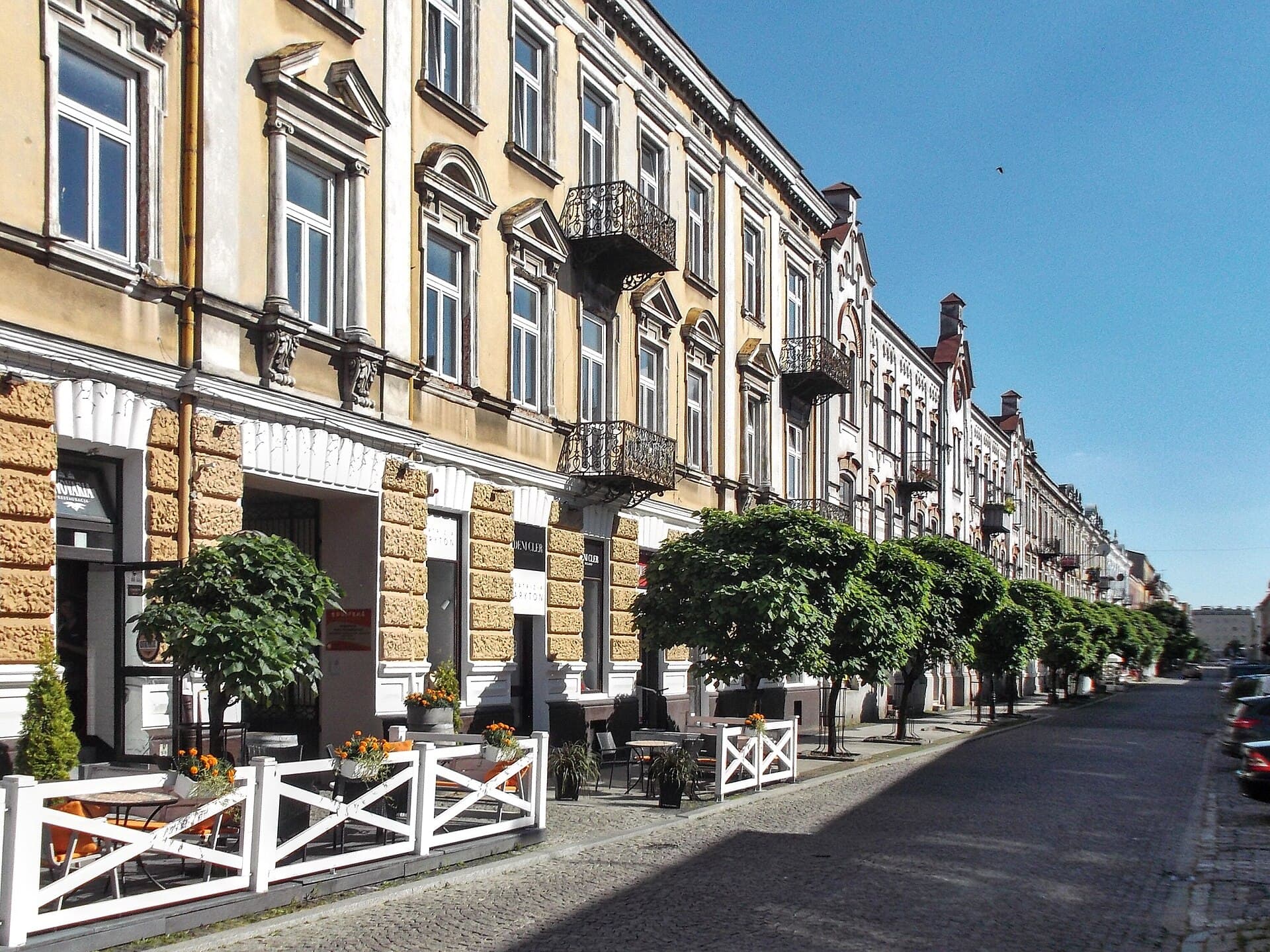
Step outside the city center to the Radom Village Museum (Muzeum Wsi Radomskiej), an open-air museum displaying traditional folk architecture and rural customs from the 18th and 19th centuries across 30 hectares. For a leisurely stroll, visit the Old Garden (Stary Ogród), one of Poland's oldest public parks, established in the early 19th century in the English landscape style. Alternatively, Planty Park offers a green promenade connecting different districts. The neo-Gothic Radom Cathedral, built between 1898 and 1918, is a prominent landmark with its impressive towers reaching approximately 72 meters. Finally, a walk along Stefana Żeromskiego Street, the city's main commercial thoroughfare, allows you to admire 19th-century tenement houses and palaces.
Radom experiences a temperate climate with four distinct seasons. The most popular time to visit for warm-weather activities is from mid-June to late August, when average temperatures range from 19°C to 20°C (66-68°F), with highs reaching around 25°C (77°F). While summer offers pleasant warmth, be prepared for occasional rain, with July and August typically seeing 12 to 14 wet days per month.
Spring (March to May) and autumn (September to November) offer milder conditions. May and September are particularly pleasant, with average temperatures around 13°C to 15°C (55-59°F). Winters (December to February) are cold, with average temperatures between 0.2°C and 1.6°C (32-35°F) and lows often dropping to -2.0°C (28°F), with snowfalls possible.
The official currency in Radom, and throughout Poland, is the Polish Złoty (PLN). While credit and debit cards (Visa, Mastercard) are widely accepted in hotels, restaurants, and larger shopping centers, it is advisable to carry some cash for smaller purchases at local markets or kiosks. ATMs are readily available across the city. Currency exchange offices, known as Kantors, are common, and you can also exchange money at banks or some hotel reception desks.
Radom is generally considered a secure destination for tourists. In case of emergencies, dial 112, the universal European emergency number. The official language is Polish. While English is spoken by younger generations and hospitality staff, it is less common among older residents. Public transportation in Radom is primarily served by a comprehensive bus network, connecting the city center with residential and suburban areas. Tickets can be purchased at kiosks or directly on the buses. For exploring the historic Old Town and main commercial street of Żeromskiego, walking offers the most immersive way to experience the city. Taxis and ride-sharing services are also available.