Kandarola Bay, Frkanj Peninsula
Before naturist beaches became widely accepted, a royal couple created a stir by embracing the 'free body culture' on Rab.
Full story unlocks in the tour
 Herbert Ortner / CC BY 4.0, via Wikimedia Commons
“Rab: Where ancient stone rises from the Adriatic and the sea air carries whispers of empires.”
Not the postcards. The stories even locals don't know — whispered in your ear, right where they happened.
Before naturist beaches became widely accepted, a royal couple created a stir by embracing the 'free body culture' on Rab.
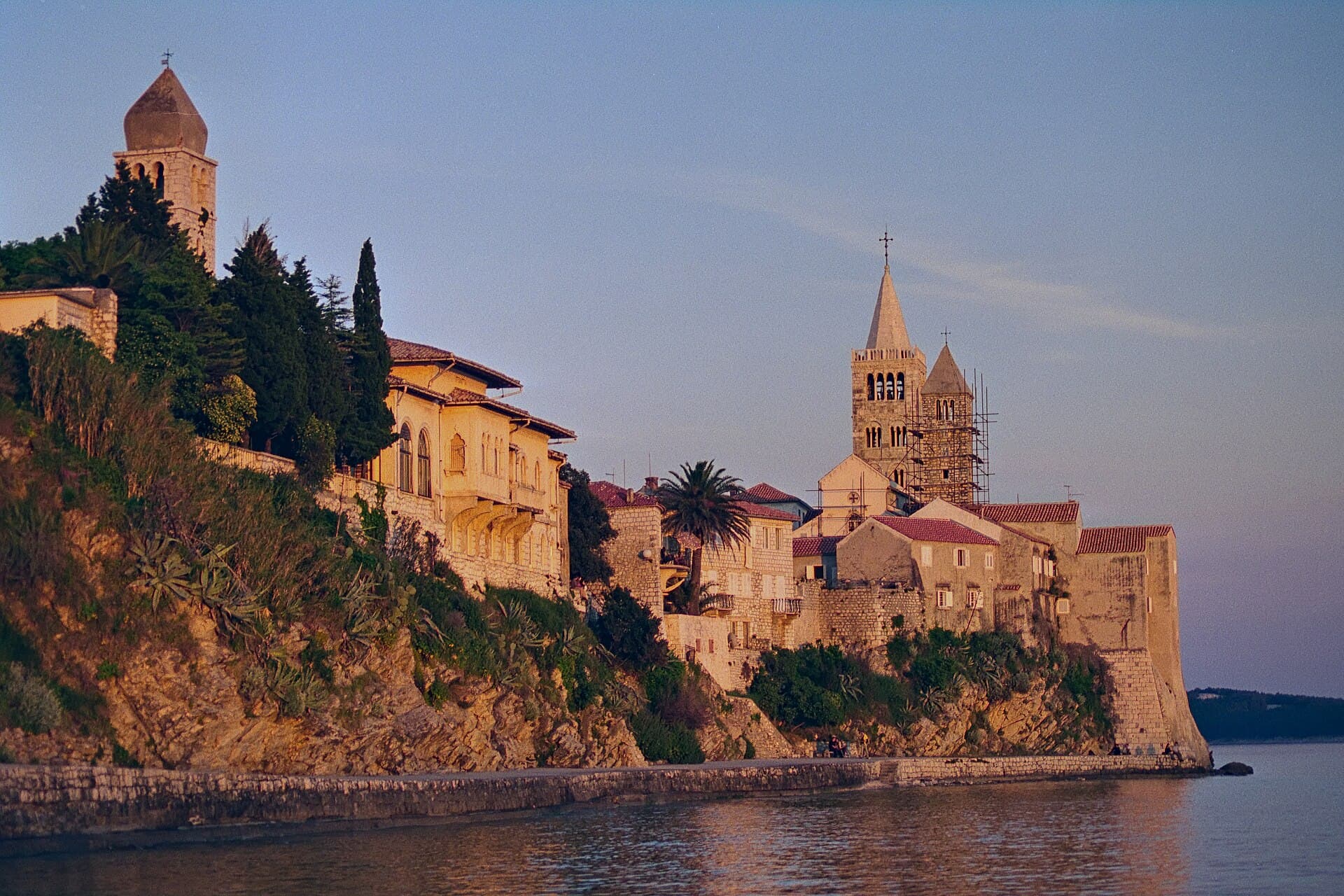
From a distance, Rab Town appears as a ship with four masts, yet these are not for sailing.
Among the religious artifacts in this museum, you will find a relic whose story credits it with saving the town from an ancient siege.
Discover every secret of Rab
Every address, every reveal in full — in your ear, right where it happened.
You pick your stops. You walk. The voice reveals what the others miss.
No tours available yet. Check back soon — we're preparing them.
Rab, an island in Croatia's Kvarner Gulf, presents a varied landscape, from the green pine forests and sandy stretches of its southwest to the rugged, wind-swept cliffs of its northeast. Known as the 'Happy Island' (derived from its Roman name, Felix Arba), Rab balances a lively tourist scene with tranquil natural escapes. Its main town, also called Rab, is a medieval wonder with a walled core and distinctive bell towers that etch a memorable skyline.
The island is a favored destination for those seeking a blend of history, outdoor activities, and relaxation by the sea. Whether exploring ancient streets, hiking through protected forests, or enjoying its many beaches, Rab provides a varied experience. It is an island that encourages a slower pace, inviting visitors to linger over local cuisine and absorb the Adriatic atmosphere.
Rab was declared a geopark in 2008, a testament to its singular natural diversity, which includes a mild climate shielded by the Kamenjak range from cold northeastern winds. This geological richness, combined with a history spanning millennia, makes Rab a compelling destination in the northern Adriatic.
The island of Rab’s history reaches back to around 360 BC, when it was first settled by prehistoric Illyrian tribes, who named it 'Arba,' meaning 'dark, green, and forested.' The Greeks likely followed, before the Romans took control, establishing Rab Town as a thriving Roman municipality in the 1st century BC. Emperor Octavian Augustus granted Rab independence, bestowing upon it the honorary epithet Felix, meaning 'happy' or 'lucky,' reflecting its flourishing, civilized status with amenities like running water, theaters, and temples.
Rab’s strategic location in the Adriatic meant it frequently changed hands over the centuries. It was a significant center during the Byzantine Empire until the 11th century. From the second half of the 11th century through the 13th century, Rab experienced a revival as a free Adriatic commune, alternating between Croatian kings and the Republic of Venice. Venetian rule, which began in 1420, lasted until 1797, leaving a lasting architectural legacy, particularly in Rab Town. During this period, Rab was an important military post due to its proximity to the Uskoks of Senj, Croatian Habsburg soldiers who often attacked the Kvarner islands.
Following the fall of Venice to Napoleon in 1797, Rab briefly came under French administration before falling to Austrian rule in 1815, remaining an Austrian crownland until 1918. After World War I, the island was occupied by Italy for two years before becoming part of the Kingdom of Yugoslavia in 1921. During World War II, Rab was again annexed by Italy, which established a concentration camp in Kampor, a site now commemorated with a memorial. After the war, it became part of the Croatian republic within the Yugoslav federation, and in 1991, Rab became part of the independent Republic of Croatia.
Rab’s historical narrative is also intertwined with notable figures. Saint Marinus, a stonemason who founded the micro-nation of San Marino, was born in Lopar on Rab more than 17 centuries ago. The island also played an unexpected role in the history of naturism, famously linked to King Edward VIII’s visit in 1936.
Rab Town, with its medieval core, is a primary attraction. Its three parallel main streets—Donja ulica, Srednja ulica, and Gornja ulica—are lined with historic houses and Baroque palaces. The town’s four Romanesque bell towers, particularly the 12th-century campanile of St. Mary’s Cathedral, are iconic and offer sweeping views from their summits. Explore the Cathedral of St. Mary the Blessed, the Monastery of St. Andrew, and the Church of St. Justine, which houses a museum of sacred art.
Komrčar Park, a Mediterranean garden adjacent to Rab Town, provides a shaded retreat with dramatic pines and winding paths. For coastal exploration, Rab offers over 30 beaches, including sandy stretches rare for Croatia. Paradise Beach (Rajska Plaža) in Lopar is a long, shallow sandy beach favored by families. Other notable beaches include Matovica and Suha Punta, and the naturist-friendly Kandarola and Sahara beaches. The Frkanj Peninsula is known for its quiet coves and clear turquoise waters, ideal for snorkeling.
For active pursuits, Rab provides numerous hiking and cycling trails, particularly on the Kalifront Peninsula through the Dundo Forest, one of the best-preserved holm oak forests in the Mediterranean. The Kamenjak Viewpoint, the island’s highest point at 408 meters, offers expansive vistas of Rab and the Adriatic. Boat trips are available to nearby islands like Goli Otok, a former prison island, and Sv. Grgur. Do not miss the Rapska Fjera, a medieval summer festival held in July, which transforms Rab Town into a lively display of historical crafts and performances.
Rab experiences a Mediterranean climate with warm summers and cool, mild winters. The most pleasant time to visit is during the intermediate seasons of late spring (May to early June) and early autumn (September to early October). During these months, temperatures are agreeable, crowds are thinner, and the sea is still warm enough for swimming and water activities. July and August are the hottest and busiest months, with average high temperatures reaching 29°C (84°F) and minimal rain, making them ideal for beach-focused holidays. While October and early November can also be favorable, some tourist establishments may begin to close.
Rab is accessible by car ferry from Stinica on the mainland to Misnjak on Rab, a 15-minute crossing. Another car ferry connects Valbiska on Krk Island to Lopar on Rab. For pedestrians and cyclists, a small boat runs from Tovarnele on Pag Island to Rab. While Rab Town is walkable, renting a car is recommended for exploring the island’s various towns and beaches. Public parking is available in Rab Town, though accommodation outside the old town often offers private parking.
Local buses operate across the island, providing a workable transport option. For a more independent experience, bikes and boats can be rented. The island has more sources of fresh water than any other Adriatic island. English and German are widely spoken, in addition to Croatian. Expect to pay around €13.50 for two sun loungers and an umbrella on popular beaches like Paradise Beach, with all-day parking costing approximately €7.00.