Pushkar Lake
The lake's serene surface holds a secret that challenges one of Hinduism's powerful deities.
Full story unlocks in the tour
 Bernard Gagnon / CC BY-SA 3.0, via Wikimedia Commons
“Where ancient legends meet desert whispers.”
Not the postcards. The stories even locals don't know — whispered in your ear, right where they happened.
The lake's serene surface holds a secret that challenges one of Hinduism's powerful deities.
Despite being a primary deity, Lord Brahma has surprisingly few temples dedicated to him.
Among the textiles and handicrafts, you might find an unexpected linguistic surprise.
Discover every secret of Pushkar
Every address, every reveal in full — in your ear, right where it happened.
You pick your stops. You walk. The voice reveals what the others miss.
No tours available yet. Check back soon — we're preparing them.
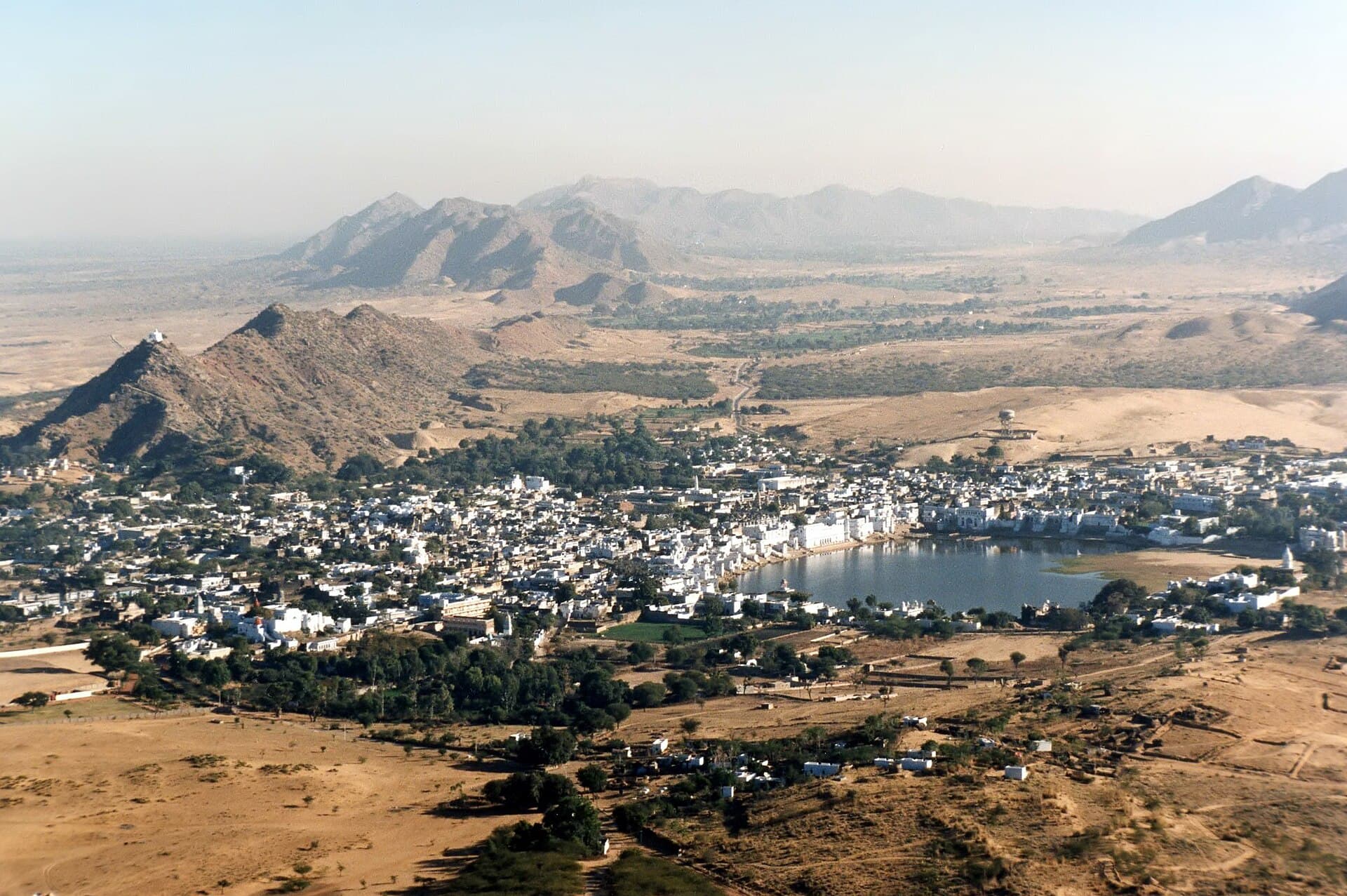
Pushkar, one of India's oldest cities, is a revered pilgrimage destination in Rajasthan. Situated northwest of Ajmer, this tranquil town is surrounded by hills on three sides, with the 'Nag Pahar' (Snake Mountain) forming a natural border. At its heart lies the sacred Pushkar Lake, believed to have formed when a lotus flower dropped from the hand of Lord Brahma, the creator.
Known as 'Tirtha Raj' or the 'king of all pilgrimage sites,' Pushkar is considered one of the five most sacred lakes in Hindu mythology, and a dip in its holy waters is believed to cleanse sins and lead to salvation. The town is home to hundreds of temples, including the prominent Brahma Temple, one of the few dedicated to Lord Brahma in the world. Beyond its spiritual significance, Pushkar transforms annually into a spectacle during the Pushkar Camel Fair, attracting traders, pilgrims, and tourists from across the globe.
## Ancient Origins and Mythological Roots Pushkar's history stretches back millennia, with microliths near Khera and Kaderi suggesting ancient human settlement. Artifacts found in the nearby Aravalli hills even bear resemblances to those from Mohenjodaro, hinting at deep historical connections. The town finds mention in ancient Hindu epics like the Ramayana, Mahabharata, and the Puranas, underscoring its long-standing religious importance.
At the core of Pushkar's identity is its mythological origin, deeply intertwined with Lord Brahma. Legend states that Brahma, in a battle with the demon Vajranabha who had slain his children, used a lotus flower to defeat him. Where three petals of this divine lotus fell, three lakes emerged, with Pushkar Lake being the most significant. The name "Pushkar" itself is derived from "Pushpa" (flower) and "Kar" (hand), symbolizing the flower from Brahma's hand. This divine act is said to have prompted Brahma to perform a yajna (sacred ritual) in Pushkar.
## Medieval Rebuilding and Enduring Faith While the original Brahma Temple is believed to be over 2,000 years old, many temples and ghats in Pushkar date from the 18th century and later. This is because numerous temples were destroyed during Muslim conquests in the region and subsequently rebuilt. For instance, the Varaha Temple, initially destroyed by Mughal emperor Jahangir, was later rebuilt by Maharaja Bakht Singh of Marwar. The Marathas also played a significant role in rebuilding several important temples.
Pushkar's fame continued to grow through the centuries, attracting royalty and devotees. During the British colonial era, the annual Pushkar Camel Fair, originally a livestock trading event, evolved into a major cultural spectacle. Today, Pushkar remains a blend of ancient traditions and a popular destination for both Indian and international visitors.
Pushkar Lake, a sacred body of water, is central to the town's spiritual life. It is surrounded by 52 bathing ghats, where pilgrims perform rituals. Taking a dip in the lake is considered highly auspicious, especially during Kartik Purnima. Remember to remove your shoes when walking around the lake.
The Brahma Temple, with its distinctive red spire and marble construction, is one of the few temples dedicated to Lord Brahma globally. Inside, you'll find a life-size statue of Brahma and silver coins embedded in the floor as offerings. Photography is prohibited inside the main temple complex.
For expansive views of Pushkar Lake and the surrounding landscape, hike to the Savitri Temple atop Ratnagiri hill. The ascent takes about an hour, or you can opt for a cable car ride. Other notable temples include the Varaha Temple, dedicated to an incarnation of Lord Vishnu, and the Rangji Temple.
Explore Pushkar's bustling bazaars, like Sadar Bazaar, for ethnic garments, traditional handicrafts, jewelry, and rose products. The town is also known for its rose cultivation, with its essence exported worldwide.
The best time to visit Pushkar is during the winter months, from October to March, when the weather is mild and pleasant. Temperatures range from 10 to 25 degrees Celsius, making it ideal for exploring. This period also coincides with the Pushkar Camel Fair, typically held in November, a major draw for tourists. Holi, the festival of colors, is celebrated in March and offers a memorable experience. Summers (March to June) are hot and dry, with temperatures reaching up to 42 degrees Celsius, while monsoons (July to September) bring greenery but also high humidity.
Pushkar is a small town, easily explored on foot. The nearest railway station is Ajmer, about 11 km away, and the closest airport is Jaipur International Airport, approximately 140-150 km distant. Buses, taxis, and Ubers are available from Ajmer to Pushkar.
As a sacred town, Pushkar is strictly vegetarian, and the consumption of meat, eggs, and alcohol is forbidden within a 2 km radius of the Brahma Temple. Dress modestly, especially when visiting temples and the lake, covering shoulders and knees. Be aware of touts around the lake offering puja services or asking for donations; it's best to politely decline and keep walking.