Cerro de los Siete Colores
The Hill of Seven Colors is a geological marvel, though its name might be a slight understatement.
Full story unlocks in the tour
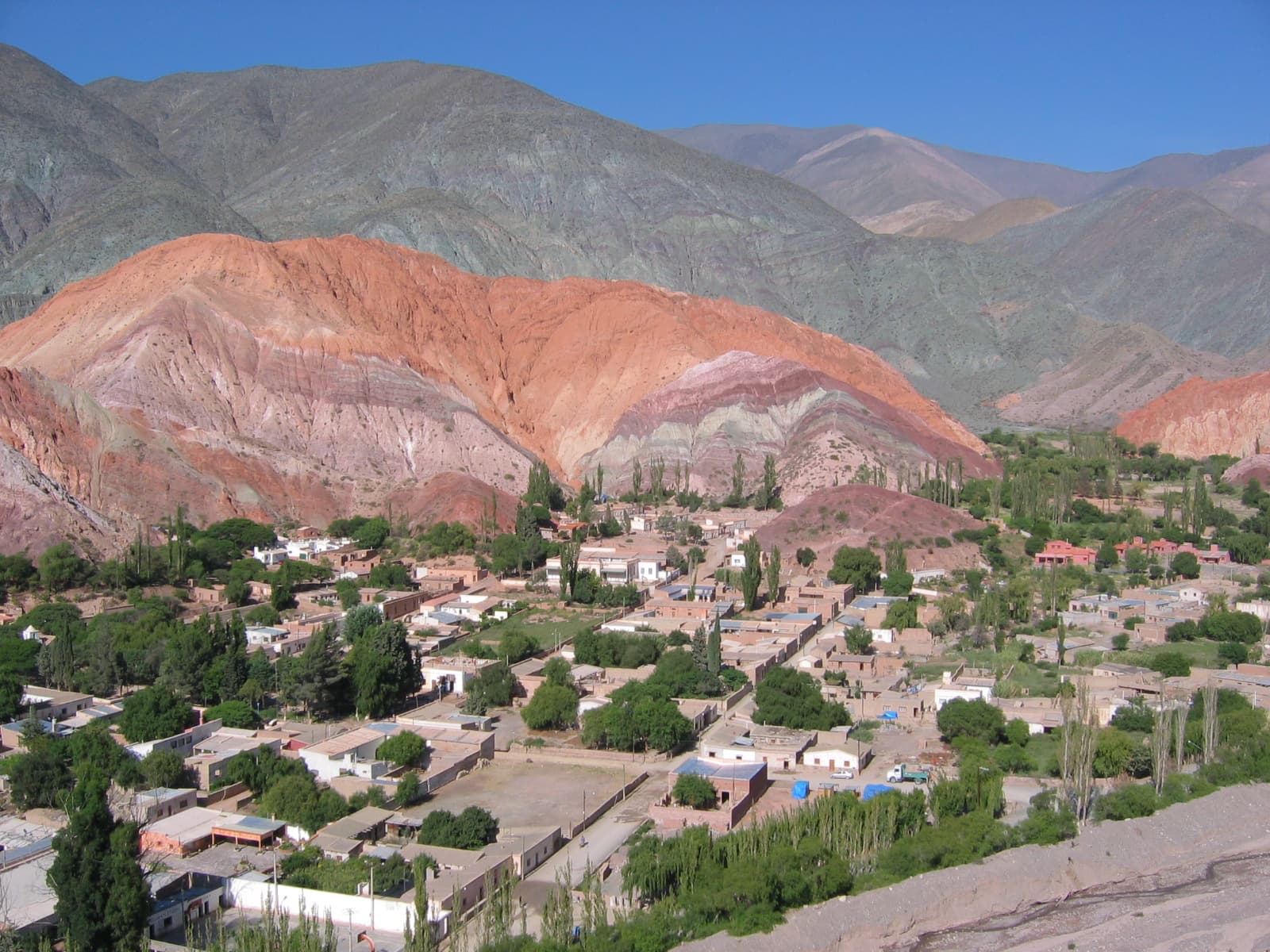 Augusto Sarita / CC BY-SA 3.0, via Wikimedia Commons
“Where ancient earth paints the sky in seven distinct hues.”
Not the postcards. The stories even locals don't know — whispered in your ear, right where they happened.
The Hill of Seven Colors is a geological marvel, though its name might be a slight understatement.
Beneath the sprawling branches of an ancient carob tree in Purmamarca, a significant historical event unfolded.
The central plaza of Purmamarca is a lively gathering place, yet it also carries a subtle message of protest.
Discover every secret of Purmamarca
Every address, every reveal in full — in your ear, right where it happened.
You pick your stops. You walk. The voice reveals what the others miss.
No tours available yet. Check back soon — we're preparing them.
Purmamarca, a name meaning "Town of the Virgin Land" in Aymara, is a village in Argentina's Jujuy province, known for its striking natural scenery and profound cultural legacy. It rests at an altitude of approximately 2,200 to 2,324 meters (7,200 to 7,625 feet) within the Quebrada de Humahuaca, a valley designated a UNESCO World Heritage Site. The village is most recognized for the Cerro de los Siete Colores, or Hill of Seven Colors, which provides a dramatic, multicolored backdrop that transforms with the light throughout the day.
The village itself is a compact collection of adobe houses with mud tiles and cardon (cactus wood) roofs, and unpaved, red-dirt roads. Life in Purmamarca often centers around its main plaza, Plaza 9 de Julio, where a lively artisan market offers regional handicrafts. This tranquil setting, combined with its pre-Hispanic origins and colonial influences, creates a unique atmosphere that draws visitors seeking a blend of natural splendor and cultural authenticity.
Purmamarca's history stretches back over 10,000 years, with archaeological evidence of early hunter-gatherer societies in the Quebrada de Humahuaca region. By 400–900 CE, these nomadic groups transitioned to settled agricultural communities, developing sophisticated stone-walled terraces and irrigation systems for crops like maize, potatoes, and coca. By the 15th century, the area, including Purmamarca, was integrated into the vast Inca Empire, serving as a vital trade and migration corridor connecting the Andean highlands with other regions.
The Spanish conquest in the 16th century brought significant changes. Encomiendas, systems of indigenous labor granted to Spanish settlers, were established in the Quebrada de Humahuaca by 1540. Despite fierce resistance during the Calchaquí Wars, which lasted over a century, the colonial system reshaped land ownership, labor, and religion. However, it did not erase the strong indigenous identity, with descendants of Aymara and Quechua groups still forming a significant portion of the local population today.
Purmamarca became a waypoint on colonial trade routes, and its Church of Santa Rosa de Lima, built in 1648 with adobe walls and a cardon cactus roof, stands as a testament to this era. This church was later declared a National Historic Monument in 1941. The village's economy, once primarily subsistence agriculture and traditional crafts, has shifted towards tourism, particularly after the Quebrada de Humahuaca was designated a UNESCO World Heritage Site in 2003.
The primary attraction in Purmamarca is the Cerro de los Siete Colores (Hill of Seven Colors), a geological formation that provides a spectacular, ever-changing backdrop to the village. The hill's vivid stratification is best observed in the morning light. A short, easy walk known as the Paseo de los Colorados loops behind the hill, offering expansive views of the multicolored rock formations and surrounding desert landscapes.
At the heart of the village is Plaza 9 de Julio, a lively square where local artisans sell textiles, pottery, musical instruments, and other handicrafts. Overlooking the plaza is the Church of Santa Rosa de Lima, a modest 17th-century colonial church with adobe walls and a distinctive roof made from giant cactus wood. Adjacent to the church stands El Algarrobo Histórico, an ancient carob tree with a wide canopy, a significant historical landmark.
Purmamarca also serves as a base for excursions to nearby attractions such as the Salinas Grandes, vast salt flats that offer a stark white contrast to the colorful mountains, and the Serranía de Hornocal, also known as the Hill of 14 Colors, which presents an even broader spectrum of hues.
The ideal times to visit Purmamarca are during spring (September to November) and autumn (March to May). During these seasons, temperatures are moderate, and there is less rain, making it perfect for outdoor activities and enjoying the landscapes. While summer (December to March) can be warm with heavier rainfall, the rains can enhance the colors of the hills. Winter (July to September) brings cooler temperatures, especially at night, so warm clothing is recommended.
Purmamarca is located about 65 kilometers (40 miles) from San Salvador de Jujuy, the provincial capital, and 188 kilometers from Salta. It is easily accessible via National Route 9. Buses run frequently between Purmamarca and nearby towns like Tilcara, as well as to San Salvador de Jujuy and Salta. For those driving, the Cuesta de Lipán offers a scenic route to the Salinas Grandes.
Accommodations in Purmamarca range from budget hostels to boutique hotels, many featuring rustic charm and views of the surrounding mountains. Booking in advance is advisable, especially during peak seasons. The town is at a high altitude, so it's wise to acclimatize slowly, stay hydrated, and avoid strenuous activities on your first day to prevent altitude sickness. Traditional Andean dishes like empanadas, tamales, humita, and locro are readily available.