Pskov Kremlin (Krom)
Beyond its formidable walls, a layer of history lies beneath your feet, hinting at a forgotten city.
Full story unlocks in the tour
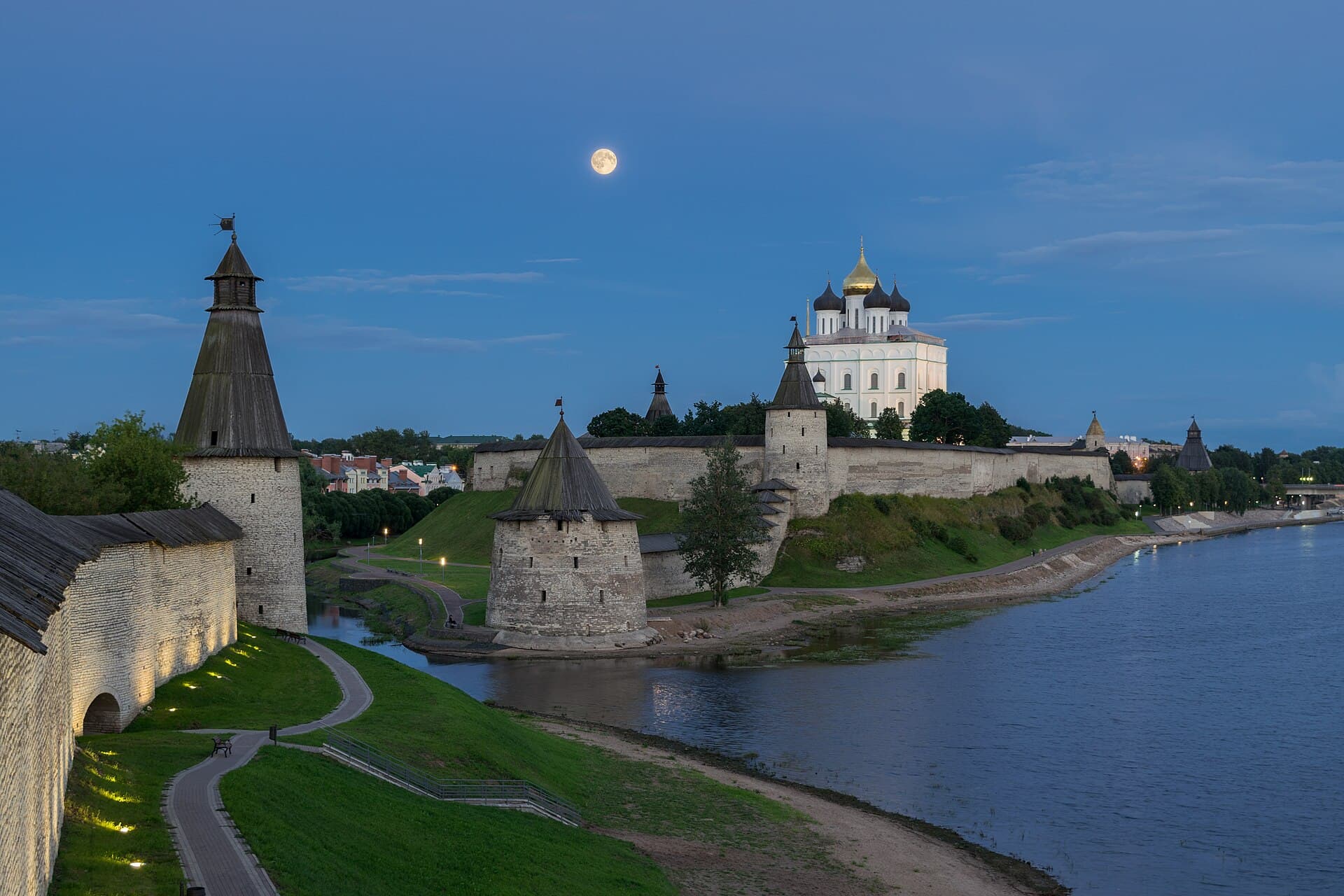 Олег Токарев / CC BY-SA 4.0, via Wikimedia Commons
“Where ancient walls echo tales of resilience and faith.”
Not the postcards. The stories even locals don't know — whispered in your ear, right where they happened.
Beyond its formidable walls, a layer of history lies beneath your feet, hinting at a forgotten city.
The frescoes within the Transfiguration Cathedral hold a secret in their very creation, a technique that was as much an art as a science.
This solitary tower on the Velikaya River isn't just a defensive structure; local lore suggests a different, more mystical purpose.
Discover every secret of Pskov
Every address, every reveal in full — in your ear, right where it happened.
You pick your stops. You walk. The voice reveals what the others miss.
No tours available yet. Check back soon — we're preparing them.
Pskov, a city in northwestern Russia, stands as a testament to centuries of often turbulent history. Positioned at the confluence of the Velikaya and Pskova Rivers, its strategic location made it a vital outpost on ancient trade routes and a frequent target for invaders. The city's most prominent feature, the Pskov Krom (Kremlin), with its imposing stone walls and onion-domed cathedrals, dominates the landscape, offering a window into its medieval past as an independent republic.
Beyond the fortified core, Pskov unfolds with a collection of ancient churches, monasteries, and defensive towers, each recounting a story of endurance, artistic achievement, and spiritual devotion. The city's architectural style, characterized by its distinct Pskovian school, features white-stone structures, often adorned with intricate decorative elements and bell towers. A visit to Pskov is an immersion into a living museum, where the echoes of princes, merchants, and monks still resonate within its age-old stones.
The origins of Pskov trace back to an ancient Slavic settlement, first mentioned in chronicles in 903 AD, making it one of Russia's oldest cities. Its strategic position at the crossroads of trade routes between Novgorod, the Baltic states, and Central Russia, coupled with its natural defenses provided by the rivers, contributed to its early growth and significance.
By the 13th century, Pskov had evolved into the independent Pskov Republic, a powerful entity that maintained a degree of autonomy even while nominally under the influence of the Novgorod Republic. During this period, the city developed an impressive system of fortifications, including the formidable Pskov Krom (Kremlin) and a series of defensive walls with numerous towers, designed to withstand frequent sieges. The city's military prowess was repeatedly tested, notably during the Livonian War in the 16th century, when Pskov successfully repelled a lengthy siege by the Polish-Lithuanian forces.
The Pskov Republic was also a significant center of Orthodox Christianity, and this spiritual devotion is reflected in its numerous churches and monasteries. The Pskovian school of architecture, characterized by its distinctive white-stone churches with elevated drums and helmet-shaped domes, flourished during this era. The Mirozhsky Monastery, with its remarkably preserved 12th-century frescoes, and the Transfiguration Cathedral within the Kremlin are prime examples of this unique architectural heritage.
The independence of Pskov ultimately waned, and it was absorbed into the Grand Duchy of Moscow in the early 16th century. Despite losing its autonomy, the city remained an important administrative and military center. The 20th century brought further challenges, including significant destruction during World War II. However, extensive restoration efforts have preserved much of Pskov's historical and architectural treasures, allowing visitors today to experience its enduring legacy.
Begin your exploration at the Pskov Kremlin (Krom), a sprawling fortress on a high promontory overlooking the Velikaya River. Inside, the magnificent Trinity Cathedral with its towering iconostasis is a focal point. Explore the Dovmontov City archaeological site, the remains of a medieval town now within the Kremlin walls.
Just outside the Kremlin, visit the Chambers of Pogankin, a 17th-century merchant house now housing a museum with Pskovian art and historical artifacts. Cross the Velikaya River to the Mirozhsky Monastery, celebrated for its remarkably preserved 12th-century frescoes in the Transfiguration Cathedral.
Walk along the ancient city walls, observing the various towers like Gremyachy Tower and Pokrovskaya Tower, offering expansive views and insights into Pskov's defensive might. Discover the charming Church of St. Basil on the Hill and the Church of St. Anastasia the Roman, examples of the unique Pskovian architectural style. For a tranquil escape, stroll through the Pskov State United Historical, Architectural and Art Museum-Reserve, which includes several historical buildings and exhibitions.
The ideal time to visit Pskov is during the late spring (May-June) or early autumn (September-early October). During these months, the weather is pleasantly mild, and the natural scenery along the rivers and around the historical sites is particularly appealing. Summers (July-August) are also good, though they can be warmer and more populated. Winters (November-April) are cold with significant snowfall, offering a different, quieter perspective, but some outdoor exploration may be challenging.
Pskov is accessible by train from Moscow and St. Petersburg, with the journey taking approximately 4-5 hours from St. Petersburg and 8-10 hours from Moscow. The city also has a small airport (PKV) with limited domestic flights. Once in Pskov, the city center and main attractions are walkable. Taxis and a local bus network are available for longer distances. The local currency is the Russian Ruble (RUB). Visa requirements for Russia vary by nationality, so it's essential to check current regulations well in advance of your trip. Russian is the official language, and while some English may be spoken in tourist-oriented establishments, having a translation app or basic Russian phrases will be beneficial.