Piazza Mercatale
This expansive medieval square holds a surprising secret about its distinctive shape.
Full story unlocks in the tour
 Massimilianogalardi / CC BY-SA 3.0, via Wikimedia Commons
“Beyond Florence's shadow, Prato weaves a story of industry, art, and unexpected allure.”
Not the postcards. The stories even locals don't know — whispered in your ear, right where they happened.
This expansive medieval square holds a surprising secret about its distinctive shape.
Prato's imposing 13th-century castle, the only Swabian-style fortress north of Sicily, offers a curious experience once you step inside.
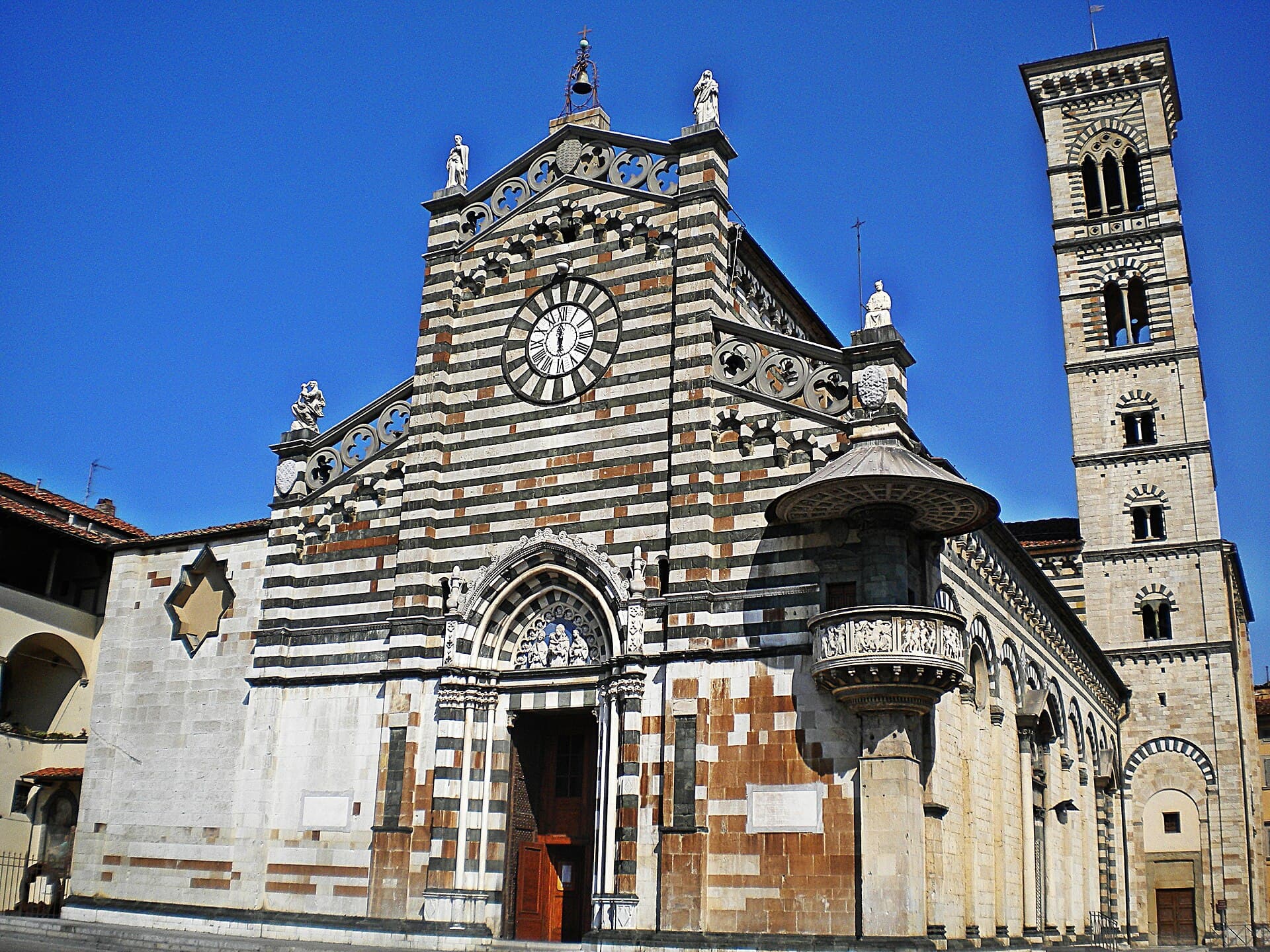
The cathedral houses a sacred relic, the 'Sacra Cintola' or Holy Belt of the Virgin Mary, displayed from an external pulpit with a unique artistic lineage.
Discover every secret of Prato
Every address, every reveal in full — in your ear, right where it happened.
You pick your stops. You walk. The voice reveals what the others miss.
No tours available yet. Check back soon — we're preparing them.
Prato, Italy, often existing in the shadow of its illustrious neighbor Florence, offers a distinctive Tuscan experience. This working city blends a profound medieval past with a creative pulse, making it an authentic destination for travelers seeking genuine Italian life without the crowds. Its historic core is a well-preserved collection of ancient allure, where narrow streets, historic piazzas, and architectural treasures await discovery.
Beyond its historical monuments, Prato is a city deeply intertwined with the textile industry, a tradition stretching back centuries. This industrial heritage has shaped its society and culture, influencing everything from its museums to its culinary specialties. With a population of over 195,000, Prato is Tuscany's second-largest city and a modern multicultural metropolis, home to one of Europe's largest Chinese migrant populations. This diversity is reflected in the city's dynamic cultural, artistic, and economic life.
Prato's origins trace back to the 10th century, when two distinct villages, Borgo al Cornio and Castrum Prati, merged. The city flourished as a free commune in the 11th century, propelled by its burgeoning commerce and wool manufacturing. The Bisenzio River played a crucial role, with a hydraulic system developed in the 11th century to power early textile machines. By the 12th century, Prato was already producing woolen cloth, a tradition that would define its identity.
The city's importance grew further with the arrival of the Holy Belt relic in the 12th century, attracting pilgrims and solidifying Prato's spiritual significance. To accommodate its growing population and economic prosperity, new lines of defensive walls were constructed in the mid-12th and early 14th centuries. However, Prato's independence was short-lived. In 1313, to counter Florence's expansion, Prato voluntarily submitted to the King of Naples, only to be sold to the Republic of Florence in 1351 for 17,500 golden florins. Prato's history then largely mirrored that of Florence for several centuries.
A pivotal, though tragic, event in Prato's history was the Sack of Prato in 1512. Spanish troops, aiming to restore the Medici family to power in Florence, besieged and devastated the city. This brutal attack ultimately led Florence to reinstate the Medici.
The 19th century marked a new era of industrial growth for Prato, particularly in the textile sector, earning it the moniker 'Italian Manchester.' This period saw the development of an industrial production system and a significant population increase. Prato became a primary industrial center, known for high-quality textiles exported globally. After World War II, while other European textile industries declined, Prato's expanded, becoming a model industrial district and one of Europe's largest textile and clothing manufacturing hubs. In 1992, Prato became the capital of its own province, solidifying its standing as a major Tuscan city.
Begin your exploration in the Centro Storico, where medieval walls enclose a wealth of sights. The Cathedral of Santo Stefano (Duomo di Prato) is a central landmark, featuring a striking black-and-white marble facade and frescoes by Filippo Lippi and Paolo Uccello. Do not miss the external pulpit by Donatello and Michelozzo, used for displaying the Sacred Belt of the Virgin Mary. Adjacent to the cathedral, the Museo dell'Opera del Duomo houses art and sacred ornaments.
The imposing Castello dell'Imperatore, a 13th-century Swabian castle, stands as a unique architectural marvel in central-northern Italy. While its interior is largely open, the structure itself is impressive, and the grounds often host events. Nearby, the Basilica of Santa Maria delle Carceri is an important example of Renaissance architecture with a Greek cross plan.
Prato's textile heritage is celebrated at the Museo del Tessuto (Textile Museum), housed in a former 19th-century textile mill. It showcases textiles from the 5th century to the present day, along with machinery and fashion exhibitions. For contemporary art enthusiasts, the Centro Pecci (Luigi Pecci Center for Contemporary Art) is Italy's first museum built specifically for international avant-garde art, featuring a striking modern design and a collection of over 1,000 works.
Wander through Piazza Mercatale, one of Europe's largest medieval squares, which once served as a market. Also, visit Palazzo Datini, the former residence of Francesco Datini, a wealthy medieval merchant, which now houses a vast archive of his business correspondence. The Palazzo Pretorio, a medieval building that once served as the city hall, is now a museum displaying works by artists like Filippo Lippi and Donatello.
The best times to visit Prato are from mid-April to mid-June and throughout September. During these periods, the weather is pleasantly warm with cooler evenings, ideal for exploring the city on foot. While some rainy days are possible, the crowds are generally smaller than during the peak summer months. July and August are hot and sunny, with daytime temperatures often reaching high levels, though evenings offer some relief. For those who do not mind the heat, late June to late August is considered the best time for hot-weather activities. October also offers mild temperatures and fewer crowds, with the added beauty of autumnal colors in the surrounding landscapes, though moderate rainfall is possible.
Prato is easily accessible by regional train from Florence, with the journey taking approximately 25 minutes from Firenze Santa Maria Novella station. The walk from Prato Centrale station to the historic center is about 10–15 minutes. If arriving by car, parking is available in Piazza Ciardi or Piazza del Mercato, both close to the city center.
Keep in mind that many stores in Prato, like other Italian towns, observe a 'siesta' period, closing from around 1:00 PM to 4:00 PM. During this time, only a few restaurants remain open. It is advisable to plan your activities accordingly, perhaps focusing on museums or a leisurely lunch during these hours. The city center is largely walkable. For local information and maps, the tourist office is a good resource.