Prague Astronomical Clock
The famous Astronomical Clock on Old Town Hall once held a secret message from its restorer.
Full story unlocks in the tour
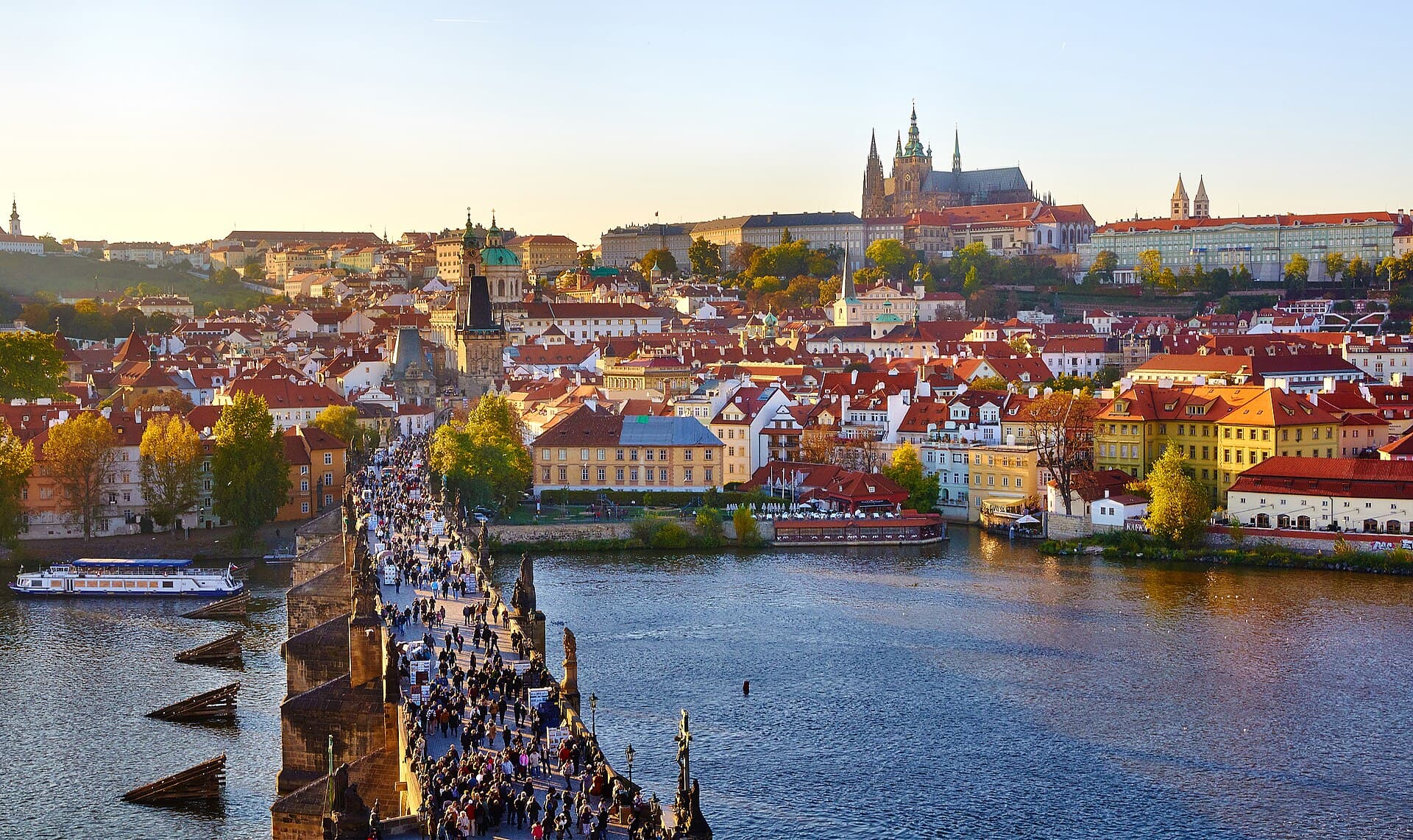 Moyan Brenn from Italy / CC BY 2.0, via Wikimedia Commons
“Prague: where gilded spires meet ancient stones, each corner a turn in a grand story.”
Not the postcards. The stories even locals don't know — whispered in your ear, right where they happened.
The famous Astronomical Clock on Old Town Hall once held a secret message from its restorer.
The foundation stone of Charles Bridge was supposedly set at a very specific, astrologically significant moment.
The Old Jewish Cemetery in Josefov contains far more burials than its 12,000 visible tombstones indicate.
Discover every secret of Prague
Every address, every reveal in full — in your ear, right where it happened.
You pick your stops. You walk. The voice reveals what the others miss.
No tours available yet. Check back soon — we're preparing them.
Prague, the capital of the Czech Republic, is a city where centuries of human endeavor are etched into every building, bridge, and narrow lane. Known as the "City of a Hundred Spires," its skyline presents a dramatic array of Romanesque, Gothic, Renaissance, and Baroque architecture. Situated along the Vltava River, Prague offers a captivating journey, from the grandeur of Prague Castle to the intimate character of its Lesser Town (Malá Strana).
Walking through Prague feels like stepping into a living chronicle, with its historic center recognized as a UNESCO World Heritage Site since 1992. The city's appeal lies not just in its iconic landmarks, but in the way its past and present intertwine, offering both profound cultural immersion and a dynamic contemporary atmosphere. It is a place that rewards careful exploration, where looking skyward often reveals unexpected architectural details and quirky artistic touches.
The area where Prague now stands has been continuously inhabited since the Paleolithic Age, with trade routes linking northern and southern Europe passing through the Vltava River valley for thousands of years. Around 500 BC, the Celtic tribe known as the Boii lived in the region, lending Bohemia its name. Slavic tribes settled in Central Bohemia in the 6th century AD, eventually becoming the dominant population.
The foundation of Prague as a significant settlement began in the 8th century, with the establishment of a castle on the site of present-day Prague Castle around 880 by Prince Bořivoj of the Přemyslid dynasty. By 973, the area became a bishopric. Prague truly flourished in the 14th century under the reign of Charles IV, who was both Holy Roman Emperor and King of Bohemia. He transformed Prague into an imperial capital, founding the New Town (Nové Město) and the enduring Charles Bridge. The Prague bishopric was elevated to an archbishopric in 1344, and the construction of St. Vitus Cathedral began during his rule.
Prague remained an important city under the Habsburg monarchy and Austria-Hungary, playing significant roles in the Bohemian and Protestant Reformations and the Thirty Years' War. By the 18th century, the Old Town, New Town, Malá Strana, and Hradčany were administratively united into a single city. The 19th century saw a significant increase in the city's Czech population, leading to a decline in the German-speaking near-majority.
In 1918, with the collapse of the Austro-Hungarian Empire after World War I, Prague became the capital of the newly independent Czechoslovak Republic. However, this period of independence was interrupted by Nazi Germany's occupation in 1939. After World War II, Prague fell under Soviet influence and a Communist regime, which lasted for four decades. The Velvet Revolution in 1989 marked Czechoslovakia's peaceful liberation from communism, and in 1993, following the split of Czechoslovakia, Prague became the capital of the new Czech Republic.
Begin your exploration at the Old Town Square, a lively central point featuring the Prague Astronomical Clock, which performs an hourly show of its Apostles. Ascend the Old Town Hall Tower for expansive views of the square and the city's many spires. From here, walk across the Charles Bridge, adorned with Baroque statues, connecting the Old Town to Malá Strana.
Dominating the skyline is Prague Castle, the largest ancient castle complex in the world. Within its expansive grounds, explore St. Vitus Cathedral, the Old Royal Palace, St. George's Basilica, and the colorful Golden Lane. Wander through the engaging streets of Malá Strana (Lesser Town), known for its Baroque architecture and quieter atmosphere. Visit the Jewish Quarter (Josefov) to see its historic synagogues and the Old Jewish Cemetery. For more expansive city views, take the funicular up Petřín Hill and ascend the Petřín Tower, a smaller replica of the Eiffel Tower.
The most pleasant times to visit Prague are during the shoulder seasons: April to May and September to October. During these months, the weather is mild, ideal for walking, and the city experiences fewer crowds than in peak summer. Spring brings blossoming trees and flowers, while autumn offers cooler temperatures and a golden hue to the city. While summer (June-August) has warm weather and long days, it also sees the heaviest tourist congestion. Winter (November-March) offers a quieter, more introspective experience with festive Christmas markets, but also shorter, colder days and occasional snow.
The official currency in the Czech Republic is the Czech Koruna (CZK), or Kč. While some areas frequented by tourists may accept Euros, it is best to use Koruna for more favorable exchange rates and to avoid confusion. Prague is a card-friendly city, so you will not need excessive amounts of cash. The official language is Czech, but English is widely spoken, especially in tourist areas. Learning a few basic Czech phrases like "Dobrý den" (hello) and "Děkuji" (thank you) is appreciated by locals.
Prague's public transport system is efficient, safe, and affordable, comprising a metro, trams, and buses. Tickets are unified across all modes and can be purchased from vending machines or via the Lítačka app. Remember to validate your ticket upon boarding or entering a metro station. From Václav Havel Airport Prague (PRG), you can reach the city center by public bus (e.g., Trolleybus 59 to Nádraží Veleslavín metro station) or the Airport Express shuttle. Taxis should be booked through reputable services or apps like Uber/Bolt to avoid inflated fares.