Old Market Square
The colorful merchant houses lining Poznań's Old Market Square hold a secret beyond their charming appearance.
Full story unlocks in the tour
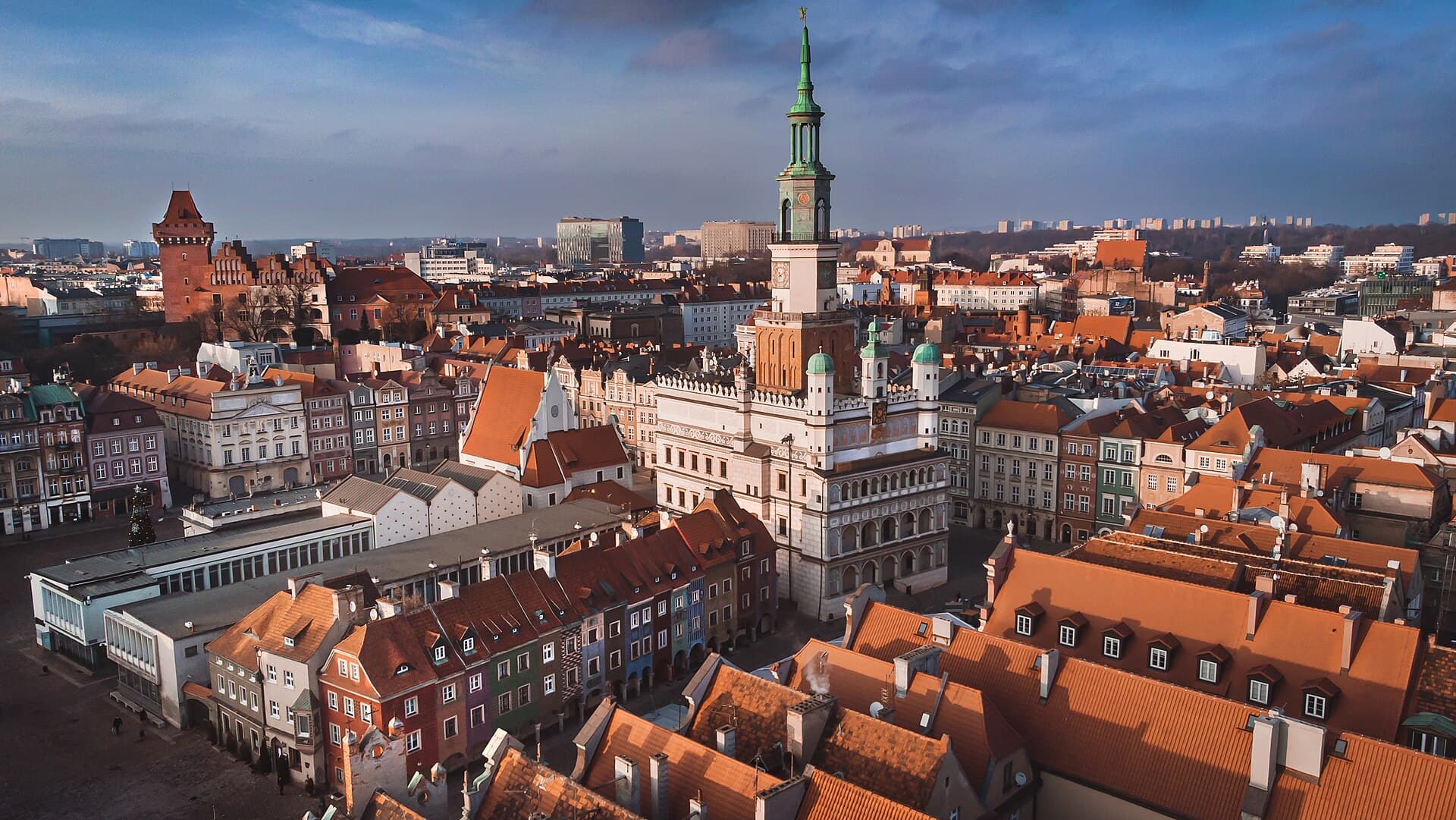 Aneta Pawska / CC BY-SA 4.0, via Wikimedia Commons
“Where Poland's story began, etched in enduring facades and ancient pathways.”
Not the postcards. The stories even locals don't know — whispered in your ear, right where they happened.
The colorful merchant houses lining Poznań's Old Market Square hold a secret beyond their charming appearance.
Poznań's Imperial Castle, a grand Neo-Romanesque edifice, was the last imperial castle built in Europe, but its purpose dramatically shifted during World War II.
The St. Martin's Croissant, a local delicacy, is more than just a pastry; it's a legally protected cultural heritage treat with a surprising origin story.
Discover every secret of Poznań
Every address, every reveal in full — in your ear, right where it happened.
You pick your stops. You walk. The voice reveals what the others miss.
No tours available yet. Check back soon — we're preparing them.
Poznań, a city in western Poland on the Warta River, serves as a significant center for culture, business, and education. With a population exceeding 540,000, it stands as Poland's fifth-largest city. This urban landscape is often considered the birthplace of Poland, having played a crucial role in the formation of the Polish state. Its historical importance is evident in its architectural variety, from Gothic and Renaissance to Neo-Classical styles.
Beyond its foundational roots, Poznań is a dynamic and prosperous city. It is recognized for its distinctive local customs, such as the Saint John's Fair and the traditional Saint Martin's croissants. The city also hosts the Poznań International Fair, one of the largest industrial fairs in Europe. Poznań offers a blend of historical charm and modern activity, making it a compelling destination for travelers seeking to delve into Polish history and contemporary urban life.
## The Cradle of Poland Poznań's origins trace back to at least the 9th century, with an early settlement on Ostrów Tumski, known as Cathedral Island. This island was the seat of the Western Polans, a West Slavic tribe, and an important cultural and political area. In 966, Duke Mieszko I, the founder of the Duchy of Poland, accepted Christianity, a pivotal event that greatly influenced the spread of Christianity throughout the country. The first bishopric in Poland was established in Poznań in 968, and construction of its cathedral began shortly after. The Poznań Cathedral also serves as the burial place for early Piast monarchs, including Mieszko I and Bolesław I the Brave, the first crowned King of Poland.
## Medieval Growth and Royal Connections Poznań was officially established as a town under Magdeburg law in 1253, with the Old Market Square laid out around this time. The Royal Castle, located on Przemysł Hill, began construction around 1249 under Przemysł I, and was expanded by his son Przemysł II, who aimed to make it a royal castle. Though Przemysł II was assassinated a year after his coronation in 1295, the castle was completed in the first half of the 14th century, becoming the largest secular structure in the Polish Kingdom at the time. The castle served as a royal residence and the seat of the General Governor of Greater Poland for centuries.
## Fires, Rebuilding, and Shifting Powers Like many historic cities, Poznań endured numerous fires and wars. A significant fire in 1536 destroyed many buildings, including the Royal Castle and the Town Hall. The Old Market Square and its surrounding buildings were largely reconstructed in the Renaissance style by Giovanni Battista di Quadro. In the 18th century, Poznań fell under Prussian rule during the Second Partition of Poland, leading to an increasing German influence. The early 19th century saw the dismantling of old city walls and significant development to the west of the old city. During the Greater Poland Uprising of 1806, Polish soldiers helped drive out Prussian forces, and the city became part of the Duchy of Warsaw.
## 20th Century Transformations The Imperial Castle, one of Poznań's most prominent landmarks, was built between 1905 and 1910 as a residence for the last German Emperor Wilhelm II. This Neo-Romanesque structure was intended to symbolize German control over Greater Poland. After World War I, it became property of the Second Polish Republic. During World War II, the castle was seized by the Nazis and repurposed as Adolf Hitler's headquarters in Poland. The city suffered heavy damage during the Battle of Poznań in 1945, with approximately 90% of the Old Town destroyed. Following the war, much of the historic center, including the Old Market Square, was rebuilt in its original style. Today, Poznań continues to thrive as a cultural and business hub, with its Imperial Castle now serving as a cultural center.
Begin your exploration at the Old Market Square (Stary Rynek), the heart of Poznań since 1253. Admire the colorful merchant houses and the Poznań Town Hall, an exquisite example of Gothic architecture. Be sure to be there at noon to witness the mechanical billy goats on the Town Hall clock tower butt heads. Nearby, you can find the Croissant Museum, an interactive experience dedicated to the famous St. Martin's Croissant, offering a tasting and a look at its unique history.
Cross to Ostrów Tumski (Cathedral Island), the oldest part of the city and the historical birthplace of Poland. Here stands the Poznań Cathedral, the oldest in Poland, where many of the country's first rulers are buried. For a sweeping view of the city, ascend the reconstructed Royal Castle on Przemysł Hill, which also houses a branch of the National Museum in Poznań. Another significant landmark is the Imperial Castle, built for Emperor Wilhelm II and later repurposed as a cultural center. Beyond the historic core, consider a visit to Cytadela Park, Poznań's largest park, featuring war museums, cemeteries, and Magdalena Abakanowicz's "Unrecognized" statues.
The best time to visit Poznań is during late spring (May, June) and early autumn (September, October) for pleasant weather and fewer crowds. During these months, the Old Town is ideal for outdoor dining, and the city feels more lived-in than touristy. Summers (July, August) are warm, with average highs around 24-26°C (75-77°F), but can be busy with festivals and trade shows. July is also the rainiest month, primarily due to short, intense thunderstorms. Winter (December-February) is cold, with temperatures around freezing, and features Christmas markets in the Old Market Square. November 11th, St. Martin's Day, is a distinctive time to visit for the traditional croissant festival.
Poznań is well-connected by train, with direct routes from Berlin (around 3 hours) and Warsaw (around 2 hours 40 minutes). Poznań–Ławica Airport (POZ) is located 7 km west of the city center, with bus line 159 offering a direct connection to the main train station in about 30 minutes.
The city has an efficient public transportation system consisting of trams and buses, operating from approximately 4:30 AM to 11 PM, with night lines available. Tickets can be purchased for specific durations (e.g., 10 minutes, 45 minutes, 24 hours, 3 days) at automated machines on vehicles and at stops, as well as at kiosks and ZTM Customer Service Points. The Poznań City Card is also available, offering free public transport and discounts at various attractions. While the central area is walkable, public transport is convenient for longer distances. The local currency is the Polish Złoty (PLN).