Frederick the Great, the 18th-century Prussian king, designed his summer palace, Sanssouci, as a place "without worries." Yet, even in his carefree retreat, a specific architectural detail reveals a monarch deeply concerned with the practicalities of his favorite hobby.
Kai Vogel / CC0, via Wikimedia CommonsPotsdam
“Where Prussian grandeur meets Cold War intrigue.”
Potsdam, as no one tells it.
Not the postcards. The stories even locals don't know — whispered in your ear, right where they happened.
This English Tudor-style palace hosted the pivotal Potsdam Conference in 1945, where Allied leaders redrew the map of post-war Europe. Observe the central courtyard closely, and you will find a floral arrangement that once made a surprising, temporary political statement.
Known as the "Bridge of Spies," this modest steel bridge connecting Potsdam and Berlin became a silent stage for Cold War cloak-and-dagger exchanges. However, the bridge's role in covert operations was not its only secret; its very construction conceals an architectural compromise.
Discover every secret of Potsdam
Every address, every reveal in full — in your ear, right where it happened.
You pick your stops. You walk. The voice reveals what the others miss.
How long do you have in Potsdam?
No tours available yet. Check back soon — we're preparing them.
The story of Potsdam
Potsdam, the capital of Brandenburg, Germany, is a city woven with threads of royal history, enlightened philosophy, and pivotal 20th-century events. Situated just 25 kilometers southwest of Berlin, this urban landscape, graced by approximately 20 lakes and rivers, was once the cherished residence of Prussian kings and German Kaisers until 1918. Its singular fusion of art and nature, characterized by magnificent palaces and elegant gardens, earned it UNESCO World Heritage status in 1990.
Beyond the grand facades and meticulously kept parklands, Potsdam offers a journey through time. From its origins as a Slavic settlement over a millennium ago to its development into a significant garrison town under the "Soldier King" Frederick William I, the city has continuously evolved. Today, Potsdam thrives as a center for science, film production—housing the world's oldest large-scale film studio, Babelsberg Studios—and tourism, drawing visitors with its cultural depth and welcoming atmosphere.
Potsdam's documented history reaches back to 993 AD, when it was first mentioned as "Poztupimi," a Slavic settlement. Its strategic position at the confluence of the Nuthe and Havel rivers made it a significant location, and by 1050, Margrave Albrecht I of Brandenburg re-established a stone castle there. The city officially received its charter in 1317.
A pivotal moment arrived in 1660 when Frederick William, the Great Elector, selected Potsdam as his hunting residence, initiating a period of substantial development. He began transforming the dilapidated old castle into a grand palace and pleasure grounds. In 1685, his Edict of Potsdam attracted persecuted Protestant Huguenots from France, alongside other immigrants from the Netherlands, Russia, and Bohemia, invigorating the city's population and economy.
The 18th century witnessed Potsdam's flourishing under the Hohenzollern dynasty. Frederick William I, known as the "Soldier King," transformed Potsdam into a prominent garrison town, leading to the construction of new residential quarters like the Dutch Quarter to house soldiers and a growing population. His son, Frederick II, or Frederick the Great, further elevated Potsdam's standing, making it a royal seat and overseeing the construction of iconic structures like Sanssouci Palace, his intimate summer retreat, between 1745 and 1747. His reign also saw the expansion of the city with new gates and barracks.
By the 19th century, Potsdam became a center of science, and construction activity peaked, adding to its architectural heritage. However, the city faced significant challenges in the 20th century. While largely spared during much of World War II, a British air raid on April 14, 1945, severely damaged the old city center. Following Germany's surrender, Potsdam played a crucial role in shaping the post-war world. From July 17 to August 2, 1945, Cecilienhof Palace hosted the Potsdam Conference, where Allied leaders—Joseph Stalin, Winston Churchill (later Clement Attlee), and Harry S. Truman—negotiated the terms for administering Germany and establishing the post-war order. The conference led to agreements on the demilitarization, denazification, democratization, and decartelization of Germany, and its division into four occupation zones.
During the Cold War, Potsdam became part of East Germany and was separated from West Berlin by the Berlin Wall. The Glienicke Bridge, connecting Potsdam to West Berlin, famously served as a site for exchanging spies. After German reunification in 1990, Potsdam was re-established as the capital of the state of Brandenburg, and extensive efforts were made to reconstruct and restore its cultural landscape, including the palaces and parks that had been affected by the Berlin Wall.
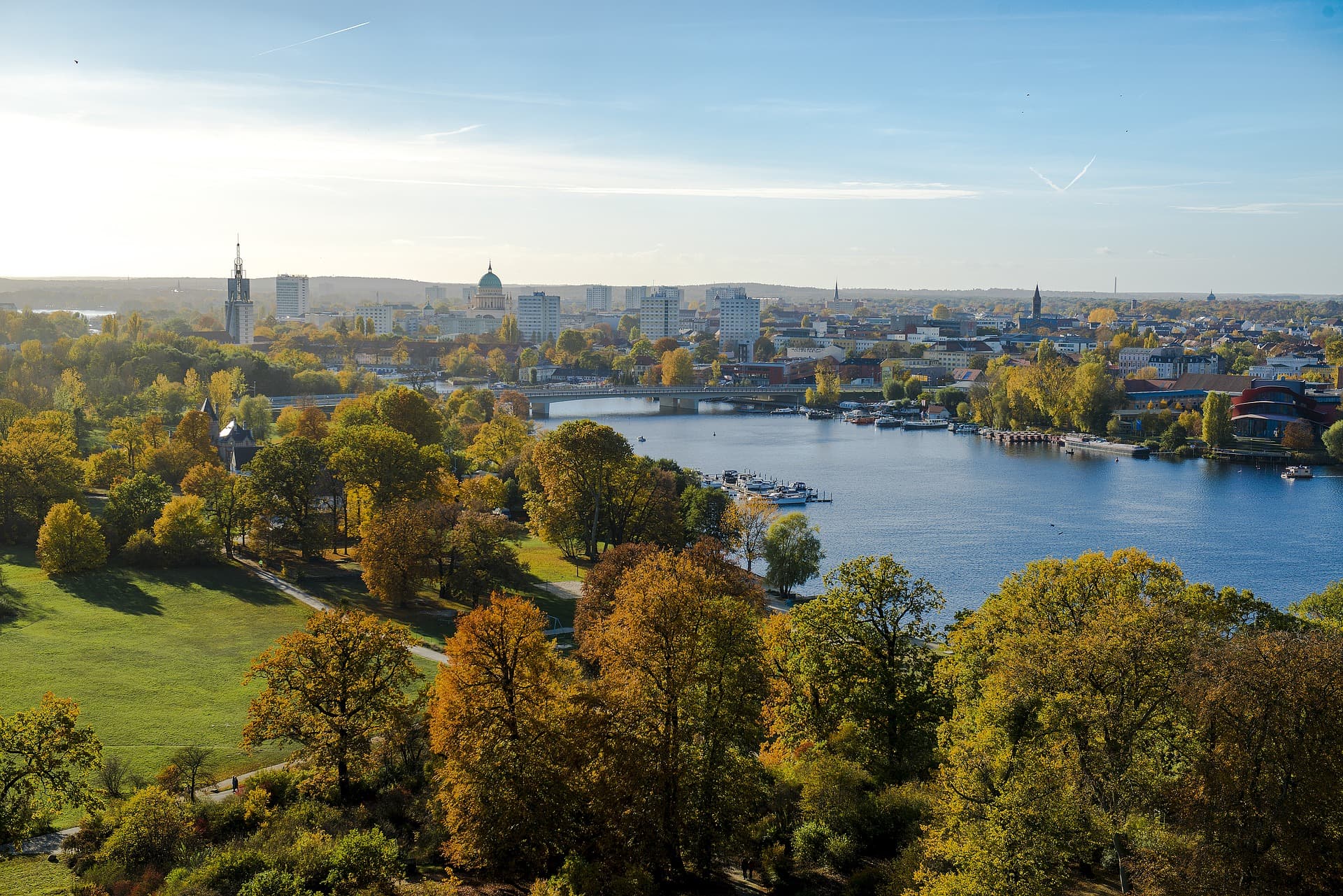
Potsdam's cultural landscape stands as a testament to centuries of royal patronage and historical significance. Sanssouci Park is an expansive UNESCO World Heritage site, home to several palaces and gardens. The most renowned is Sanssouci Palace, Frederick the Great's rococo summer residence, notable for its terraced vineyards and intimate scale. Within the park, you will also encounter the grander New Palace, constructed between 1763 and 1769, and the Orangery Palace, overlooking Italian-style gardens. The Chinese House, an exquisite example of Rococo Chinoiserie, is another highlight.
Beyond Sanssouci, Cecilienhof Palace, constructed in the English Tudor style, carries immense historical weight as the venue for the 1945 Potsdam Conference. Visitors can explore the conference rooms, including the Great Hall where the Allied leaders convened. The Dutch Quarter, also known as "Little Amsterdam," is a distinctive neighborhood with 134 red-brick houses, originally built for Dutch craftsmen. Today, it is a lively area with boutiques, cafes, and galleries.
The Glienicke Bridge, famously called the "Bridge of Spies," spans the Havel River and offers views of Glienicke Palace and Babelsberg Palace. While the bridge itself is a plain steel construction, its Cold War history makes it a compelling site. Other notable attractions include Potsdam's own Brandenburg Gate, built in 1770 and predating its Berlin counterpart, and the Alexandrowka Russian Colony, featuring fourteen wooden houses built for Russian singers of the Prussian court.
Potsdam is a captivating destination throughout the year, with each season offering a different appeal. For pleasant weather ideal for exploring the numerous gardens and parks, spring (April to June) and early autumn (September to October) are highly recommended, often with fewer crowds. Late April is particularly appealing, coinciding with the Tulip Festival in the Dutch Quarter. Summer (July to August) brings warmer temperatures, averaging around 19-21°C, with highs reaching 24-25°C, making it suitable for outdoor performances and lakeside activities, though it can be busier. Winter (December to February) offers a cooler, quieter experience, with average temperatures around 2-4°C, and the allure of Christmas markets.
Potsdam is easily accessible, situated just 25 kilometers southwest of Berlin. From central Berlin, you can reach Potsdam in about 45 minutes by taking the S7 S-Bahn line to Potsdam Hauptbahnhof. Regional trains also provide quicker connections to stations like Potsdam-Sanssouci and Potsdam-Charlottenhof. If driving, the autobahn (A115) will get you there in under 40 minutes.
Once in Potsdam, navigating the city is convenient. The city is very bike-friendly, with many scenic routes and readily available rental bikes. Public transportation, including trams, buses, and S-Bahn, is well-established. For exploring the palaces and parks, consider purchasing a Sanssouci+ Ticket, which grants access to multiple palaces and can be bought online or in person, though online booking is advised for Sanssouci Palace to secure a fixed admission time. While most of Potsdam is accessible, some hillier terrain around the palaces might require alternative routes for those with mobility considerations.
- What is Potsdam most known for?
- Potsdam is most known for its numerous palaces and extensive parklands, particularly Sanssouci Park, which is a UNESCO World Heritage site. It is also recognized as the former royal residence of Prussian kings and for hosting the pivotal Potsdam Conference in 1945.
- Is Potsdam suitable for a day trip from Berlin?
- Yes, Potsdam is a popular and straightforward day trip from Berlin, located just 25 kilometers southwest of the city. It is accessible by train in about 30-45 minutes.
- What is the most effective way to travel around Potsdam?
- Potsdam is a very walkable and bike-friendly city. Public transportation, including trams and buses, is also efficient for reaching various attractions.
- Is it necessary to purchase palace tickets in advance?
- While tickets can often be purchased on-site, it is highly recommended to buy tickets in advance, especially for Sanssouci Palace, to secure a fixed admission time and avoid potential queues. The Sanssouci+ Ticket offers access to multiple palaces.
- What is the Dutch Quarter?
- The Dutch Quarter, or Holländisches Viertel, is a distinctive area in Potsdam featuring 134 red-brick houses built in the 18th century for Dutch immigrants. It is now a lively district with shops, cafes, and a unique architectural style.
- What significant event occurred at Cecilienhof Palace?
- Cecilienhof Palace was the location of the Potsdam Conference from July 17 to August 2, 1945. Here, Allied leaders Joseph Stalin, Winston Churchill (and later Clement Attlee), and Harry S. Truman met to discuss the post-World War II order, including the administration and division of Germany.