The Clock Tower (Torre del Reloj)
The city's iconic Clock Tower, a 17th-century landmark, is known by locals as 'the nose of Popayán.' However, a closer look reveals something quite peculiar about its face.
Full story unlocks in the tour
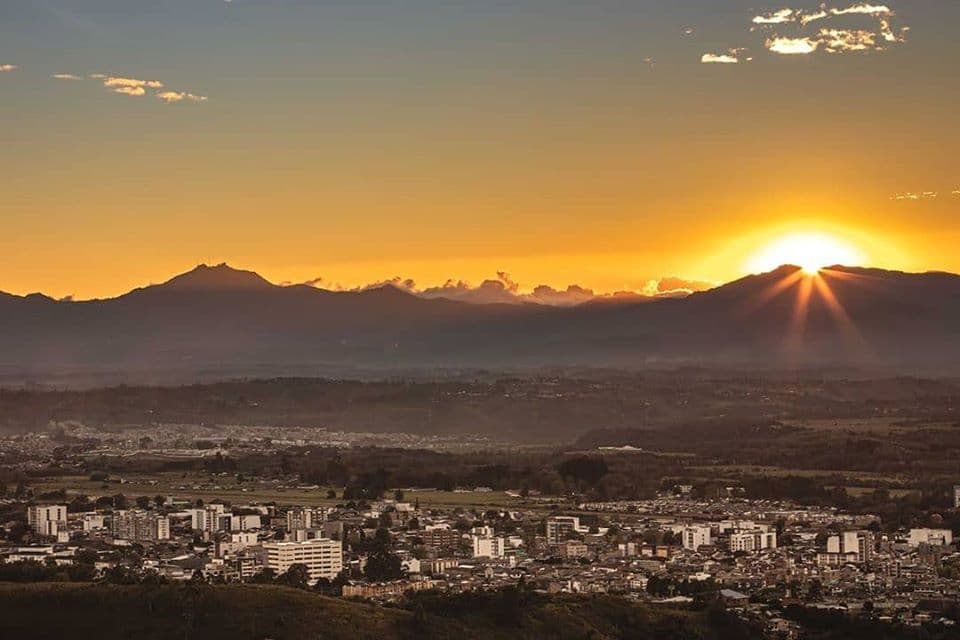 Junior Segura fotografía / CC0, via Wikimedia Commons
“Colombia's 'White City' invites you to wander through centuries of history, where every corner holds a story.”
Not the postcards. The stories even locals don't know — whispered in your ear, right where they happened.
The city's iconic Clock Tower, a 17th-century landmark, is known by locals as 'the nose of Popayán.' However, a closer look reveals something quite peculiar about its face.
This historic bridge, connecting the city center to its northern neighborhoods, bears a name that hints at a humbling journey.
A prominent hill crowned with a statue of Popayán's founder, Sebastián de Belalcázar, was not always a Spanish colonial monument.
Discover every secret of Popayán
Every address, every reveal in full — in your ear, right where it happened.
You pick your stops. You walk. The voice reveals what the others miss.
No tours available yet. Check back soon — we're preparing them.
Popayán, often referred to as 'La Ciudad Blanca' or the 'White City,' stands as a testament to colonial grandeur in southwestern Colombia. Its historic center, renowned for its impeccably preserved whitewashed buildings, offers a visual journey back in time. This city, between the Western and Central Andean mountain ranges, captivates with its distinct architecture, lively cultural traditions, and a palpable university-town atmosphere.
More than just a picturesque stop, Popayán holds significant historical and cultural weight. It's a city that has consistently played a crucial role in Colombia's development, from its days as a colonial gold trading hub to its current status as a UNESCO Creative City of Gastronomy. While it may not draw the same throngs of international tourists as Cartagena or Medellín, Popayán offers an authentic and unhurried experience, inviting visitors to delve into its layered past and lively present.
Popayán was officially established on January 13, 1537, by Spanish conquistador Sebastián de Belalcázar. Its strategic location in the Pubenza Valley, positioned along the vital trade route connecting Lima, Quito, and Cartagena, quickly propelled it into prominence. The city's prosperity was largely fueled by the management of gold mining in the Pacific lowlands and the development of agriculture, making it a significant economic and administrative center.
From its early days, Popayán solidified its identity as an aristocratic and religious stronghold. The construction of numerous churches and monasteries, alongside the initiation of its renowned Holy Week processions in 1556, cemented its status as a major religious hub in Colombia. The city's financial influence grew further with the opening of the Royal Mint in 1758, allowing it to mint its own gold coins. The establishment of the University of Cauca in 1827 also transformed Popayán into a key educational and intellectual center, earning it the nickname 'University City.'
Popayán's architectural landscape, characterized by massive, lime-whitened walls, carved wooden balconies, and inner courtyards, is considered one of the most complete and well-preserved examples of Spanish colonial architecture in Latin America. However, this architectural heritage has faced challenges. The city lies in a zone of seismic activity and has been repeatedly damaged by earthquakes throughout its history. The most devastating of these occurred on March 31, 1983, which severely damaged the historic center. Rather than rebuilding with modern structures, a meticulous restoration effort spanning a decade ensured the historical accuracy and preservation of Popayán's unique colonial ensemble, bringing it back to its former glory.
Begin your exploration in Parque Caldas, the city's main square, surrounded by colonial and republican buildings. From here, you can visit the neoclassical Catedral Basílica Nuestra Señora de la Asunción. Wander through the white-walled streets, admiring the colonial architecture and wrought-iron balconies. Do not miss the Iglesia de San Francisco, considered a masterpiece of Colombian Baroque, and La Ermita, the oldest church in Popayán, dating back to 1546.
Walk across the Puente del Humilladero, a 19th-century brick bridge offering views of the Río Molino. For panoramic city views, hike up El Morro de Tulcán, an ancient indigenous pyramid site now topped with a statue of Sebastián de Belalcázar. Popayán also offers several museums, including the Museo Guillermo León Valencia, dedicated to a former Colombian president, and the Casa Museo Mosquera. The Natural History Museum, housed within the University of Cauca, presents an extensive collection of animal specimens, minerals, and archaeological artifacts.
Beyond the city center, consider day trips to Puracé National Natural Park, a UNESCO Biosphere Reserve with volcanoes, hot springs, and diverse wildlife. The archaeological sites of Tierradentro, a UNESCO World Heritage Site known for its pre-Columbian underground tombs, and San Agustín, with its ancient statues, are also accessible from Popayán.
The best time to visit Popayán for pleasant weather and outdoor activities is from early June to late September, with a peak in the second week of August. During these months, rainfall is less frequent, and skies are clearer. Popayán experiences a tropical climate tempered by its altitude, with stable temperatures around 18°C (64°F) year-round. Evenings can be cool, so bringing layers is advisable.
If you plan to experience the renowned Holy Week processions, held between Friday of Sorrows and Holy Saturday, be aware that this is a major event. Book accommodations and tours 6-12 months in advance, as the city fills with visitors.
Popayán is well-connected and can be reached by air or land. Flights are available from Bogotá directly to Popayán's Guillermo León Valencia Airport. For those traveling overland, Popayán is approximately a 3-hour drive from Cali and serves as a convenient stop on routes to Ecuador or the archaeological sites of San Agustín and Tierradentro. Buses run regularly from major cities like Cali, Pasto, and Medellín.
The historic center of Popayán is compact and easily explored on foot. While the center is generally considered safe, especially during the day and evening when people are present, it's wise to be cautious when venturing beyond the main tourist areas, particularly at night. Popayán is known for being more affordable than cities like Medellín, offering good value for food, accommodation, and coffee. Many small, family-run hotels are available in the city center.