Pontevedra's Name Origin
The city's designation, Pontevedra, plainly signifies 'old bridge,' acknowledging its Roman foundations. Yet, a less common interpretation offers a more lively image.
Full story unlocks in the tour
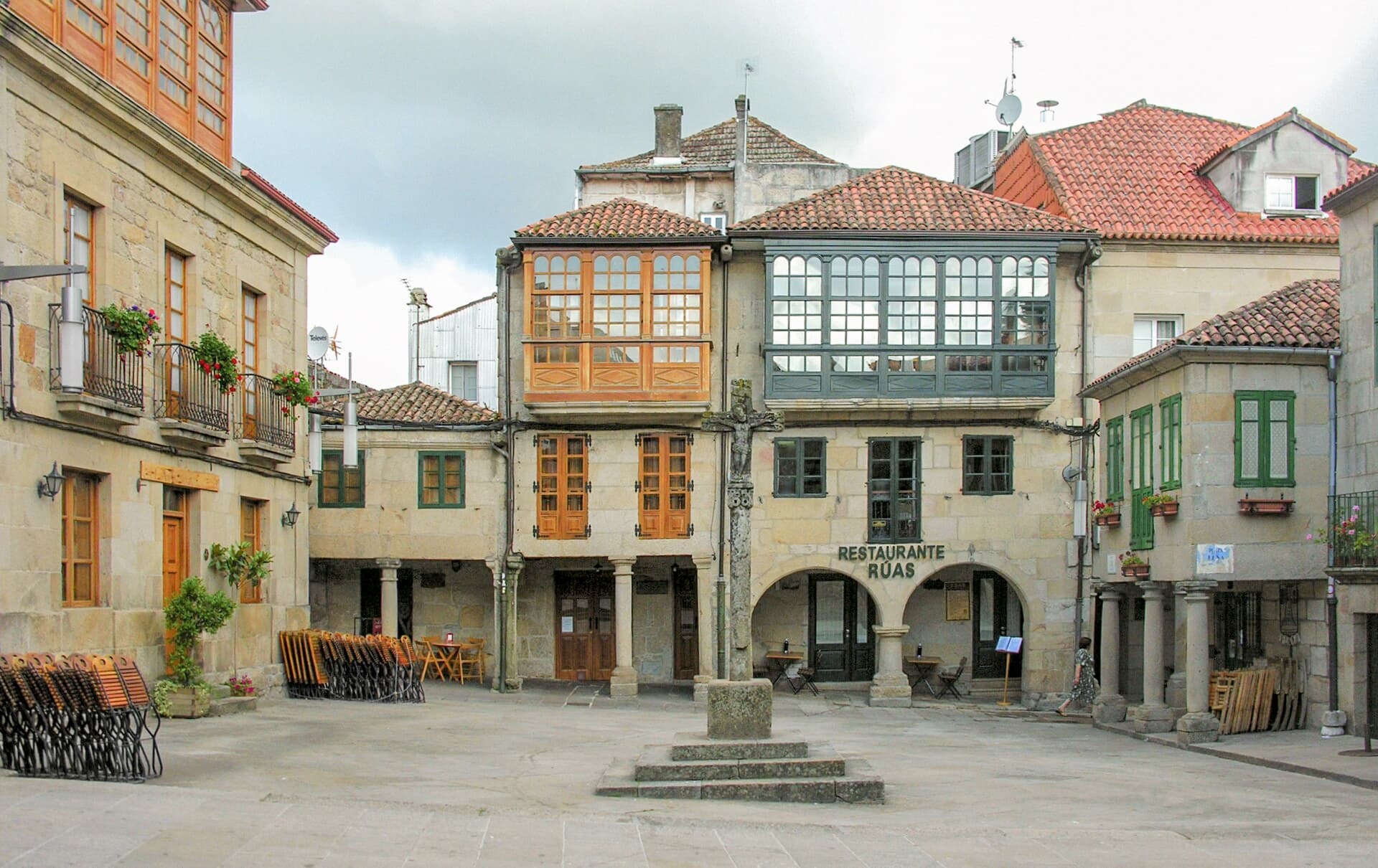 Luis Miguel Bugallo Sánchez (http://commons.wikimedia.org/wiki/User:Lmbuga) / CC BY-SA 3.0, via Wikimedia Commons
“Pontevedra: Where ancient stones narrate modern triumphs of urban design.”
Not the postcards. The stories even locals don't know — whispered in your ear, right where they happened.
The city's designation, Pontevedra, plainly signifies 'old bridge,' acknowledging its Roman foundations. Yet, a less common interpretation offers a more lively image.
This Gothic convent, established in the 14th century, is said to have been founded by a renowned traveler on the Camino de Santiago. However, the story of its construction unveils an unexpected rivalry.
This evocative medieval square, a central point of Pontevedra's old town, derives its name from a common commodity once exchanged here. Still, a detail at its core provides a clue to a much older city landmark.
Discover every secret of Pontevedra
Every address, every reveal in full — in your ear, right where it happened.
You pick your stops. You walk. The voice reveals what the others miss.
No tours available yet. Check back soon — we're preparing them.
Pontevedra, a city within the autonomous community of Galicia in northwestern Spain, presents an engaging fusion of ancient chronology and contemporary urban ingenuity. Celebrated for its remarkably preserved historic core, which is largely given over to pedestrians, the city invites unhurried exploration of its stone-paved passages and medieval plazas. Positioned on the Lérez River at the mouth of the Ría de Pontevedra, it serves as a significant stop along the Portuguese Way of the Camino de Santiago pilgrimage route.
Pontevedra has earned international recognition for its dedication to urban quality of life and accessibility, even inspiring urban strategies in other European cities. Its evolution into a pedestrian-oriented center has established it as a model for sustainable urban mobility. Beyond its urban planning accolades, Pontevedra is a city where history is tangible, from its Roman beginnings to its thriving maritime era, making it a compelling destination for those seeking cultural immersion and a relaxed pace.
Pontevedra's history extends back to pre-Roman eras, with some historians suggesting its origins as an early Roman road stop. The city's name, 'Pontevedra,' is widely believed to stem from the Latin 'Pons Vetus,' meaning 'Old Bridge,' a reference to an ancient Roman bridge that once spanned the Lérez River. The current medieval Burgo Bridge is considered the successor to this original Roman structure.
Pontevedra ascended to prominence in the 12th century, thriving as an important commercial center and Galicia's foremost port. King Ferdinand II granted the city a charter in 1169, bestowing special trading rights, particularly for fish-related commodities. By the 15th century, Pontevedra reached its peak as a trade and communications hub, becoming the largest and most influential of Galicia's ancient cities. Its port was so vital that one of Christopher Columbus's vessels, the carrack Santa María, originally named La Gallega, was constructed here.
The city's prosperity began to recede in the late 16th century, partly due to the silting of the Lérez River, which rendered the harbor unsuitable for large-scale navigation. Despite this downturn, Pontevedra experienced a revitalization in the 19th century, becoming a provincial capital in 1833, a decision that spurred urban expansion and led to the construction of a railway. In recent times, Pontevedra has distinguished itself with its innovative urban planning, transforming its historic core into a pedestrian-friendly zone and garnering international accolades for its sustainable mobility and urban quality of life.
Begin your exploration in the Praza da Leña, a quintessential Galician medieval square recognized for its granite residences, arcades, and a 15th-century cruceiro. This square also contains structures belonging to the Provincial Archaeological Museum.
Only a brief stroll away, uncover the Basílica de Santa María la Mayor, a striking 16th-century church considered Pontevedra's principal religious edifice. Its elaborate Plateresque Renaissance facade, resembling a stone altarpiece, is a particular highlight.
The Convent of San Francisco, a Gothic construction from the 14th century, stands in the city center overlooking the Praza da Herrería. Inside, you can discover medieval tombs of notable figures such as Paio Gómez Chariño.
No visit to Pontevedra is complete without experiencing the Museum of Pontevedra. Spread across several historic buildings, including the Sarmiento and Castelao buildings, it houses a varied collection ranging from prehistoric gold artifacts to Galician art from the 14th to 21st centuries, and works by Spanish masters like Dalí and Picasso. The museum also encompasses the evocative Ruins of San Domingos, a 13th-century Gothic convent.
Finally, seek out the Church of the Pilgrim Virgin (Igrexa da Virxe Peregrina), an 18th-century Baroque church with a distinctive scallop-shell-shaped floor plan, symbolizing its importance on the Camino de Santiago.
Pontevedra enjoys a temperate climate with mild winters and warm summers, making it a destination suitable for any season. For the driest and sunniest conditions, ideal for exploring the city and nearby coastal areas, plan your visit during the summer months from June to August or the first half of September. The transitional seasons of April, May, and October offer pleasant weather with fewer visitors. While winters bring more rainfall, temperatures remain relatively mild.
Pontevedra's historic core is largely pedestrianized, making it exceptionally walkable and enjoyable to traverse on foot. Many attractions, including the Museum of Pontevedra, provide complimentary entry. Be aware that many establishments in Spain, including some points of interest, observe a midday break, so arrange your schedule accordingly. The city is a significant stop on the Portuguese Way of the Camino de Santiago, and you will encounter the ancient scallop symbol throughout. Pontevedra is well-connected within Galicia and to other parts of Spain by rail. For those wishing to explore beyond the city, nearby fishing communities like Combarro and the Cíes Islands are popular excursions.