Plzeň Historical Underground
Beneath Plzeň's ancient paving stones lies a secret city, a labyrinth of tunnels and cellars.
Full story unlocks in the tour
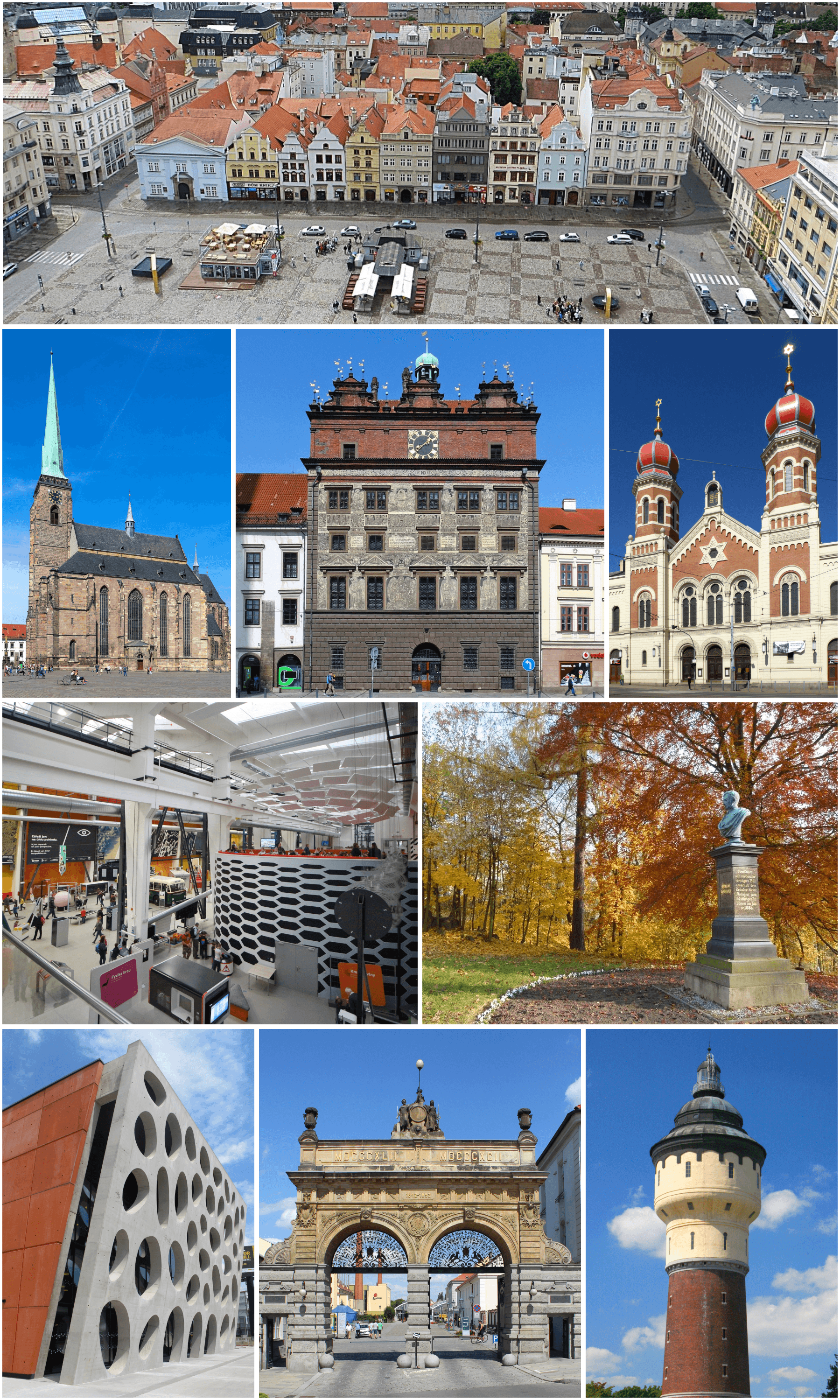 Náměstí Republiky - panoramio (6).jpg: Mister No (Panoramio) Plzeň Cathedral of Saint Bartholomew-0146.jpg: Isiwal Rathaus-pilsen.jpg: Matthias Süß Pilseno, la Granda Sinagogo, 30.jpeg: Aisano Plzeň TechMania hala 2.jpg: VitVit Pomnik kopeckeho.jpg: Pablo.czech Nové divadlo v Plzni 03.JPG: Hadonos Plzeň, brána, čelní pohled (2).jpg: Jan Polák Pilsen-Water Tower.jpg: Tamorlan / CC BY-SA 4.0, via Wikimedia Commons
“Where golden lager flows and centuries unfold, Plzeň invites you to uncover its spirited past.”
Not the postcards. The stories even locals don't know — whispered in your ear, right where they happened.
Beneath Plzeň's ancient paving stones lies a secret city, a labyrinth of tunnels and cellars.
While the Great Synagogue commands attention, another, older synagogue in Plzeň holds a quieter, more resilient story.
The strikingly modern New Theatre in Plzeň carries a playful nickname given by locals.
Discover every secret of Plzeň
Every address, every reveal in full — in your ear, right where it happened.
You pick your stops. You walk. The voice reveals what the others miss.
No tours available yet. Check back soon — we're preparing them.
Plzeň, often recognized by its German name Pilsen, is a city in the western Czech Republic, celebrated globally as the origin of Pilsner beer. Located approximately 90 kilometers southwest of Prague, it stands as the country's fourth-largest city, with a population surpassing 180,000. Plzeň rests at the convergence of four rivers—the Mže, Úhlava, Úslava, and Radbuza—which unite to form the Berounka River, a strategic position that historically fostered trade.
Beyond its brewing heritage, Plzeň offers a profound sense of history, impressive architecture, and a lively cultural landscape. The city's historic center, a protected urban monument reservation, displays a fusion of Gothic and Renaissance styles, with pastel-colored buildings and inviting pathways. Honored as the European Capital of Culture in 2015, Plzeň has evolved from a post-communist industrial center into a dynamic destination that welcomes visitors to explore its past and present.
Whether you are drawn by the promise of a fresh Pilsner Urquell directly from its source or the allure of delving into centuries of Bohemian history, Plzeň presents a compelling journey. From its grand Republic Square to its secluded underground passages, the city invites exploration, promising discoveries that extend far beyond its renowned golden lager.
## From Royal City to Industrial Powerhouse Plzeň's origins can be traced to the late 9th century, with the first written mention of Plzeň Castle in 976. The city of New Plzeň was formally established in 1295 by King Wenceslas II of Bohemia, strategically placed on a vital trade route connecting Bohemia with Bavaria. By the 14th century, Plzeň had grown to become the third-largest city in Bohemia, after Prague and Kutná Hora, with approximately 3,000 inhabitants. The right to brew beer was granted to 260 citizens by King Wenceslas II, a financially advantageous privilege that allowed them to sell beer from their homes.
During the 15th-century Hussite Wars, Plzeň stood as a Catholic bastion, successfully resisting multiple sieges. The city continued to thrive, and in the late 16th century, Emperor Rudolf II even made Plzeň his temporary seat from 1599 to 1600. The 17th century brought the Thirty Years' War, during which Plzeň was occupied by Mansfeld in 1618 before being recaptured by Imperial troops. The architecture of Plzeň began to be significantly shaped by the Baroque style from the end of the 17th century.
## The Genesis of Pilsner and 20th Century Trials The 19th century marked a period of rapid industrialization for Plzeň. It became home to the Škoda Works, an engineering company that grew to be one of the most important in Austria-Hungary and later Czechoslovakia. However, it was in 1842 that Plzeň truly made its indelible mark on the world. Dissatisfied with the inconsistent quality of local brews, the city's brewers enlisted Bavarian master brewer Josef Groll. His innovative method, utilizing local ingredients and a new style of bottom-fermented lager, resulted in the creation of Pilsner beer, a style that would eventually account for 70% of the world's beer production. The Pilsner Urquell Brewery, established from this tradition, is now the largest brewery in the Czech Republic.
Plzeň's 20th-century history was marked by significant trials. It was part of the Austro-Hungarian monarchy until 1918, then became part of independent Czechoslovakia. In 1939, German forces occupied the city, transforming it into a major producer of German weapons during World War II. In 1945, the city was liberated by the U.S. Army, an event that was suppressed during the subsequent Communist regime (1948-1989). During this period, Plzeň was largely a "grey and sad city" focused on heavy machinery production. Following the Velvet Revolution in 1989 and the fall of communism, many properties were returned to their original owners, leading to reconstruction and a renewed focus on preserving the city's heritage. In 2015, Plzeň was recognized as a European Capital of Culture, further underscoring its transformation and distinct identity.
Begin your exploration at Republic Square (Náměstí Republiky), one of Europe's grandest squares, framed by Gothic and Renaissance buildings. The square is dominated by the Cathedral of St. Bartholomew, which features the tallest church tower in the Czech Republic at 102.6 meters. Ascend the 301 steps for expansive views of the city and surrounding region. Also on the square is the Renaissance City Hall, dating back to 1558, adorned with sgraffito.
No visit to Plzeň is complete without a journey to the Pilsner Urquell Brewery. Take a tour to understand the brewing process, observe the production line, and sample beer directly from the cellars. Adjacent to the brewery, the Brewery Museum recounts the story of beer from antiquity to the present day.
For a singular perspective, descend into the Plzeň Historical Underground, a network of 15 to 20 kilometers of corridors, cellars, and wells originating from the 14th century. A guided tour covers approximately 800 meters, revealing medieval life and offering a cool respite on warm days. Visitors aged 18 and over receive a voucher for a complimentary beer at the conclusion of the tour.
Explore the Great Synagogue, the second largest in Europe and third largest in the world, with its impressive Romanesque-Moorish architecture. For a more personal experience, seek out the reconstructed Old Synagogue, set within a courtyard. Finally, consider a visit to the Josef Kajetán Tyl Theatre, a Neo-Renaissance building with Art Nouveau elements, or its modern counterpart, the New Theatre.
The ideal time to visit Plzeň for pleasant weather and outdoor activities spans from mid-May to mid-September. During these months, temperatures are mild to warm, creating comfortable conditions for walking tours and enjoying outdoor cafes. June offers a good balance of agreeable weather and extended daylight hours, while July and August are the busiest, presenting a lively atmosphere and numerous festivals. For fewer crowds and comfortable temperatures, consider visiting in May or September. April is also a favorable option, with fewer tourists and the opening of many seasonal attractions. Winters are cold and grey with frequent snowfalls, but hotel prices are typically lower.
Plzeň is located approximately 90 kilometers southwest of Prague and is readily accessible by car, train, or bus. The city operates on Central European Time (CET). The official language is Czech, and the currency used is the Czech Crown (CZK). The main postal code for Plzeň is 301 00. For emergencies, dial 112.
Public transport in Plzeň is efficient, with tickets available at information centers. If driving, note that the speed limit in towns is 50 km/h, and drivers sit on the left side of the vehicle, adhering to right-side drive rules. There is a zero-tolerance policy for drink driving. Tourist Information Centers are located in the historical city center on Republic Square and at the main train station, offering maps, information in multiple languages, and assistance with accommodation.