Rishengchang Exchange House
Pingyao was once the financial heart of China, but the first 'bank' here wasn't just about money.
Full story unlocks in the tour
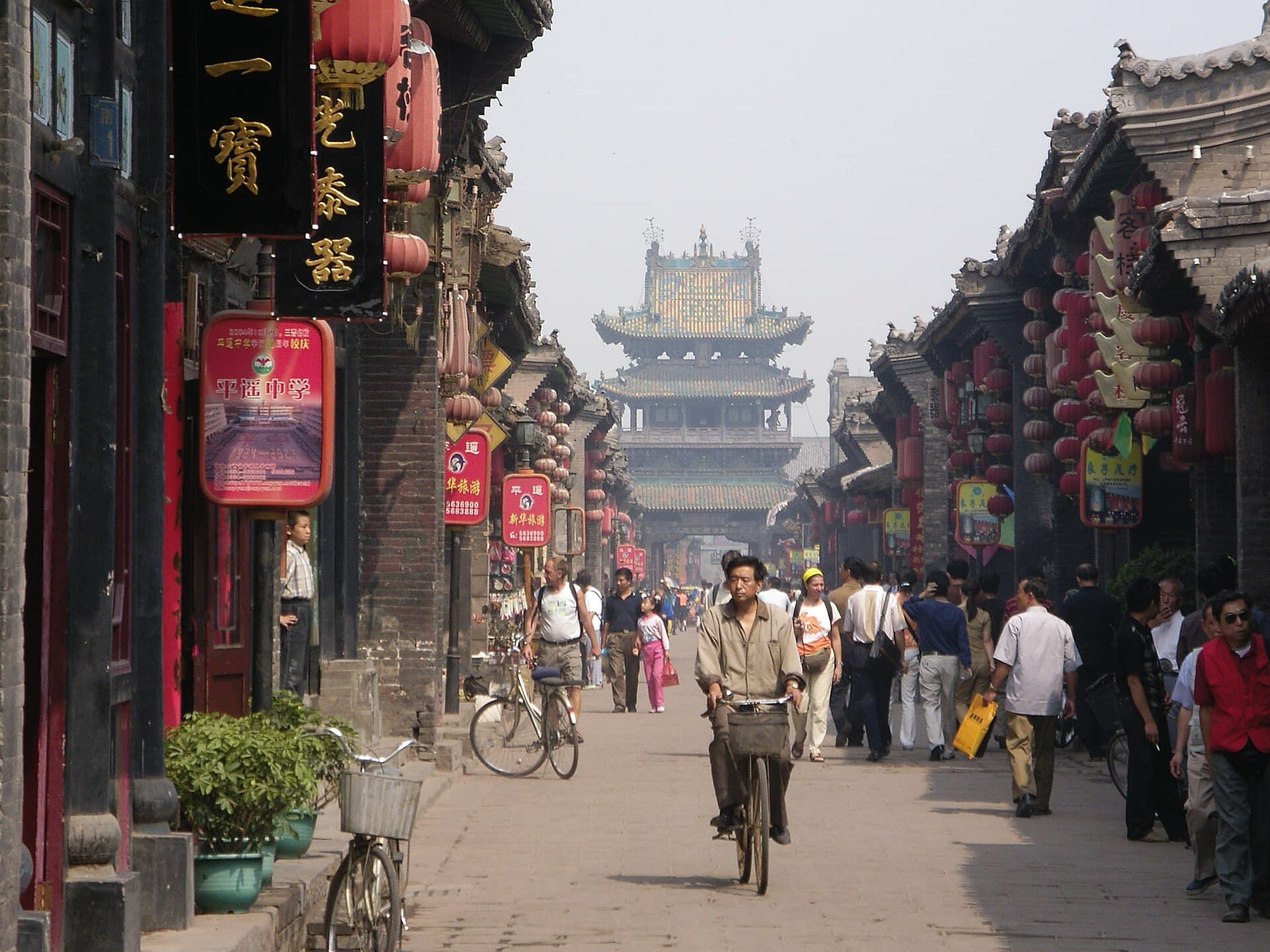 Benzh / Public domain, via Wikimedia Commons
“Where ancient finance met timeless walls.”
Not the postcards. The stories even locals don't know — whispered in your ear, right where they happened.
Pingyao was once the financial heart of China, but the first 'bank' here wasn't just about money.
The city's massive walls, built for defense, also tell a symbolic story.
Beyond the city walls, a quiet temple holds a secret of ancient construction.
Discover every secret of Pingyao
Every address, every reveal in full — in your ear, right where it happened.
You pick your stops. You walk. The voice reveals what the others miss.
No tours available yet. Check back soon — we're preparing them.
Pingyao, a UNESCO World Heritage Site in central Shanxi province, offers a rare, tangible journey into Imperial China. This ancient walled city stands as one of the best-preserved examples of a Han Chinese city from the Ming and Qing dynasties. Its well-maintained urban plan, complete with towering city walls, traditional courtyard houses, and a labyrinth of narrow streets, provides a coherent and immersive historical experience.
Stepping through Pingyao's gates feels like entering a living museum, where the pace slows, and the sounds of modern life fade. The city's authenticity is a defining characteristic, presenting a picture of traditional Chinese life, commerce, and religion that has largely been lost in other rapidly developing urban centers. It’s a place where history isn't just displayed behind glass, but surrounds you, inviting exploration into its cobbled lanes and centuries-old structures.
The origins of Pingyao trace back over 2,800 years to the Western Zhou Dynasty (827-782 BC), when it was initially constructed as a fortress. General Yin Jifu established earthen ramparts for defense during this period. The area transitioned through various states, belonging to Jin during the Spring and Autumn period and later to Zhao during the Warring States era. Under the Qin Dynasty, the town was known as Pingtao, and by the Han Dynasty, it became the seat of a county administration.
The city's iconic walls, which largely define its present-day appearance, were rebuilt and expanded in 1370 during the early Ming Dynasty. These fortifications, averaging 12 meters high and over six kilometers in circumference, feature 72 watchtowers and 3,000 crenellations. The layout within these walls, a tight grid of streets, courtyard houses, temples, and official buildings, has remained remarkably stable for centuries.
Pingyao's economic prominence began to soar from the 16th century, culminating in the 19th century when it emerged as a significant financial center. More than twenty draft banks, or piaohao, operated within the city, with Rishengchang, founded in 1823, becoming the most influential. These institutions revolutionized finance by introducing paper remittances, allowing merchants to transfer money across long distances without the risks of carrying physical silver. Rishengchang, often called China's first draft bank, controlled a substantial portion of China's silver trade at its peak. This period of prosperity, however, began to unravel after the fall of the Qing Dynasty in 1912, leading to Rishengchang's closure in 1914.
In 1997, the ancient city of Pingyao, along with the nearby Shuanglin and Zhenguo Temples, was designated a UNESCO World Heritage Site, recognizing its exceptional preservation of Ming and Qing urban planning and architecture.
Begin your exploration with a walk along the Pingyao City Wall. This 12-meter-high Ming-era fortification completely encircles the ancient town, offering expansive views of the rooftops, temple towers, and narrow streets within. From above, you can appreciate the city's unique 'turtle' shape, a symbol of longevity.
Next, immerse yourself in the world of ancient Chinese finance at the Rishengchang Exchange House. Considered China's first bank, this 19th-century complex showcases original counters, historic documents, and even an underground vault, revealing Pingyao's past as a major financial center.
Explore the Ancient Government Office (Yamen), a large Qing-dynasty complex that once housed courtrooms, jails, and ceremonial halls. Live reenactments of ancient trials are sometimes performed here, bringing history to life.
Wander along Ming-Qing Street (South Street), the main pedestrian thoroughfare lined with traditional shops, teahouses, and red lanterns. In the evenings, the street glows with lanterns, creating a magical atmosphere.
For a quieter experience, visit the Confucian Temple, a serene site with traditional Chinese architecture dating back over 700 years. It is considered the best-preserved Confucian Temple in China. Nearby, the Temple of the City God offers impressive sculptures within its Taoist setting.
Outside the city walls, consider a visit to Shuanglin Temple, known for its collection of over 2,000 decorated clay statues, many dating from the 12th to 19th centuries. Another option is Zhenguo Temple, which features the Wanfo Shrine, one of China's oldest wooden buildings constructed without nails.
The most pleasant times to visit Pingyao are during spring (April to May) and autumn (September to October). Temperatures are mild, making it comfortable for walking the city walls and exploring the narrow streets. Autumn also brings clear skies and the Pingyao International Photography Festival, which draws visitors globally.
Summer (July to August) can be hot and humid with higher rainfall, and also sees peak crowds. Winter (December to February) is cold, with temperatures dropping below freezing at night, but offers a unique, atmospheric experience with potential snow. Chinese New Year in February is particularly festive, with red lanterns and dragon dances transforming the city.
Pingyao is easily accessible by high-speed train, with Pingyao Gucheng Station about 15-20 minutes from the ancient city walls. Direct trains are available from major cities like Beijing and Xi'an. Taiyuan Wusu Airport is approximately 100 km away, with shuttle buses connecting to Pingyao.
Within the ancient city walls, cars are not permitted, making it ideal for walking or cycling. Battery-powered sightseeing cars are available for longer distances. A single entrance ticket, valid for three days, grants access to around 20 attractions within the city. Many guesthouses inside the old town are beautifully restored courtyard homes, offering a traditional stay. Staying overnight allows you to experience the city's tranquil mornings and lantern-lit evenings after most tour groups have departed.