The Siq
The entrance to Petra is a dramatic, winding gorge. Yet, it is more than just a path.
Full story unlocks in the tour
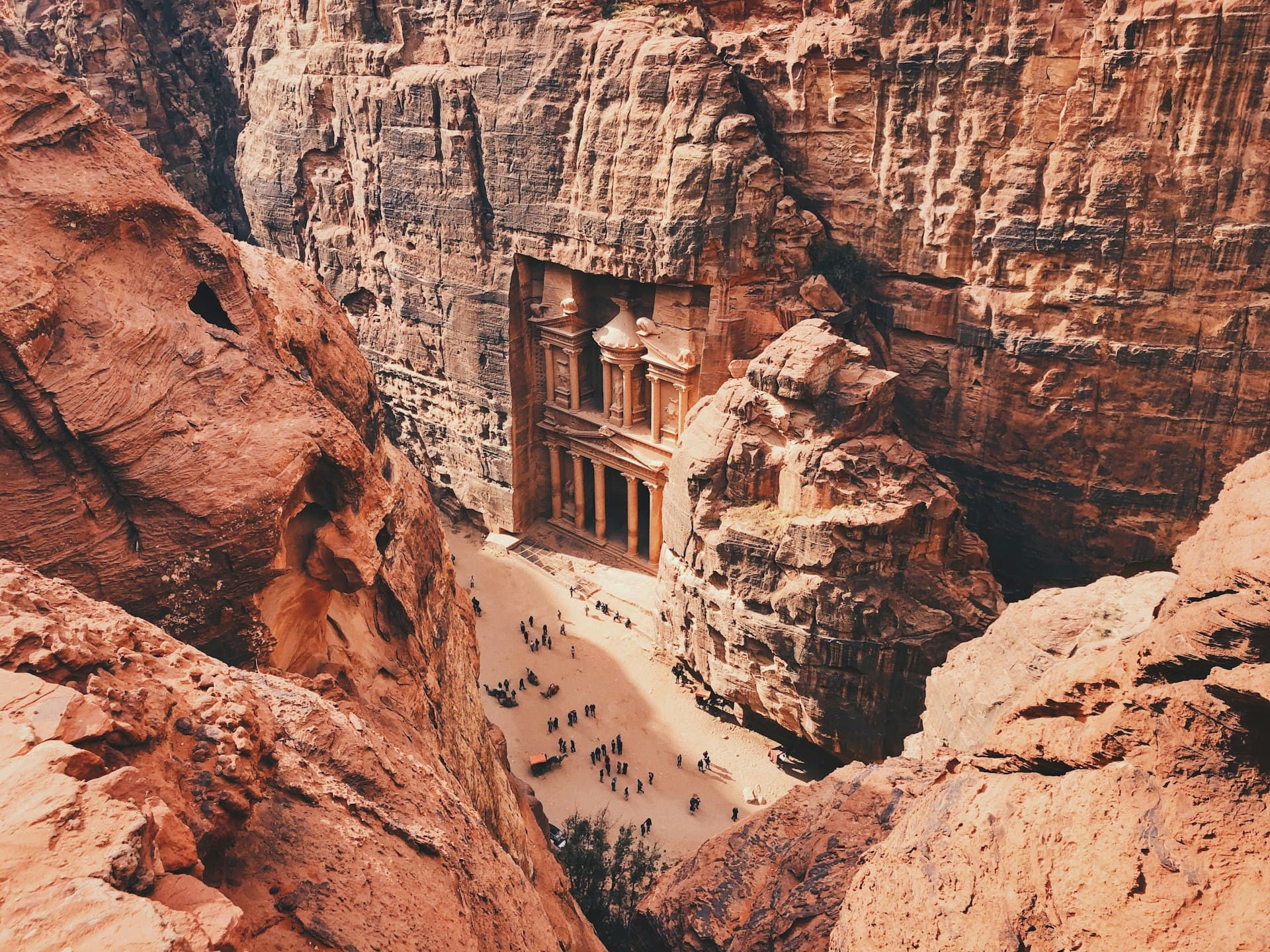 Photo: Alex Vasey / Unsplash
“Walk through a narrow canyon to a city carved from rose-red stone.”
Not the postcards. The stories even locals don't know — whispered in your ear, right where they happened.
The entrance to Petra is a dramatic, winding gorge. Yet, it is more than just a path.
The most iconic facade in Petra is not what its name suggests.
A short distance from Petra lies a smaller, often overlooked site with a unique secret.
Discover every secret of Petra
Every address, every reveal in full — in your ear, right where it happened.
You pick your stops. You walk. The voice reveals what the others miss.
No tours available yet. Check back soon — we're preparing them.
Petra, often called the “Rose City” for its distinctive rose-colored sandstone, is an ancient city and archaeological site in southern Jordan. This UNESCO World Heritage Site and one of the New Seven Wonders of the World is renowned for its rock-cut architecture and sophisticated water conduit systems. Once the thriving capital of the Nabataean Kingdom, Petra served as a vital trading hub, connecting Arabia, Egypt, and the Mediterranean.
Carved into shimmering sandstone cliffs, Petra's monumental facades and dramatic desert setting have captivated travelers for centuries. Though its exact founding date is unknown, the city began to prosper around the 1st century BCE, reaching a population of up to 30,000 to 40,000 inhabitants. Petra’s unique blend of natural beauty and ingenious human engineering makes it an unforgettable destination, inviting visitors to explore its labyrinthine passages and uncover the mysteries of its past.
## The Rise of the Nabataeans Petra's story begins with the Nabataeans, an ancient Arab people who emerged in the deserts of northern Arabia as early as the 4th century BCE. Originally nomadic, they mastered survival in harsh desert environments and evolved into highly skilled traders. By controlling crucial caravan routes that transported spices, frankincense, bitumen, and textiles, the Nabataeans accumulated immense wealth and political influence. They established Petra as their capital, strategically choosing its location for its proximity to trade routes and a perennial spring.
## A City Carved from Stone and Water The Nabataeans literally carved their city into the mountains, creating elaborate structures directly from the rose-red sandstone cliffs. Beyond their architectural prowess, they were engineering geniuses, particularly in hydrology. In a desert region receiving only about 86 mm (3.4 inches) of rainfall annually, they developed an intricate water system. This sophisticated network included channels and pipes carved along cliff faces, covered ceramic pipelines to reduce evaporation, and cisterns capable of storing thousands of liters. Dams and reservoirs controlled flash floods and filtered sediment, ensuring a continuous water supply for a population of up to 40,000, supporting public baths, gardens, and trade caravans.
## Roman Annexation and Decline By 106 AD, the Nabataeans lost their independence, and Petra was annexed by the Roman Empire, becoming the capital of the Roman province of Arabia Petraea. Under Roman rule, Petra continued to prosper for a time, with modifications like the Roman-style theater. However, the emergence of new sea trade routes gradually diminished Petra's importance as a trading hub, leading to a decline in its population. A major earthquake in 363 AD destroyed many buildings and severely damaged the city's vital water system, further contributing to its abandonment. While some Christian churches were built during the Byzantine era, the city continued its decline and was largely abandoned by the early Islamic era, used primarily for shelter by nomadic shepherds for centuries.
## Rediscovery and Modern Recognition Petra remained unknown to the Western world until 1812, when Swiss explorer Johann Ludwig Burckhardt, disguised as a Bedouin, rediscovered the site. His accounts sparked renewed interest, and Petra's fame grew. In 1985, UNESCO inscribed Petra as a World Heritage Site, recognizing it as one of the most precious cultural properties of humanity. In the early 2000s, it was named one of the New Seven Wonders of the World, leading to a significant increase in tourism and ongoing efforts to protect its fragile ruins.
The journey into Petra typically begins with the Siq, a narrow, winding gorge with towering sandstone cliffs that dramatically reveal the iconic Al-Khazneh (The Treasury). Beyond the Treasury, the Street of Facades presents a row of rock-cut tombs and houses. Nearby, the ancient Nabataean Theatre, carved directly into the rock, could seat over 6,000 spectators.
Further into the site, the Royal Tombs—including the Urn Tomb, Silk Tomb, Corinthian Tomb, and Palace Tomb—display Hellenistic architectural influences carved into the cliffs. The Colonnaded Street, a remnant of Roman influence, was once a main shopping thoroughfare. At its end lies the Qasr al-Bint temple and the Great Temple, one of Petra's largest archaeological structures. For those with energy, a hike up 800 steps leads to Ad Deir (The Monastery), a monumental facade rivaling the Treasury in splendor and offering expansive views. Consider the Al-Khubtha Trail for a panoramic viewpoint overlooking the Treasury, the Theatre, and the Street of Facades.
The best times to visit Petra are during the spring (March to May) and autumn (September to November). During these months, temperatures are pleasantly mild, ranging from around 20°C to 25°C (68°F to 77°F), making it comfortable for exploring the vast archaeological site. The weather is generally dry, and the landscape in spring can be alive with wildflowers. While these are peak tourist seasons, arriving early in the morning, around 6:00 AM when the site opens, can help you avoid the largest crowds and the midday heat. Summer (June to August) can be scorching, with temperatures often exceeding 30°C (86°F), making extended exploration challenging. Winter (December to February) brings cooler temperatures, occasional rainfall, and fewer crowds, but nights can be cold, and there's a possibility of snow.
Petra is a large archaeological site, so comfortable, sturdy walking shoes are essential. Dress modestly out of respect for local customs, covering shoulders and knees; a scarf can also offer protection from sun and dust. Bring a hat, sunglasses, and plenty of sunscreen, as shade is limited within the site. Carrying sufficient water is crucial, though it can be purchased inside the park at a higher price.
The entrance fee for Petra varies, with a one-day ticket costing 50 Jordanian dinars (approximately $70 USD) for adults. Children under 12 enter for free. The Jordan Pass is highly recommended for international visitors, as it includes visa fees and entry to over 40 attractions, including Petra. The Petra Visitor Centre opens daily from 6:00 AM to 6:00 PM in summer and 6:00 AM to 4:00 PM in winter. Guided tours are available and can provide valuable insights. Restrooms, restaurants, and souvenir shops are located near the entrance and within the site. While you cannot stay overnight inside the archaeological site, the nearby town of Wadi Musa offers a range of accommodation options.