Place du Tilleul
The grand lime tree in Pérouges' main square offers more than just shade.
Full story unlocks in the tour
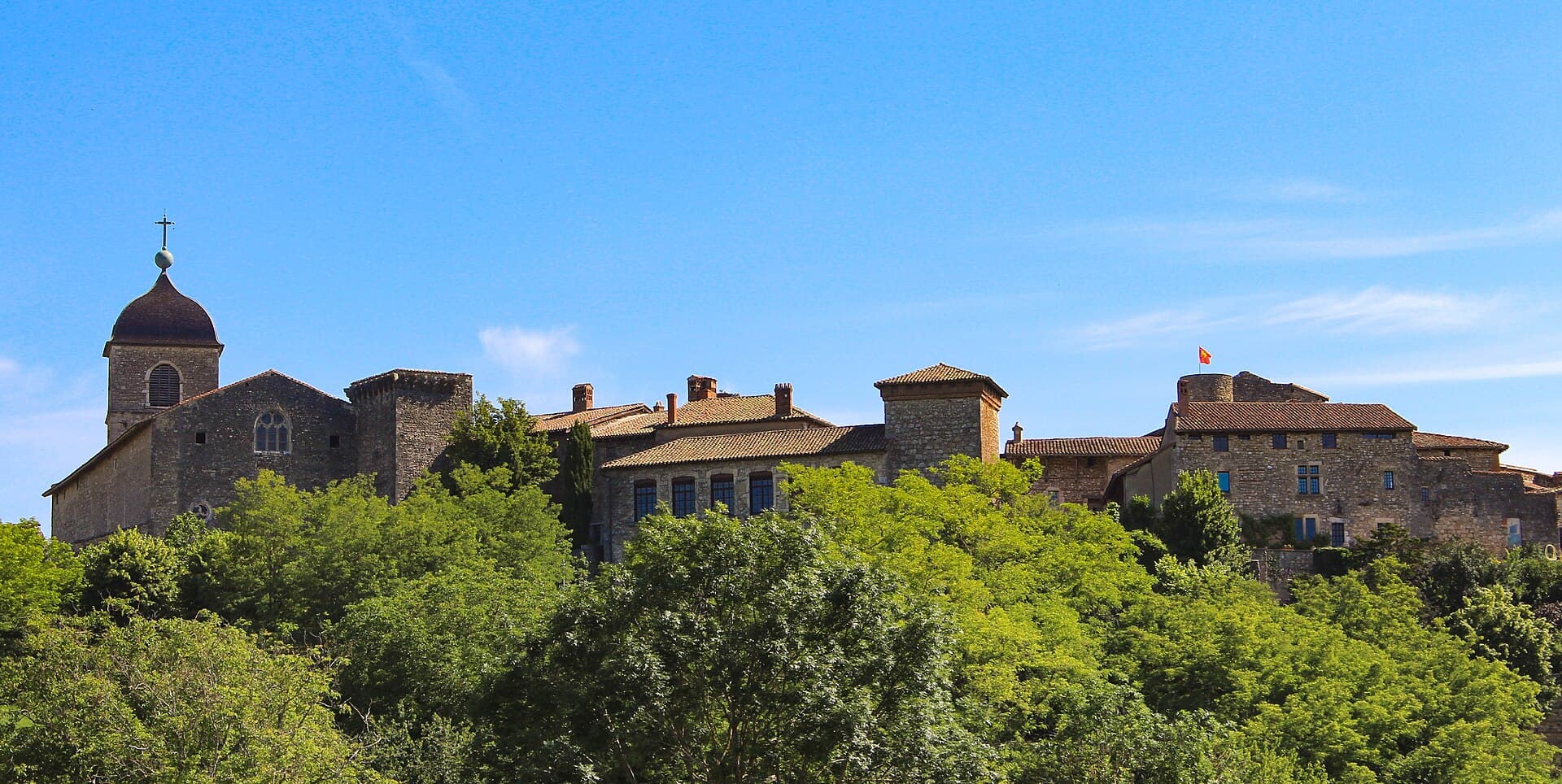 Marilou Perino / CC BY-SA 4.0, via Wikimedia Commons
“Where ancient stones recount centuries of life.”
Not the postcards. The stories even locals don't know — whispered in your ear, right where they happened.
The grand lime tree in Pérouges' main square offers more than just shade.
The irregular stones underfoot reveal a story of ingenuity.
This church served a dual purpose beyond spiritual comfort.
Discover every secret of Pérouges
Every address, every reveal in full — in your ear, right where it happened.
You pick your stops. You walk. The voice reveals what the others miss.
No tours available yet. Check back soon — we're preparing them.
Upon a hilltop overlooking the Ain plain, Pérouges stands as a medieval walled town, seemingly untouched by time. Situated approximately 30 kilometers northeast of Lyon, this village is celebrated for its well-maintained architecture, featuring stone-paved paths and timber-framed homes.
Passing through its ancient archways, visitors are transported to an earlier era, where the authenticity of its past is carefully preserved. The village, recognized as one of "Les Plus Beaux Villages de France" (The Most Beautiful Villages of France), draws those seeking a glimpse into medieval life.
Despite its popularity, Pérouges maintains a serene atmosphere, with residents still living within its old walls. It offers a distinct opportunity to wander through historical passageways, discover artisan workshops, and taste local culinary traditions, such as the famous Galette de Pérouges.
Pérouges possesses ancient origins, with archaeological evidence pointing to human presence as early as the Chalcolithic age (around 2500 to 1800 BC). The town as it stands today began to take form in the Middle Ages, with the first documented records appearing in the 12th century. Initially a fortified settlement, its strategic hilltop position overlooking the Ain plain, at the intersection of trade routes between Lyon and Geneva, was vital for its development.
By the 13th century, Pérouges had acquired a fortified wall and a compact urban layout that largely remains today. The town gained charters of franchise by 1236, granting its inhabitants particular freedoms and self-governance. Between the late 15th and 16th centuries, Pérouges experienced an economic peak, thriving on the linen and cloth trade. Artisans and weavers prospered, contributing to a steady population increase that reached nearly 1,500 residents by the end of the 18th century.
The 19th century brought considerable difficulties. The Industrial Revolution and the re-routing of roads and railways bypassed Pérouges, leading to a dramatic reduction in its textile industry and population, which fell from 1,500 to as few as 90 inhabitants. The village faced the threat of demolition in 1909. However, a dedicated group of locals formed the Comité de Défense et de Conservation du Vieux Pérouges in 1912, committed to safeguarding the town's history and architecture. With support, an ambitious restoration project began, transforming the Maison des Princes into a museum and opening the Hostellerie to accommodate travelers.
These efforts succeeded, and Pérouges became known for its authentic medieval appearance, attracting filmmakers as early as 1921 for productions like The Three Musketeers. Today, Pérouges is celebrated for its preserved heritage and is a popular destination for travelers, offering a tangible connection to medieval urban planning and craftsmanship.
Begin your exploration at the Upper Gate (Porte d'en Haut), where the tourist office is located. The entire village is pedestrian-only, making it ideal for walking. Wander the stone-paved paths, observing the distinctive half-timbered houses and stone facades. The main square, Place du Tilleul, forms the core of the village, featuring a historic lime tree planted in 1792. Here, you'll find the 13th-century inn, Hostellerie du Vieux Pérouges, and the Museum of Old Pérouges.
Visit the fortress-like Church of Sainte-Marie Madeleine, a 15th-century structure that served both as a place of worship and defense. Stroll along the medieval ramparts for wide views of the Rhône Valley and, on a clear day, even the distant Alps. Discover artisan shops selling local crafts, from ceramics to woodworking and leather goods. Do not miss trying the local specialty, the Galette de Pérouges, a sweet, buttery dessert.
The most favorable time to visit Pérouges is between April and October, when the weather is agreeable with average temperatures ranging from 18°C to 29°C. These months offer excellent conditions for sightseeing and exploration. December is also a popular time to visit for the festive Christmas market. To avoid larger gatherings, consider visiting early in the day before 10 AM or later in the afternoon after 3 PM.
Pérouges is readily accessible, located about 30-40 minutes from Lyon. The most convenient way to reach the village is by car via the A42, or by train from Lyon Part-Dieu to Meximieux-Pérouges station, followed by a 20-minute walk. Parking is available at the base of the hill, as the village itself is pedestrian-only.
Plan for 2-4 hours to explore thoroughly. Wear comfortable, sturdy shoes due to the uneven stone-paved paths. While exploring is free, plan for parking, food, and optional museum visits or guided tours. Many shops close for lunch, typically from 12:30 PM to 2:30 PM. Public restrooms are available near the main square.