The Casa de las Conchas (House of Shells)
A residence in Peñíscola's old town is completely covered in seashells, yet the story behind its unique facade speaks less of mere decoration and more of resourceful survival.
Full story unlocks in the tour
 Grodin.tierce / CC BY-SA 3.0, via Wikimedia Commons
“Where ancient stones meet cinematic seas.”
Not the postcards. The stories even locals don't know — whispered in your ear, right where they happened.
A residence in Peñíscola's old town is completely covered in seashells, yet the story behind its unique facade speaks less of mere decoration and more of resourceful survival.
This formidable Templar fortress once sheltered a pope, and a clandestine staircase within its walls was rumored to have appeared overnight.
Beneath the old town lies a natural sea cave that, under specific conditions, creates a dramatic spectacle.
Discover every secret of Peñíscola
Every address, every reveal in full — in your ear, right where it happened.
You pick your stops. You walk. The voice reveals what the others miss.
No tours available yet. Check back soon — we're preparing them.
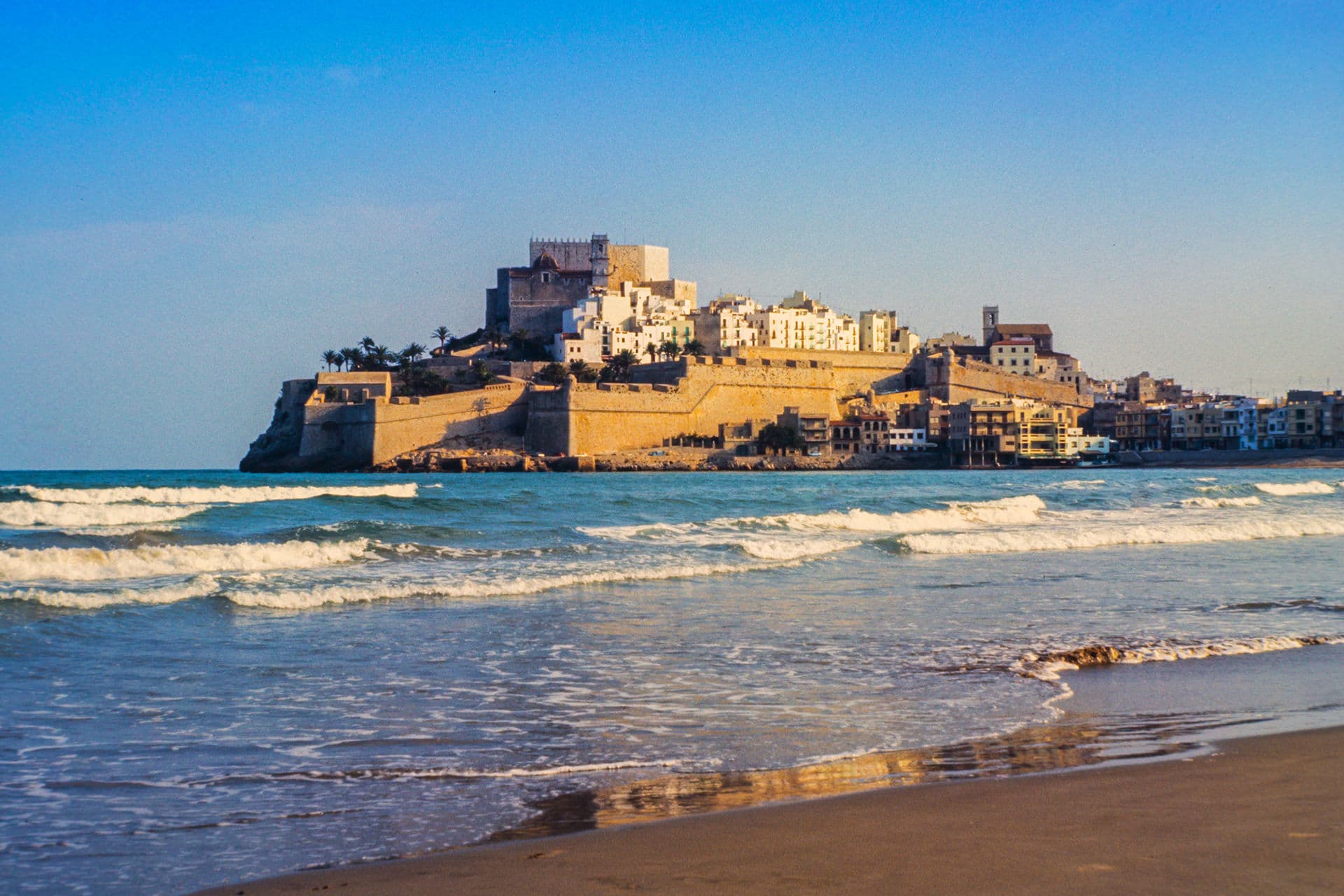
Peñíscola, sometimes referred to as the "Gibraltar of Valencia" or "The City in the Sea," rises from a fortified rocky peninsula along Spain's northern Costa del Azahar. This historic town, home to approximately 8,000 year-round residents, is defined by its walled medieval quarter, which ascends 64 meters above the Mediterranean. Its distinctive geography, linked to the mainland by a slender strip of land, has rendered it a strategic stronghold for centuries.
Beyond its striking silhouette, Peñíscola offers a convergence of ancient history and Mediterranean allure. Its winding lanes, ancient walls, and the commanding Castle of Peñíscola recount narratives spanning over 2,500 years, from early civilizations to medieval grandeur and its contemporary role as a tourist destination. The town has also seized the imagination of filmmakers, serving as a backdrop for significant productions like El Cid and Game of Thrones.
Peñíscola's story stretches back over 2,500 years, with the earliest evidence of human habitation dating to the Iberian period, specifically the Ilercavones during the Bronze Age. These early inhabitants engaged in commerce with Phoenicians and Greeks, who left their imprint on the city's designation. The Greeks from Zacynthos named it Quersonesos, meaning "peninsula," a term later adapted by the Romans to Paene + Insula, meaning "almost an island," which eventually evolved into today's Peñíscola. Under Roman governance, Peñíscola developed into a strategic port, fostering trade and growth in the area.
In 718 AD, Peñíscola came under Muslim dominion, known as Banaskula, and was transformed into an unassailable fortress by the sea. Its strategic position made it a crucial trading port and a base for incursions into Catalonia. The Arab Alcazaba, constructed atop the tombolo, served as the city's defensive core, encircled by farming villages. Muslim control concluded in the 13th century with the Christian Reconquest. King Jaume I of Aragon granted Peñíscola its charter of population in 1251, establishing Christian governance.
The most recognizable structure, Peñíscola Castle, was primarily erected by the Knights Templar between 1294 and 1307, upon the foundations of earlier Phoenician and Arab walls. The Templars, a Christian military order, received Peñíscola in 1294 and focused on creating an impregnable fortress. After the Templars were suppressed in 1312, the castle was assumed by the Order of Montesa.
Peñíscola gained particular historical prominence in the early 15th century when it became the stronghold of Antipope Benedict XIII, also known as Papa Luna (Pedro de Luna). He resided in the castle from 1417 until his passing in 1423, making Peñíscola one of only three towns in Europe, alongside Rome and Avignon, to have hosted a papal court. During his tenure, he transformed the castle into a papal residence and amassed a significant library.
In the 16th century, under King Philip II, Peñíscola's defenses were reinforced against pirate incursions and Turkish attacks. Military architect Giovanni Battista Antonelli designed these Renaissance fortifications, including the Portal Fosc. The 19th century saw Peñíscola endure Napoleonic occupation and the Carlist Wars, yet it maintained its function as a trading port. The latter half of the 20th century marked a turning point with the expansion of tourism, significantly boosted by films like El Cid (1961) and Calabuch (1956), which showcased Peñíscola's beauty internationally. More recently, the town served as a filming location for the acclaimed series Game of Thrones.
The central focus of Peñíscola is the Castillo de Peñíscola, also known as Papa Luna's Castle. This 13th-century Templar fortress, later a papal residence, provides expansive views of the Mediterranean. Explore its Romanesque architecture, including the Guard Corps and the Templars' Basilica. Surrounding the castle is the Walled Old Town, a maze of whitewashed pathways within 16th-century Philip II walls. Wander through these appealing streets, uncovering viewpoints and historic gates like the Portal de Sant Pere and Portal Fosc.
Do not overlook the Bufador, a natural sea cave where, on stormy days, seawater dramatically bursts forth. The Casa de las Conchas (House of Shells), a distinctive building adorned with countless shells, offers another intriguing stop. For those who appreciate nature, the Sierra de Irta Natural Park to the south presents unspoiled coastal mountain ranges, secluded coves, and walking paths. The Harbor and Promenade offer an animated atmosphere, especially around 5 PM when fishing trawlers return with their daily catch. You can also walk along portions of the city walls for striking photographic opportunities with old watchtowers.
Peñíscola can be appreciated throughout the year, but the ideal time for pleasant weather and manageable crowds is late spring (May-June) or early autumn (September-October). During these months, daytime temperatures range from 20-28°C (68-82°F), and the Mediterranean is warm enough for swimming. The summer months of July and August bring peak heat (28-32°C / 82-90°F) and larger crowds, with Spanish families gathering on the beaches. If you prefer a more tranquil experience, November to March offers mild, breezy weather (13-18°C / 55-64°F) and nearly private castle visits, though some dining establishments may be closed.
Peñíscola is situated on the northern Costa del Azahar, approximately 140 kilometers north of Valencia. The nearest major airports are Valencia Airport (140 km south) and Barcelona-El Prat Airport (240 km north), with Castellón Airport (65 km away) serving budget airlines. Renting a car is a convenient choice for navigating the area. The old town is entirely walkable and largely pedestrianized.
Restaurants typically serve lunch between 2-4 PM and dinner rarely before 9 PM, so plan your meals accordingly. While Peñíscola is considered a secure destination, be mindful of minor pickpocketing in crowded areas during summer festivities. Both Castilian Spanish and Valencian (a Catalan dialect) are official languages, with street signs and menus often bilingual. ATMs from CaixaBank and Santander generally impose lower fees than tourist-oriented Euronet machines.