Pécs Cathedral
The grand Pécs Cathedral, with its four towers, holds a secret beneath its imposing facade.
Full story unlocks in the tour
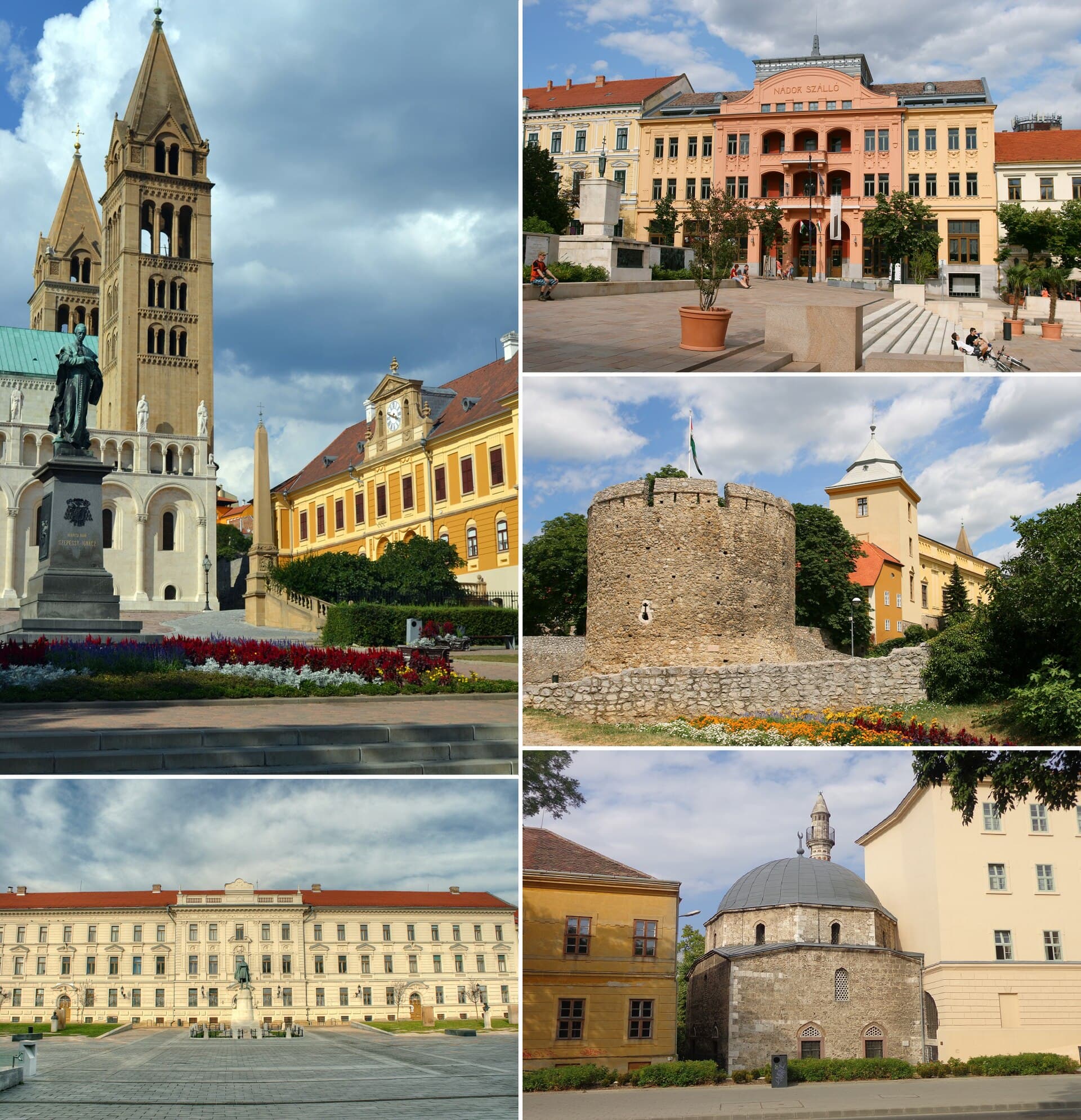 Imoti95 / CC BY-SA 4.0, via Wikimedia Commons
“Where Roman roots, Ottoman domes, and Zsolnay artistry intertwine.”
Not the postcards. The stories even locals don't know — whispered in your ear, right where they happened.
The grand Pécs Cathedral, with its four towers, holds a secret beneath its imposing facade.
Beneath the modern streets of Pécs lies a subterranean world that tells a surprising story of early Christianity.
The Zsolnay Cultural Quarter is more than just a collection of museums; it is a living legacy of a family's artistic innovation.
Discover every secret of Pécs
Every address, every reveal in full — in your ear, right where it happened.
You pick your stops. You walk. The voice reveals what the others miss.
No tours available yet. Check back soon — we're preparing them.
Pécs, the fifth largest city in Hungary, offers a captivating blend of history, culture, and a distinct sub-Mediterranean atmosphere. Located in the country's southwest, at the foot of the Mecsek Mountains and near the Croatian border, Pécs has been a crossroads of civilizations for over two millennia. Its mild climate, more sunshine hours than much of Hungary, and a relaxed pace make it an inviting destination for those seeking to explore beyond Budapest.
The city's identity is a rich fabric woven from Roman foundations, Ottoman rule, and Hungarian artistry. Recognized as a UNESCO World Heritage site and a former European Capital of Culture in 2010, Pécs presents a unique opportunity to witness layers of history in its architecture, museums, and public spaces. From ancient Roman burial grounds to Ottoman mosques now serving as churches, and the distinctive Zsolnay porcelain that graces its buildings, Pécs rewards leisurely exploration.
The origins of Pécs stretch back to ancient times, with archaeological findings dating back 6,000 years, and the area inhabited by Celts before the Roman era. The Romans founded the city of Sopianae in the early 2nd century, establishing wine-producing colonies in what was then the province of Pannonia. By the 4th century, Sopianae had evolved into a significant early Christian center, a legacy profoundly preserved in its UNESCO-listed Early Christian Necropolis.
In early medieval Hungary, Pécs, known in Latin documents as Quinque Ecclesiae ('Five Churches'), became an important religious hub and episcopal seat. King Stephen I founded the Roman Catholic Diocese of Pécs in 1009. A pivotal moment arrived in 1367 with the establishment of Hungary's first university by King Louis I the Great, solidifying Pécs's role as a center of learning and culture. Janus Pannonius, a prominent humanist poet and Bishop of Pécs in the 15th century, further enhanced the city's cultural standing.
The 16th century brought a dramatic shift with the Ottoman occupation, which lasted from 1543 to 1686. During this period, Pécs transformed into an important Muslim center, leaving behind a substantial architectural heritage, including the largest number of Turkish Ottoman buildings in Central Europe. The Mosque of Pasha Qasim, now a Catholic church, stands as a prominent reminder of this era, its Ottoman dome and Islamic architectural features coexisting with Christian elements. Following the Austro-Hungarian Compromise of 1867, Pécs experienced significant development, including railway connections to Budapest, and saw the rise of industries like the world-renowned Zsolnay porcelain and ceramics.
Begin your exploration at Széchenyi Square, the lively heart of Pécs, where historical landmarks converge. Here, the Mosque of Pasha Qasim, now a Catholic church, dominates the square with its distinctive dome. Nearby, you will find the ornate Zsolnay Fountain, a testament to the city's famous porcelain artistry.
A short stroll leads to the Pécs Cathedral, an imposing four-towered basilica with origins dating back to the Roman period. Adjacent to the cathedral is the UNESCO World Heritage-listed Early Christian Necropolis, an underground complex of 4th-century burial chambers adorned with intricate frescoes. Delve into the city's artistic side at the Zsolnay Cultural Quarter, a sprawling complex featuring museums, galleries, and artisan shops showcasing the Zsolnay ceramics, including the iconic eosin glaze.
For expansive views, ascend the Pécs TV Tower on Misina Hill, offering sweeping vistas of the city and surrounding Mecsek Mountains. Explore the Tettye district, where the Tettye Ruins provide a unique atmosphere amidst gardens and elevated viewpoints. Do not miss the Jakovali Hassan Pasha Mosque, unique for retaining its original minaret. The city also offers several museums, including the Csontváry Museum, dedicated to the renowned Hungarian painter Tivadar Csontváry Kosztka, and the Modern Hungarian Gallery.
Pécs enjoys a sub-Mediterranean climate, offering milder winters and more sunshine hours than much of Hungary. The ideal times to visit are late spring (May to June) and early autumn (September to October). During these months, temperatures are pleasant, ranging from 20-25°C (68-77°F), perfect for outdoor exploration without extreme heat or cold. Summers (July-August) can be warm to hot, with temperatures sometimes exceeding 30°C (86°F), though evenings offer a refreshing drop in temperature. Winter is generally mild by Hungarian standards, with less snow than Budapest, and offers a quieter experience with lower prices and festive Christmas markets.
Pécs is a compact and walkable city, making it easy to explore its historic center on foot. For reaching the suburbs or further attractions, city buses are available. Most international visitors arrive via Budapest, with direct trains taking approximately 2.5 to 3.5 hours. The local currency is the Hungarian Forint (HUF), and while some tourist-oriented businesses may accept Euros, it is advisable to carry HUF for markets and taxis. ATMs are readily available.
Pécs is generally considered a safe city for tourists, with a low crime rate. Standard urban precautions, such as securing valuables and avoiding poorly lit streets at night, are recommended. While Hungarian is the official language, many people in the tourism sector speak English or German. Learning a few basic Hungarian greetings like "Szia" (hi) and "Köszönöm" (thank you) is always appreciated. Tipping 10-15% in restaurants is customary if service is not included.