St. Stephen's Cathedral
The world's largest cathedral organ in Passau holds a secret beyond its impressive pipe count.
Full story unlocks in the tour
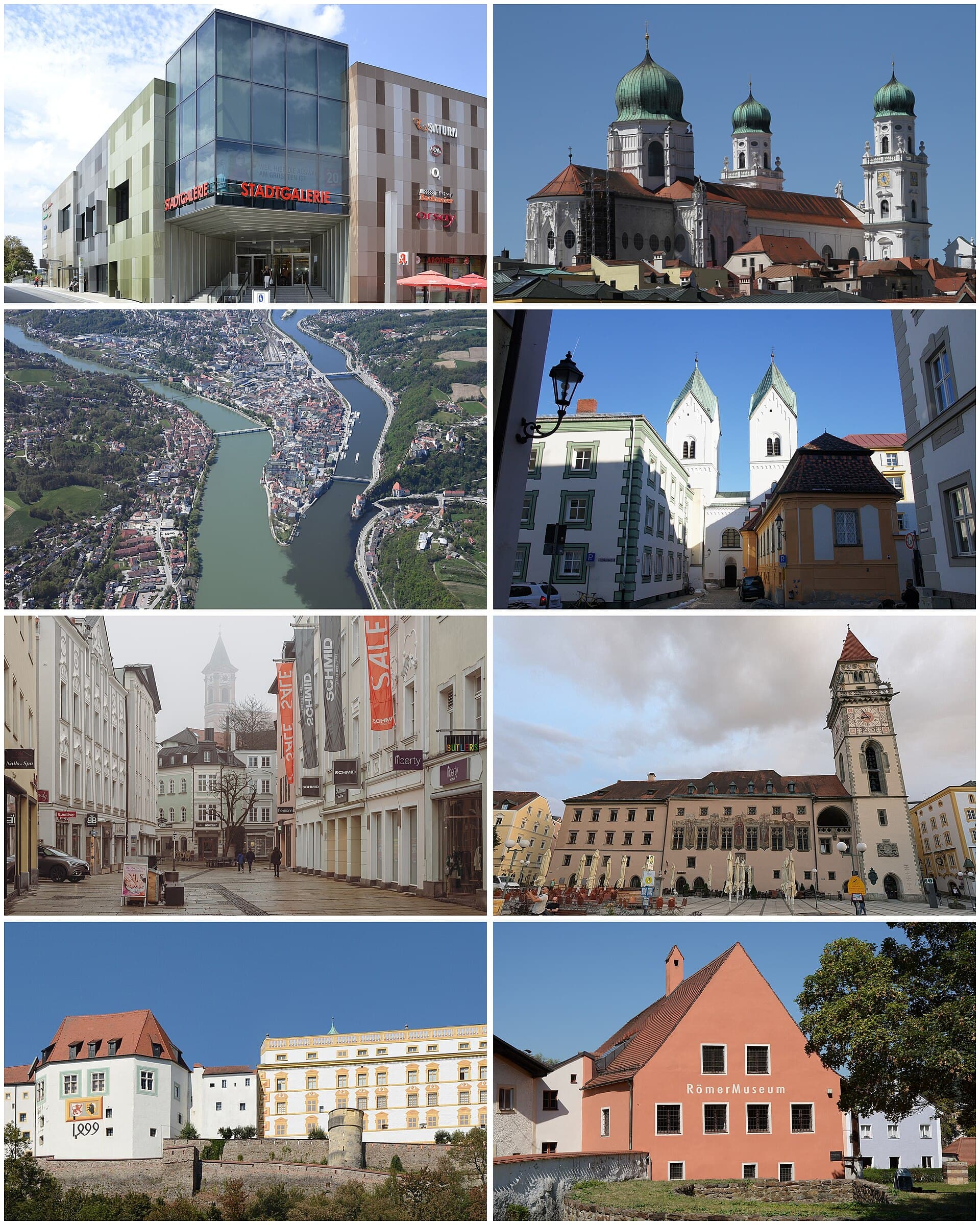 Compiled by Viceskeeni2 / CC0, via Wikimedia Commons
“Where three rivers converge, Baroque beauty unfolds.”
Not the postcards. The stories even locals don't know — whispered in your ear, right where they happened.
The world's largest cathedral organ in Passau holds a secret beyond its impressive pipe count.
The medieval Veste Oberhaus fortress, towering over Passau, displays a peculiar detail on one of its towers that hints at a historical workaround.
At Passau's famous confluence, the three rivers—Danube, Inn, and Ilz—meet, yet they don't immediately blend into one uniform color.
Discover every secret of Passau
Every address, every reveal in full — in your ear, right where it happened.
You pick your stops. You walk. The voice reveals what the others miss.
No tours available yet. Check back soon — we're preparing them.
Passau, often called the "City of Three Rivers" or "Bavarian Venice," is a captivating city in southeastern Germany, situated at the confluence of the Danube, Inn, and Ilz rivers near the Austrian border. Its unique geography, where three distinct waterways converge, has shaped its identity for over 2,000 years, creating a picturesque old town with a blend of German and Austrian influences and ornate Italian Baroque architecture.
The city's allure lies in its walkable, stone-paved streets, impressive historical buildings, and the ever-present backdrop of its rivers. From the commanding Veste Oberhaus fortress that offers sweeping views of the city and its waterways to the grandeur of St. Stephen's Cathedral, Passau invites exploration. It's a destination that seamlessly weaves together a storied past with a lively present, evident in its student population and thriving café culture.
Passau serves as a popular stop for Danube River cruises and a starting point for cycling enthusiasts on the Danube Cycle Path. Whether you're drawn to its architectural splendor, its unique natural phenomenon, or its cultural offerings, Passau offers a memorable experience.
Passau's history stretches back over 2,000 years, beginning as a Celtic settlement known as Bojodurum. Later, it became the site of a Roman camp called Castra Batava. In the 5th century, Saint Severinus established a monastery in the city. The diocese of Passau was founded in 739 AD by Archbishop Boniface, and for a significant period, it was the largest diocese in the Holy Roman Empire.
From the 10th century, the bishops of Passau gained secular authority, becoming powerful prince-bishops who ruled the city until 1803. In 1219, they constructed the formidable Veste Oberhaus fortress, which overlooked the confluence of the three rivers and served as a symbol of their power. Despite their authority, the prince-bishops faced resistance from the townsfolk, who unsuccessfully attacked the fortress three times in an attempt to gain municipal freedom.
During the Middle Ages, Passau flourished as an important trade and shipping center, primarily due to its strategic location on the rivers. The salt trade, often referred to as "white gold," was particularly lucrative, with Passau collecting taxes on all commerce passing through its waterways. The city was also renowned for its production of swords and bladed weapons during the Renaissance, with Passau smiths stamping their blades with the distinctive "Passau wolf" mark, believed by superstitious warriors to confer invulnerability.
Devastating fires in 1662 and 1680 destroyed much of the city. The subsequent rebuilding efforts, led by Italian architects and artisans like Carlo Lurago and Giovanni Battista Carlone, gave Passau its distinctive Italian Baroque character, which is still evident today in its ornate buildings and cathedral. Throughout its history, Passau has also been prone to flooding due to its riverine location, with high-water marks on the town hall serving as a visual timeline of these events.
In 1803, Passau was secularized and divided between Bavaria and Salzburg, eventually becoming part of Bavaria in 1805. The city also played a role in World War II, housing three sub-camps of the Mauthausen-Gusen concentration camp. Today, Passau is an economic, cultural, and communications hub for southeastern Bavaria, known for its university and a blend of historical significance and modern life.
Begin your exploration at the Dreiflüssseeck (Three Rivers Confluence), where the Danube, Inn, and Ilz rivers meet, showcasing a remarkable interplay of distinct water colors. For expansive views of this natural spectacle and the city, ascend to Veste Oberhaus, a medieval fortress now home to a museum detailing Passau's history. You can reach it via a scenic trail with 200 steps or a shuttle bus from the town hall square.
In the heart of the Old Town, St. Stephen's Cathedral (Dom St. Stephan) dominates the skyline with its Baroque architecture and green, onion-domed towers. Inside, marvel at the world's largest cathedral organ, which features 17,974 pipes and 233 registers across five separate instruments. Organ recitals are held on weekdays at noon from May to October.
Wander through the appealing Old Town (Altstadt), with its stone-paved streets, picturesque squares like Residenzplatz, and Italian-style Baroque buildings. Explore Höllgasse (Artists' Alley), a colorful street lined with galleries and workshops. Other notable sights include the Passau Glass Museum, showcasing Bohemian glass, and the historic Town Hall (Altes Rathaus), where flood marks on its facade tell tales of the city's relationship with its rivers.
Passau welcomes visitors year-round, but the main season extends from spring through fall. For warm-weather activities and pleasant temperatures, late June to early September is ideal, with average highs around 74°F (23°C). This period also sees numerous fairs, concerts, and events. Spring (March to May) and fall (September onwards) offer cooler temperatures and fewer crowds, making them excellent shoulder seasons, with autumn providing particularly vivid fall colors along the rivers. Winter (November to March) can be cold, often dropping below freezing, but the Christmas market transforms the Old Town into a festive wonderland in December. Be prepared for occasional rainfall throughout the year.
Passau is a very walkable city, with most main sights easily accessible on foot. However, some streets are stone-paved and uneven, and there are steep paths and steps, such as the trail to Veste Oberhaus, so comfortable, flat shoes are recommended. For those with mobility issues, the Passau tourist office offers downloadable maps of barrier-free routes.
Getting to Passau is convenient. The closest major airports are Munich International Airport (MUC) in Germany and Linz Airport (LNZ) in Austria. From these airports, you can reach Passau by train or rental car. Train connections are excellent, with regular services from Munich (approximately 2.5 hours) and Vienna (around 3 hours). The A3 autobahn provides easy car access. If you plan to explore on your own, consider purchasing a 24-hour Passau RegioCard for discounted admission to many attractions.