Palencia Cathedral, Door of the Dead
Examine a particular gargoyle on the cathedral, and you might discern a figure quite unexpected for a medieval religious structure.
Full story unlocks in the tour
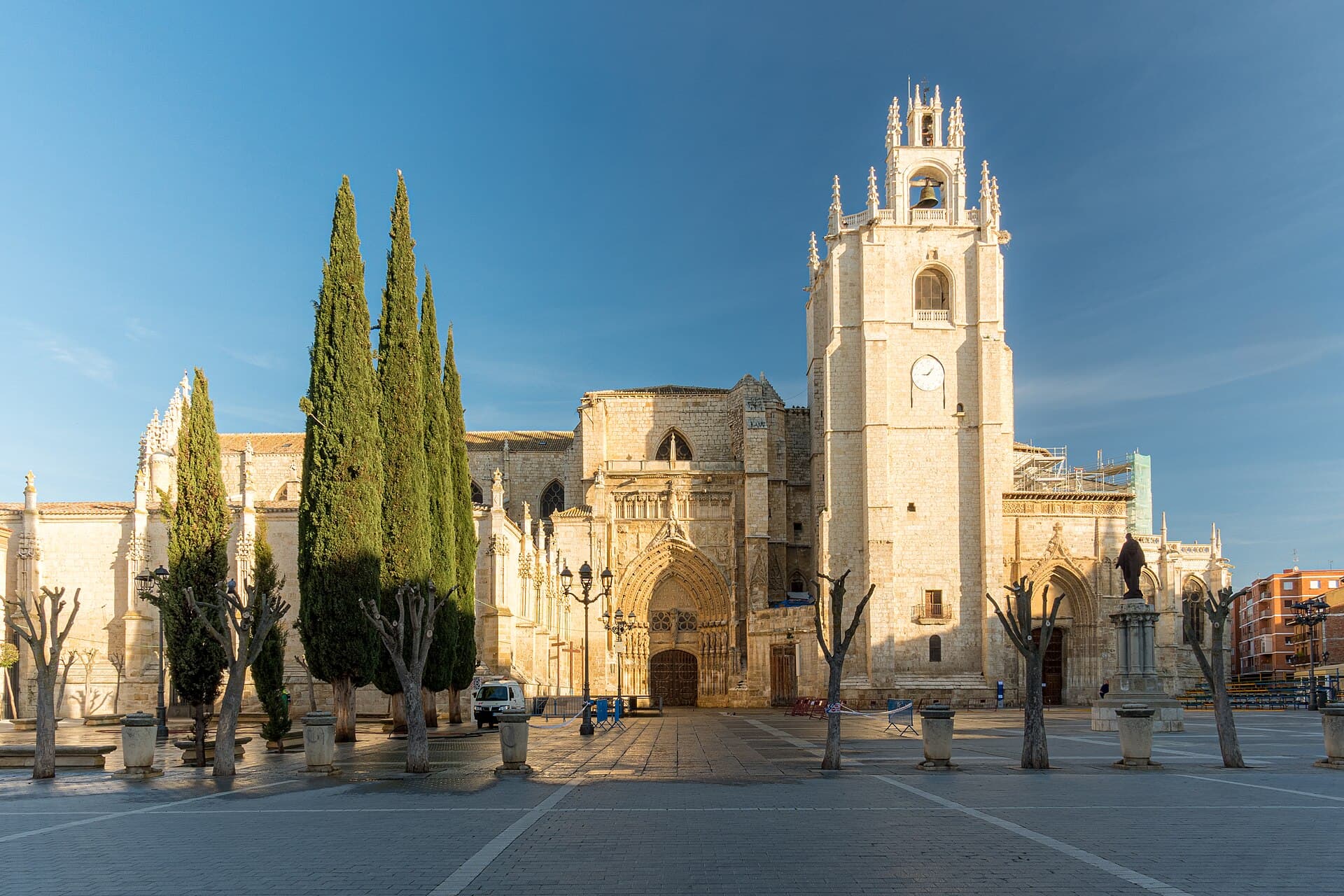 Fernando Pascullo / CC BY-SA 4.0, via Wikimedia Commons
“Palencia: Where ancient stones speak and verdant parks invite repose.”
Not the postcards. The stories even locals don't know — whispered in your ear, right where they happened.
Examine a particular gargoyle on the cathedral, and you might discern a figure quite unexpected for a medieval religious structure.
This church is said to have hosted a momentous wedding that echoes through Spanish legend.
The grand Christ statue surveying Palencia holds a personal connection to its creator.
Discover every secret of Palencia
Every address, every reveal in full — in your ear, right where it happened.
You pick your stops. You walk. The voice reveals what the others miss.
No tours available yet. Check back soon — we're preparing them.
Palencia, a city in the autonomous community of Castile and León, offers a serene experience, a quiet counterpoint to Spain's more frequented tourist destinations. Situated in the tranquil Carrión river valley, it is a city that encourages unhurried exploration on foot, notable for its abundant green spaces per inhabitant. Palencia is a place where history is etched into its stone architecture and a relaxed rhythm of life allows for authentic discovery.
Often called "The Unknown Beauty," Palencia's Gothic cathedral stands as a testament to the city's understated allure. Beyond its historical monuments, Palencia provides a gateway to the wider province, which contains one of Europe's largest concentrations of Romanesque art. From ancient Roman vestiges to medieval narratives, Palencia reveals its character to those who take the time to wander its avenues and delve into its past.
Palencia's origins extend back to the Vaccaei, a Celtiberian tribe who established a fortified settlement called Pallantia. This early community fiercely resisted Roman expansion before eventually being integrated into the Roman Empire. Evidence of Roman occupation, such as the Puentecillas bridge, can still be seen today. The city's strategic location in the fertile Carrión River valley and at the crossroads of trade routes contributed to its early development.
During the Visigothic period, Palencia became an important episcopal see. In the 7th century, the Visigothic King Wamba brought the relics of Saint Antoninus (San Antolín) to the city, who subsequently became Palencia's patron saint. Following the Muslim invasion, the region became a sparsely populated area, gradually repopulated over time.
Palencia experienced a period of significant splendor in the Middle Ages. King Alfonso VIII of Castile was a great supporter of the city, granting it a charter and the cross on its coat of arms for its contribution to the Battle of Las Navas de Tolosa in 1212. At the king's behest, Spain's first university, the Studium Generale, was founded in Palencia around 1208, though it was short-lived. The construction of the grand Gothic Cathedral of San Antolín began in 1321, on the remains of earlier Visigothic and Romanesque churches.
In modern times, the Canal de Castilla, an ambitious engineering project designed to transport wheat, was built by Fernando VI and Carlos III. Today, Palencia is an important center for agri-food, automotive, and construction materials industries.
Begin your exploration on Calle Mayor, Palencia's pedestrian main street, lined with 18th, 19th, and early 20th-century architecture. This central artery is a nexus of shops and a place to observe daily city life.
The Palencia Cathedral, known as "La Bella Desconocida" or "The Unknown Beauty," is a Gothic masterpiece constructed between 1321 and 1504. Its austere exterior conceals a rich interior, containing works by artists such as El Greco and Berruguete, and a crypt with Visigothic and Romanesque remains.
Surveying the city is the Cristo del Otero, a 21-meter-high Art Deco statue of Christ created in 1930 by local sculptor Victorio Macho. It provides expansive views of Palencia and the surrounding area. The Plaza Mayor, with its Neoclassical City Hall, serves as a central gathering point. Nearby, the Church of San Miguel is notable for its Gothic tower and its rumored connection to El Cid's wedding. For a peaceful retreat, the Huerta de Guadián Park features the Romanesque hermitage of San Juan Bautista, carefully relocated stone by stone to this green sanctuary. The Canal de Castilla, a significant Enlightenment-era engineering project, is also accessible for walking or cycling along its towpaths.
The most agreeable time to visit Palencia for warm-weather activities is from mid-June to mid-September, when average daily high temperatures exceed 76°F (24°C). July stands as the warmest month, with an average high of 83°F (28°C). For milder temperatures, spring and autumn (May, June, September, and October) offer comfortable conditions for exploration, with daytime highs between 20°C and 27°C (68°F and 81°F). While these transitional seasons can bring occasional showers, extended periods of rain are infrequent. Winters are cool, with average lows descending to around 0.6°C (33°F) in January.
Palencia is a city easily traversed on foot, making its main attractions readily accessible. Comfortable footwear is advised due to the amount of walking involved. The city experiences a continental climate, so pack layers to adapt to temperature fluctuations throughout the day, particularly during spring and autumn. An umbrella or raincoat is sensible during the wetter periods of spring and late autumn.
Palencia is well-connected, with high-speed train services to Madrid and León. The cost of living is generally lower than in many other Spanish cities, offering reasonable rates for accommodation. While securing a room is usually straightforward, booking in advance is highly recommended if you plan to visit during Holy Week (Semana Santa), as hotels fill quickly for this important event. The local cuisine presents dishes like lechazo asado (roast lamb) and pichón estofado (stewed pigeon). The city also cultivates a lively tapas culture, with many establishments around Calle Mayor and Plaza Mayor offering pinchos with local wines.