Ampera Bridge
The Ampera Bridge, a defining feature of Palembang, was conceived with a grand ambition that was soon set aside.
Full story unlocks in the tour
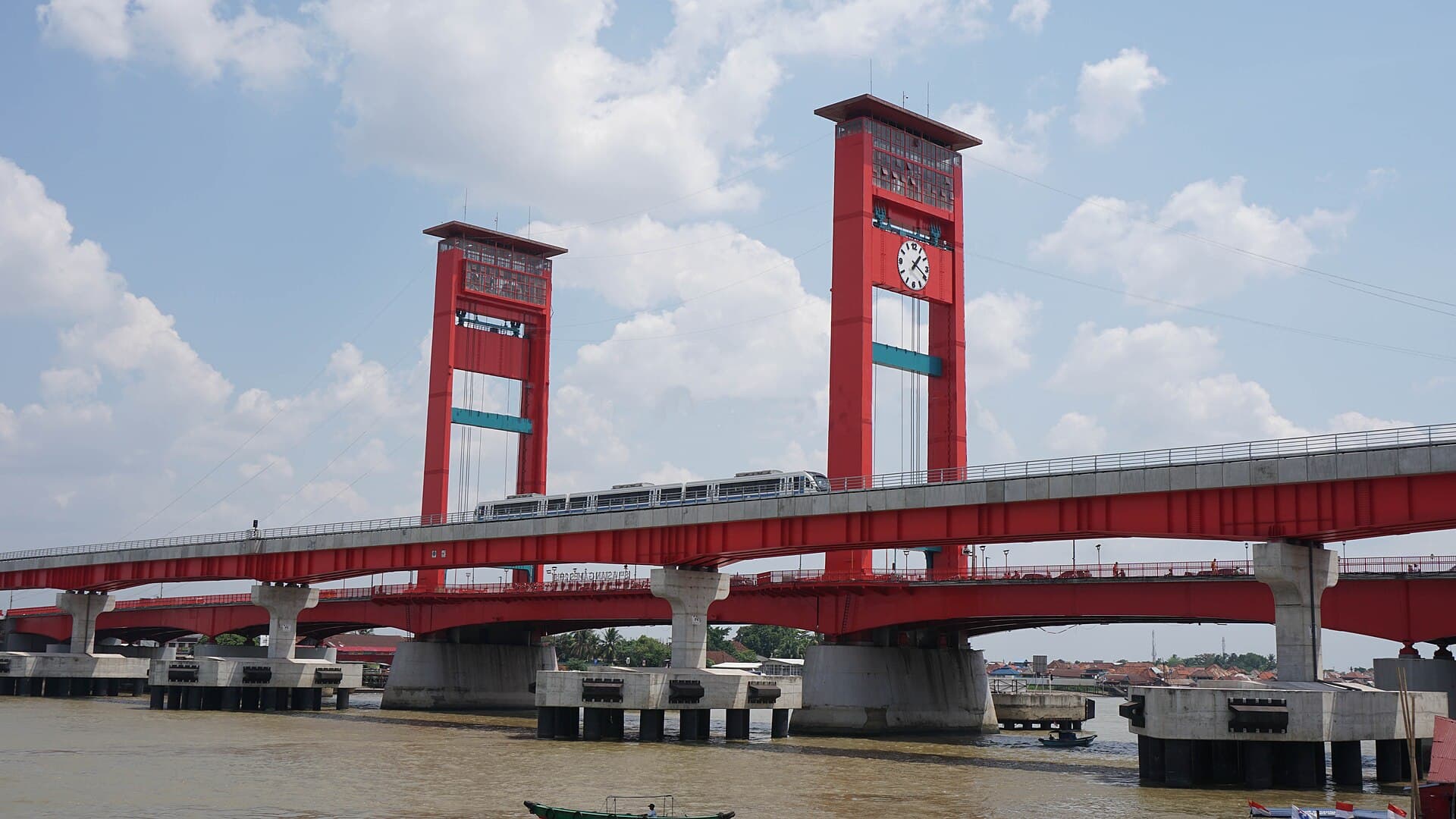 Gaudi Renanda / CC BY-SA 4.0, via Wikimedia Commons
“Where ancient empires meet the flowing river.”
Not the postcards. The stories even locals don't know — whispered in your ear, right where they happened.
The Ampera Bridge, a defining feature of Palembang, was conceived with a grand ambition that was soon set aside.
This small island in the Musi River is said to hold the memory of a sorrowful love story between a Chinese merchant and a Palembang princess.
Palembang's most celebrated dish, pempek, carries an intriguing origin tale linked to an elderly Chinese immigrant and a distinctive way of calling out to the vendor.
Discover every secret of Palembang
Every address, every reveal in full — in your ear, right where it happened.
You pick your stops. You walk. The voice reveals what the others miss.
No tours available yet. Check back soon — we're preparing them.
Palembang, the capital of South Sumatra, Indonesia, is a city woven into the fabric of time, considered one of the oldest in Southeast Asia. Its lifeblood is the powerful Musi River, which divides the city into two distinct areas: Seberang Ilir to the north and Seberang Ulu to the south. This expansive urban center, the second largest on Sumatra, offers a compelling blend of historical grandeur and contemporary life, shaped by its strategic location and enduring cultural heritage.
From its origins as the heart of the powerful Srivijaya maritime empire to its present-day role as a significant regional hub, Palembang has consistently been a nexus of trade, culture, and influence. The city's identity is deeply intertwined with its riverine landscape, earning it the moniker "The Venice of the East" due to its many tributaries and streams. Visitors to Palembang can explore centuries of history, savor unique culinary delights, and witness a lively culture shaped by diverse influences.
## The Cradle of Srivijaya Palembang's recorded history extends back to the 7th century, establishing it as the oldest existing city in Indonesia. It rose to prominence as the capital of the Srivijaya Empire, a maritime power that flourished from the 7th to the 13th centuries. This empire controlled vital maritime trade routes, particularly through the Strait of Malacca, connecting China, India, and the Malay Archipelago. Palembang's strategic position on the Musi River allowed it to become a thriving international port, facilitating the trade of gold, spices, precious woods, and other exotic goods.
Beyond its economic strength, Srivijaya was also a significant center of Buddhist culture and education. The Chinese pilgrim I-Tsing, who visited in the 7th century, described Palembang as a major scientific center with an extensive library and over a thousand Buddhist scholars. He even advised Chinese monks to study Sanskrit in Palembang before continuing their pilgrimage to India.
## Decline and the Rise of the Sultanate The golden age of Srivijaya began to fade after a devastating attack by the South Indian Chola dynasty in 1025, which weakened the empire. By the 14th century, Palembang came under the influence of the Javanese Majapahit Empire. After a period of Majapahit control and even governance by Chinese merchants, the city regained political independence with the establishment of the Palembang Sultanate in 1659.
Under the Sultanate, Islam became the dominant religion, and the city experienced a cultural resurgence, marked by the construction of significant Islamic architecture like the Great Mosque of Palembang, completed in 1748. The Dutch East India Company established a trading post in Palembang in 1619, and by 1642, they had secured a monopoly over the pepper trade. Tensions escalated, leading to conflicts, and the Sultanate was eventually abolished by the Dutch in 1823, with Palembang becoming part of the Dutch East Indies.
## Modern Palembang In the late 19th and early 20th centuries, Palembang re-emerged as an economic center, particularly with the introduction of new export crops like robusta coffee by the Dutch. During World War II, the city was occupied by Japan from 1942 to 1945. After Indonesia's independence, Palembang became the capital of the Residency of Palembang, which later formed the South Sumatra province. The city played a role in the Indonesian National Revolution, notably during the "Battle of Five Days and Nights" in January 1947.
Today, Palembang continues to evolve, hosting major international events like the Southeast Asian Games in 2011 and the Asian Games in 2018, alongside Jakarta. It also features Indonesia's first light rail system, which began operation in 2018.
The Ampera Bridge stands as Palembang's most recognizable landmark, spanning the Musi River and connecting the city's two main sections. Best viewed at night when illuminated, it offers grand views of the river and cityscape. Take a boat tour along the Musi River to experience traditional river life and observe floating markets.
For a journey into the past, visit the Sultan Mahmud Badaruddin II Museum, housed in the former palace of an early 19th-century sultan, displaying relics from the Palembang Sultanate. The Balaputra Dewa Museum offers a broader look at Palembang's past, including a traditional Rumah Limas house. Do not miss the Great Mosque of Palembang, an impressive structure completed in 1748, blending local, Middle Eastern, and Chinese architectural styles.
Explore Kemaro Island, a small delta in the Musi River featuring a Buddhist temple and a nine-story pagoda built in 2006. It is a tranquil spot with cultural significance, especially during Cap Go Meh celebrations. Another distinctive religious site is Al-Qur'an Al-Akbar, home to the world's largest wooden Quran, intricately carved on giant planks. Wander through Kampung Al-Munawar Arab Village, known for its over 250-year-old houses showcasing a blend of Malay and Arab architecture.
Palembang experiences a tropical climate with rainfall throughout the year. The most comfortable time to visit for more pleasant weather and less rain is during the dry season, which runs from June to September. During these months, the average temperature is around 28°C (82°F), with rainfall varying between 104 mm to 120 mm. The warmest month is typically May, with average temperatures around 86°F (30°C), while January is cooler, averaging 82°F (28°C). For activities in warm weather, late May to early October is generally recommended.
The local currency in Palembang is the Indonesian Rupiah (IDR). Visa requirements depend on your nationality, with many countries eligible for visa-free entry or visa on arrival for short stays; it is advisable to check with the Indonesian embassy or consulate before traveling.
When exploring Palembang, respectful attire is important, especially when visiting religious sites. Remember to remove your shoes before entering mosques or someone's home. It is also customary to use your right hand when giving or receiving items.
Palembang has a light rail system, the first in Indonesia, which can be useful for getting around. For navigating the Musi River, motorboats such as speedboats and ketek (small boats) can be hired from under the Ampera Bridge or in front of the Sultan Mahmud Badaruddin II Museum. While the city has large roads, older neighborhoods often feature intricate grids of small alleys, so addresses may be given with double road names for clarity. The main spoken language is Palembang Malay, locally known as baso Pelembang, which has Javanese influences and differs from standard Indonesian in vocabulary, phonology, and grammar.