Palazzo della Ragione
Beneath the grand hall of the Palazzo della Ragione, a curious stone once served a rather humbling public purpose.
Full story unlocks in the tour
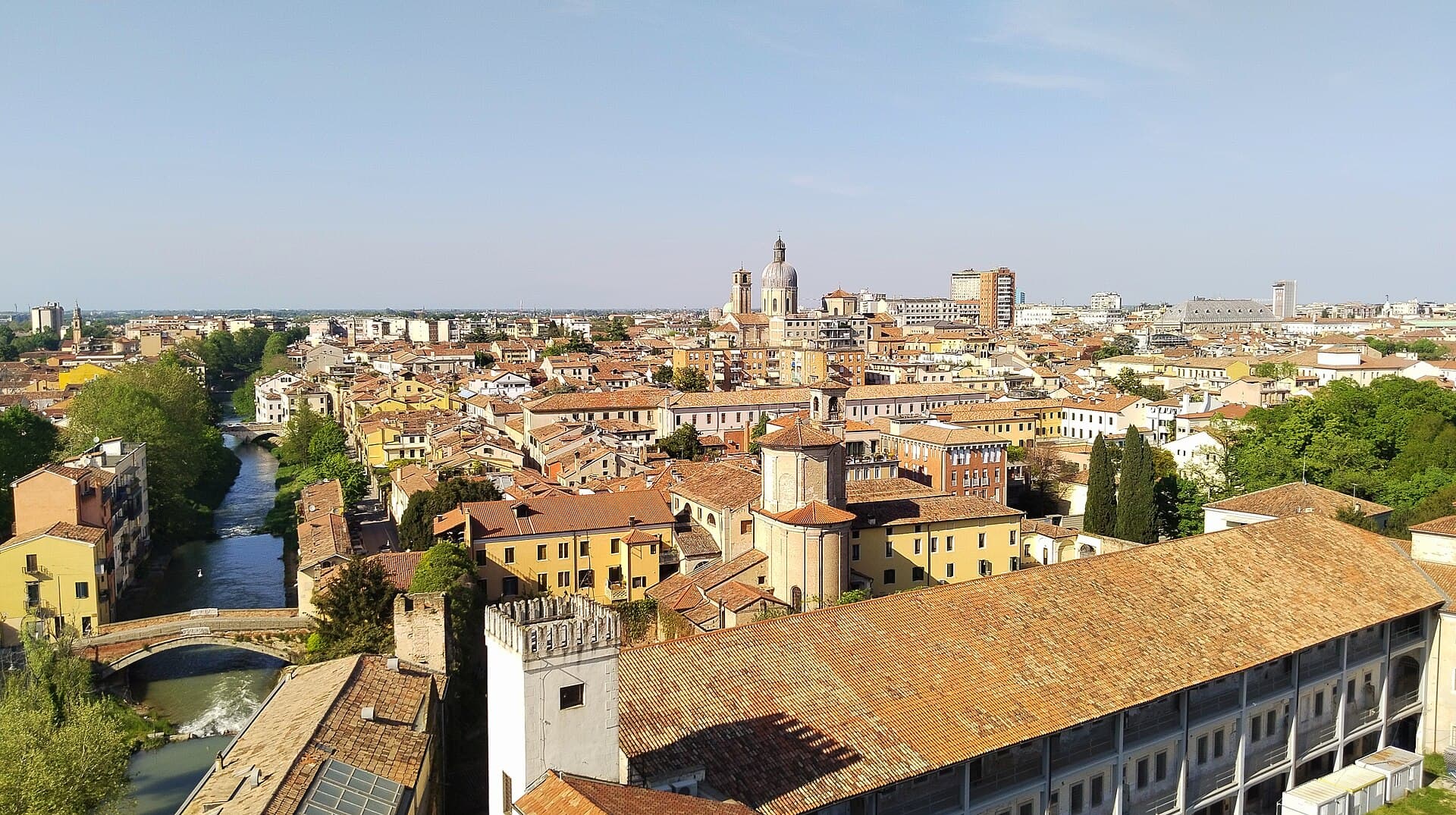 Ricalvo10 / CC0, via Wikimedia Commons
“Padova: Where ancient intellect meets youthful vitality.”
Not the postcards. The stories even locals don't know — whispered in your ear, right where they happened.
Beneath the grand hall of the Palazzo della Ragione, a curious stone once served a rather humbling public purpose.
For nearly a century, one of Padova's most renowned cafes maintained an open invitation, day and night.
While frequently recognized as the world's oldest botanical garden, a particular detail distinguishes Padova's claim.
Discover every secret of Padova
Every address, every reveal in full — in your ear, right where it happened.
You pick your stops. You walk. The voice reveals what the others miss.
No tours available yet. Check back soon — we're preparing them.
Padova, also known as Padua, is a city in Italy's Veneto region, positioned along the Bacchiglione River, approximately 40 kilometers (25 miles) west of Venice. It is a place where layers of history, artistry, and intellectual pursuit converge. Though often overshadowed by its more celebrated neighbor, Venice, Padova offers a distinct and enriching experience. The city serves as an economic and communication nexus for its area, with a population exceeding 200,000 as of 2025.
Padova is honored for its substantial contributions to science and art, holding two UNESCO World Heritage sites: the 14th-century frescoes, including those by Giotto in the Scrovegni Chapel, and its Botanical Garden, the world's oldest academic botanical garden still in its original location. The city's identity is deeply interwoven with its esteemed university, one of the world's oldest, established in 1222. This academic heritage continues to infuse Padova with a youthful energy, creating a lively destination for both residents and visitors.
Padova asserts itself as one of northern Italy's most ancient cities, with a foundational legend tracing back to 1183 BC. This account credits the Trojan prince Antenor, who, according to Virgil's Aeneid, settled in the Euganean plain following the fall of Troy. By the 4th century BCE, it had become the primary Venetian center. Under Roman governance, known as Patavium, it flourished as a prosperous city, esteemed for its horses and wool. The city's affluence was such that by the close of the 1st century BC, it was considered the wealthiest city in Italy outside of Rome.
After the Roman Empire's decline, Padova endured incursions from the Huns and Goths, and was sacked by Attila in 450 AD. It later came under Lombard dominion in 568 AD. The city saw a resurgence around the year 1000, evolving into a free city-state. The 14th century placed Padova under the governance of the Carrara family from 1318 to 1405. During this period, the city thrived as a center of learning and art, drawing figures like the poet Dante.
In 1405, Padova transitioned to the Republic of Venice, remaining under its authority until 1797. This era proved particularly significant for the University of Padova, which maintained a profile of profound academic and religious liberty, even hosting students and educators suspected of heresy during the Counter-Reformation. The 16th century marked a 'golden age' for the university, elevating it to one of Europe's most distinguished educational institutions. Following the Venetian Republic's collapse, Padova fell under Austrian governance from 1815 to 1866, playing an active part in the Risorgimento, the movement for Italian unification. In 1866, it was incorporated into the Kingdom of Italy.
Padova presents a rich array of sights that interweave art, history, and academic tradition. The Scrovegni Chapel is an essential experience, housing Giotto's groundbreaking 14th-century frescoes, a UNESCO World Heritage site. Visits are carefully managed to protect the artwork, so securing reservations in advance is crucial.
The Palazzo della Ragione, a medieval town hall and market structure dating from 1218, stands as another iconic landmark. Its upper floor, known as the Salone, displays a magnificent sequence of 14th-century frescoes. The ground floor continues to host a historic food market.
Prato della Valle is one of Europe's grandest elliptical squares, featuring 78 statues of influential figures connected to Padova, encircled by a canal and a verdant island. It is a lively public space, frequently hosting markets.
The Orto Botanico di Padova, established in 1545, is the world's oldest academic botanical garden still in its original location and a UNESCO World Heritage site. It cultivates over 6,000 plant species and has played a pivotal role in the advancement of botany and medicine.
Explore the University of Padova, particularly the Palazzo del Bo, which contains the world's oldest anatomical theater, dating from 1595. Galileo Galilei once lectured here. The Basilica of Saint Anthony of Padua, a major pilgrimage destination, also stands as a significant architectural and artistic treasure.
The most agreeable times to visit Padova are during spring and early summer, specifically from mid-April to mid-June, or in September. During these months, the weather is generally mild and pleasant, making it ideal for exploring the city on foot. While summer (June to August) can be hot and humid, with average daily highs around 30-35°C (86-95°F), some days, particularly in June, can still be enjoyable. Autumn (September and October) offers comfortable temperatures and beautiful light, especially for photography. Winter, from December to February, is cold and damp, with temperatures often near freezing.
Padova is readily accessible by train, with frequent connections to nearby cities like Venice (approximately 30 minutes away). The city center is largely flat and inviting for walking, making it simple to explore on foot or by bicycle. Public transportation is available for longer distances. When planning your visit, consider acquiring a Padova Card for potential reductions on attractions and transport. For the Scrovegni Chapel, booking ahead is strongly advised due to strict timed-entry regulations. Numerous self-guided audio tours are available for Padova, offering the flexibility to explore at your own pace and learn about local history and intriguing spots. These tours often function offline and provide turn-by-turn directions.