Ourense Cathedral
The Santo Cristo in Ourense Cathedral is said to possess a peculiar, living quality.
Full story unlocks in the tour
 Victor Hermida Prada / CC BY 2.0, via Wikimedia Commons
“Ourense: Where ancient thermal waters greet Galician character.”
Not the postcards. The stories even locals don't know — whispered in your ear, right where they happened.
The Santo Cristo in Ourense Cathedral is said to possess a peculiar, living quality.
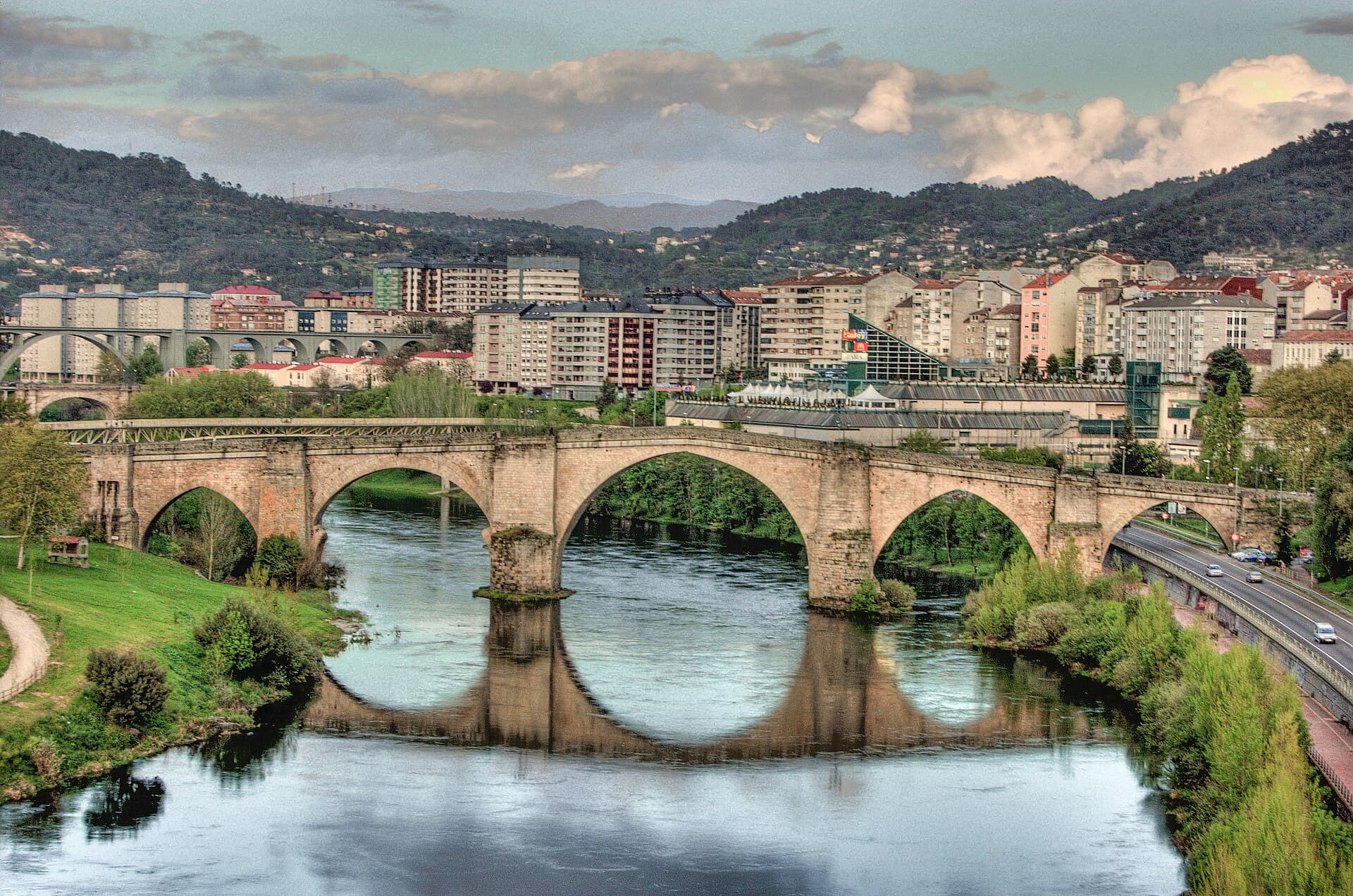
Ourense's iconic Roman Bridge, a symbol of the city for centuries, once had a feature you won't find today.
Unlike many central squares, Ourense's Praza Maior has a distinct tilt.
Discover every secret of Ourense
Every address, every reveal in full — in your ear, right where it happened.
You pick your stops. You walk. The voice reveals what the others miss.
No tours available yet. Check back soon — we're preparing them.
Ourense, known as 'A cidade das Burgas' (The City of As Burgas), is a city in Galicia, northwestern Spain, distinguished by its abundant thermal springs. Situated along the Miño River, the city's origins are deeply intertwined with these hot waters, which drew Roman settlers two millennia ago. Today, Ourense maintains its connection to water with eight bridges spanning the Miño River, offering both historical significance and modern convenience.
The city presents a compelling blend of ancient history and a relaxed, walkable atmosphere. Its medieval quarter, centered around the impressive cathedral, invites exploration through a labyrinth of narrow streets and spirited squares. Beyond the historical core, Ourense offers a unique micro-climate, distinct from the typical Galician coast, with warm summers and mild, wet winters. This inland location, surrounded by mountains, has shaped its character and contributed to its thermal heritage, making it a destination where well-being and history converge.
The history of Ourense begins with the Romans in the 1st century AD, who were drawn to the region by its unique hot springs and the gold deposits in the Miño River. The Romans established a settlement here, initially called 'Auria' or 'Aquis Aurienses' (golden waters), recognizing the strategic importance of the river crossing and the therapeutic value of the thermal waters. They constructed the first bridge over the Miño, the Ponte Vella, which became a vital link for trade routes connecting Roman cities like Bracara Augusta (Braga) and Asturica Augusta (Astorga). The thermal site of As Burgas, with its pool-sanctuary and Roman bathhouse, became a place of pilgrimage, demonstrating the early significance of these springs for health and worship.
Following the Roman era, Ourense became a significant city within the Suebi Kingdom during the 5th, 6th, and 7th centuries. The city's first cathedral is believed to have been built during this period. However, this period of prominence was interrupted by the Moorish invasion in 716 AD, which led to the sacking and depopulation of the area. King Alfonso III of Asturias initiated the city's rebuilding and resettlement in the 9th century, laying the foundations for the current cathedral. The 11th century saw further redevelopment under King Sancho II. The Ourense Cathedral, dedicated to St. Martin of Tours, was largely constructed between the 12th and 13th centuries, becoming a central feature of the medieval city.
For centuries, Ourense's mountainous geography led to some isolation, impacting its economic development compared to other Galician provinces. Traditional industries included iron foundries, clothing manufacturing, flour milling, and sawmills. The 19th century brought renewed economic activity with improvements in land transportation, and the arrival of the railway in 1881 further boosted Ourense as a commercial hub. The construction of the New Bridge (Ponte Nova) in 1918 facilitated urban expansion across the Miño River. In 1975, the Old Town was declared a Historic-Artistic Ensemble, ensuring the preservation of its monuments. Today, Ourense continues to embrace its thermal identity, with new facilities along the Miño River solidifying its status as a popular spa tourist destination, much like in Roman times.
Begin your exploration in the Old Town (Casco Vello), a maze of narrow streets and squares where many buildings have been renovated, attracting small businesses. The Praza Maior serves as the city's heart, home to the city hall and Episcopal Palace, and is notable for its unique inclination.
The Ourense Cathedral, a Romanesque temple with Gothic, Baroque, and Neoclassical elements, is a central monumental area. Inside, do not miss the Pórtico del Paraíso, a sculptural work with preserved original polychromy, and the Chapel of Santo Cristo.
Ourense is defined by its thermal waters. The As Burgas hot springs are a crucial stop, located in the city center. Here, water emerges at over 60°C and fills public pools, offering a unique bathing experience. Along the Miño River, discover other thermal areas like A Chavasqueira, O Tinteiro, Burgo do Muíño das Veigas, and Outariz, many with free access.
Cross the Ponte Vella (Roman Bridge), a pedestrian-only structure with seven original arches, offering vistas of the Miño River. For a modern contrast, see the Millennium Bridge, with its distinctive elliptical design and a pedestrian walkway rising 22 meters above the river for expansive views. Consider a day trip to the Ribeira Sacra, known for its centuries-old vineyards and monasteries along the Sil and Miño Rivers, with striking canyon landscapes.
Ourense experiences warm summers and mild, wet winters. The best time to visit for warm-weather activities is from mid-June to mid-September, with July being the clearest and sunniest month. To avoid the intense summer warmth, consider visiting in spring (mid-April to mid-June) or autumn (mid-September to mid-October), though these periods may have more rainfall. Rainfall is lowest in July and August, peaking in November. The city hosts various festivals, including the International Cinema Festival in November and the Magosto festival, a traditional chestnut celebration, also in autumn.
Ourense is a walkable city, making it easy to explore its historic center and thermal areas on foot. The official languages are Galician and Spanish, with most people understanding both. Those in hospitality often know English. The currency is the Euro (EUR).
For a general overview of the city, especially the historic center and thermal baths along the Miño River, a tourist train operates on holidays and weekends. Tickets can be purchased on the train or at the tourist office near Plaza Mayor. The Ourense Tourist Office is located by the cathedral entrance, with varying hours throughout the week. Santiago de Compostela (SCQ) is the most convenient airport, about 115 km northwest, with flights from across Europe. Vigo (VGO) and A Coruña (LCG) offer domestic flights. Taxis and local buses are available for transport within the city and to thermal areas further afield.