Spasskoye-Lutovinovo Museum-Reserve
Ivan Turgenev's ancestral estate reveals a formative influence on his literary perspective.
Full story unlocks in the tour
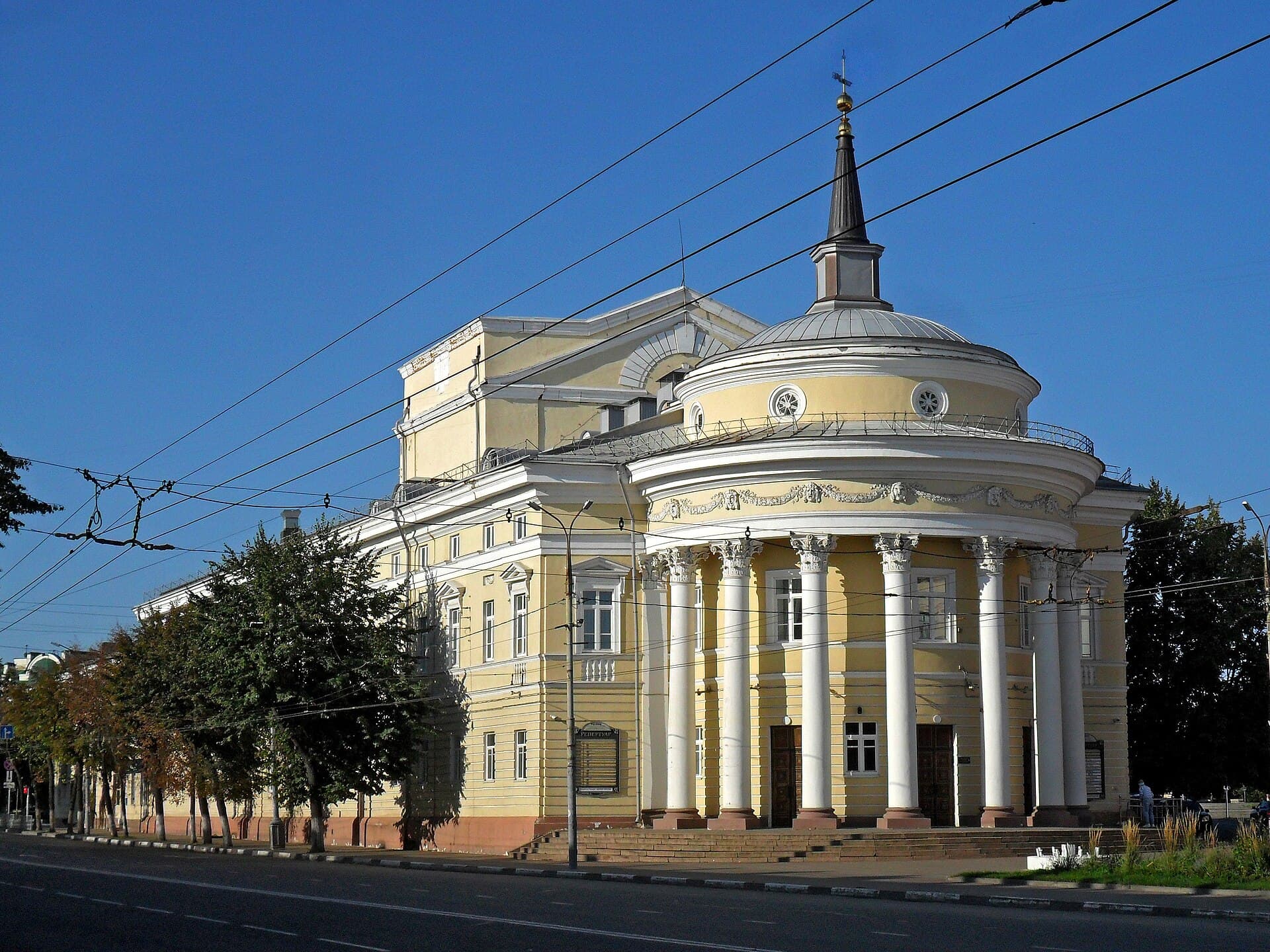 Sviraman / CC BY-SA 4.0, via Wikimedia Commons
“Orel: Where the Oka River flows through pages of Russian prose.”
Not the postcards. The stories even locals don't know — whispered in your ear, right where they happened.
Ivan Turgenev's ancestral estate reveals a formative influence on his literary perspective.
Among the historical artifacts, a surprising exhibit showcases a unique local distinction.
This central pedestrian street, seemingly ordinary, echoes with literary footsteps.
Discover every secret of Orel
Every address, every reveal in full — in your ear, right where it happened.
You pick your stops. You walk. The voice reveals what the others miss.
No tours available yet. Check back soon — we're preparing them.
Orel, also known as Oryol, is a city in western Russia, positioned on the Oka River, approximately 368 kilometers (229 miles) south-southwest of Moscow. This regional capital within the Central Federal District is celebrated for its extensive literary and dramatic heritage. Often referred to as the "Literary Capital of Russia," Orel has been home to distinguished writers such as Ivan Turgenev, Nikolai Leskov, and Leonid Andreev.
Beyond its literary connections, Orel offers a blend of historical landmarks, cultural sites, and natural beauty. The city center, particularly along the banks of the Orlik and Oka rivers, unfolds a picturesque historical landscape with mansions, churches, squares, and well-kept alleys. Visitors can explore monuments of 17th to 19th-century temple architecture, spanning from traditional Russian styles to strict classicism. Orel's parks and museums offer further insights into Russia's past and culture, making it a compelling destination for those interested in history and literature.
The city's name, Orel, means "eagle" in Russian, a symbol of power and majesty. This etymology is thought to be connected to either the historical presence of eagles in the region or the city's strategic placement on a high hill. A prominent modern sculpture of a giant eagle stands on Privokzalnaya Square, welcoming visitors arriving by train and serving as a symbol of the city.
Orel was established in 1566 by order of Ivan the Terrible as a fortress to defend Russia's southern borders from Crimean Tatars. Initially a wooden fortress and settlement, its early history is not extensively documented. In the early 17th century, Orel became a flashpoint for revolts against the reigns of Boris Godunov and Vasili IV Shuysky. The city endured destruction by Polish troops in 1611 and 1615, leading to its reconstruction in 1636.
By the mid-18th century, Orel emerged as a significant center for grain production, with the Oka River serving as a major trade route until the 1860s, when railroads supplanted it. Orel received town status in 1702 and became part of the Kiev Governorate in 1708, later transferring to the Belgorod Governorate in 1727. In 1778, the Orel Vice-Royalty was established. The 19th century saw Orel evolve into a characteristic gentry and merchant city.
During World War II, Orel suffered extensive damage. The city is also known for its historical prisons, which were used during Tsarist Russia, the Soviet Union, and Nazi Germany. Today, Orel is recognized as an important industrial and cultural center, particularly for its literary heritage. It is celebrated as the birthplace of prominent Russian writers such as Ivan Turgenev (born in Orel in 1818), Nikolai Leskov (born in Oryol Gubernia in 1831), and Leonid Andreev (born in Oryol in 1871). The city's cultural landscape includes numerous memorial museums dedicated to these literary figures, as well as several theaters.
Begin your exploration at the confluence of the Oka and Orlik rivers, known as the Strelka, where the Orel Fortress was founded in 1566. This memorial park offers expansive city views and features an obelisk commemorating Orel's 400th anniversary. Nearby, you will discover the Epiphany Cathedral, the city's oldest stone building.
Walk along Lenin Street, a pedestrian thoroughfare in the historic center, lined with historic merchant mansions like the Apollonov House, recognized for its ornate stucco. This street leads to the pedestrian Leninsky (Alexandrovsky) Bridge. From the bridge, visit the "Noble Nest" Park, the setting of Ivan Turgenev's novel. The Literary Quarter is a compelling destination for book lovers, with museums dedicated to Ivan Turgenev, Nikolai Leskov, and Ivan Bunin, offering insights into their lives and works within their former residences.
Other notable sites include Lenin Square, the main city hub with government buildings and the Turgenev State Academic Drama Theatre. Tankers' Square (Skver Tankistov) features a T-34 tank and the Eternal Flame, honoring the city's liberation in 1943. For a broader historical perspective, the Orel Regional Museum provides an overview of the city's history from its founding to its cultural and military development. The Military History Museum offers a comprehensive look at the region's military past, including a section on the Battle of Kursk.
Orel experiences a temperate continental climate with distinct seasons. Summers are comfortable and partly cloudy, while winters are long, freezing, snowy, windy, and often overcast. The most favorable time for warm-weather activities and general outdoor tourism is from late June to late August, with July being the warmest month, averaging a high of 75°F (24°C). May and September also offer pleasant conditions. Rainfall is moderate throughout the year, with July typically being the wettest month and March the driest. Even during warmer months, evenings can be cool, so a light sweater is advisable.
The official currency in Orel, and throughout Russia, is the Russian Ruble (RUB), symbolized by ₽. Banknotes are available in denominations of 5, 10, 50, 100, 200, 500, 1000, and 5000 rubles, with coins in 1, 2, 5, and 10 rubles, and 1, 5, 10, and 40 kopeks. While 5, 10, 200, and 2000 RUB notes are less commonly used, it is helpful to be aware of them.
Orel is approximately a 5-hour drive south of Moscow. The road from Moscow is a 4-lane highway until Tula, then typically 2-3 lanes of moderate quality. Alternatively, express commuter trains run from Moscow's Kursky railway station, with an evening departure arriving in Orel around 10:40 PM, and an overnight sleeper train also available. Within Orel, public transportation includes buses, trolleybuses, trams, and minibuses (marshrutkas). A river tram also operates for tourist purposes, shuttling between Central Park and Luzhkovsky Bridge.