Oradea City Hall Tower
The clock tower of Oradea's City Hall holds a silent testament to a pivotal moment in history.
Full story unlocks in the tour
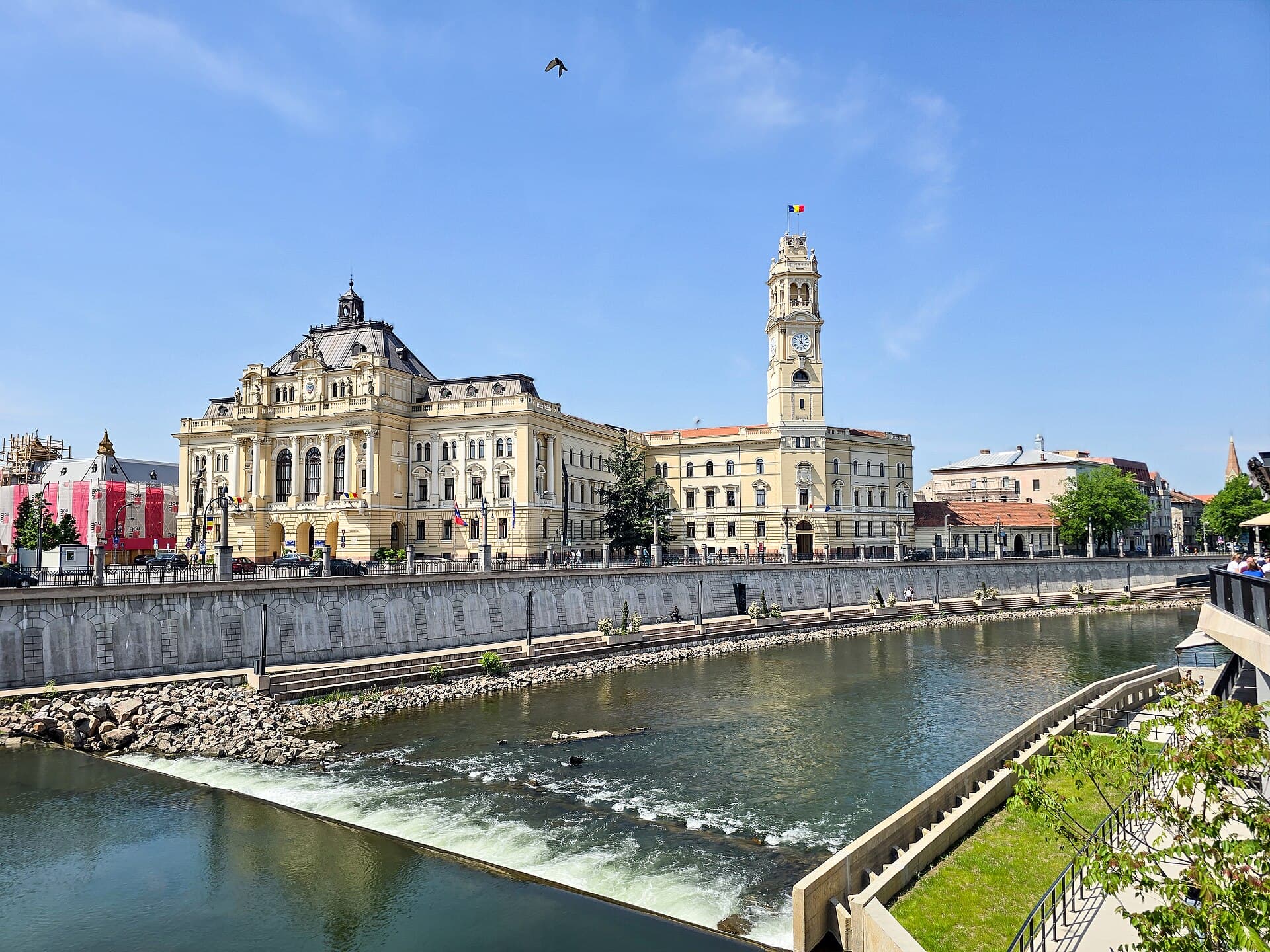 Szilas / CC BY 4.0, via Wikimedia Commons
“Where Art Nouveau dreams meet medieval whispers.”
Not the postcards. The stories even locals don't know — whispered in your ear, right where they happened.
The clock tower of Oradea's City Hall holds a silent testament to a pivotal moment in history.
The defensive moat surrounding Oradea Fortress wasn't just filled with water. It had a unique, natural heating system.
This iconic Art Nouveau palace in Oradea has a secret history as a hub for early 20th-century entertainment and media.
Discover every secret of Oradea
Every address, every reveal in full — in your ear, right where it happened.
You pick your stops. You walk. The voice reveals what the others miss.
No tours available yet. Check back soon — we're preparing them.
Oradea, situated in western Romania, is a city where the Crișul Repede river gracefully divides its landscape, creating a distinctive urban canvas. Often celebrated as Romania's capital of Art Nouveau, the city is a living museum of early 20th-century Secessionist architecture, earning its place in the prestigious European Art Nouveau Network alongside cities like Barcelona and Vienna.
Beyond its architectural grandeur, Oradea offers a blend of historical depth, cultural aliveness, and a relaxed atmosphere. The city's strategic location near the Hungarian border has shaped its multicultural identity, evident in its diverse architectural styles, from Baroque to Eclectic. Visitors can explore medieval fortifications, unwind in thermal spas, and wander pedestrian streets lined with cafes and shops, all contributing to Oradea's unique character.
Oradea's origins trace back to the 12th century, with its first written mention as Varadinum in 1113. King Ladislaus I is credited with founding a monastery here in the late 11th century, which spurred the settlement's growth. The city flourished in the 13th and 14th centuries, becoming a significant pilgrimage center after King Ladislaus I's canonization in 1192. The Citadel of Oradea, first mentioned in 1241 during the Mongol invasion, became a crucial defensive and administrative hub.
The 15th century marked a period of cultural flourishing, transforming Oradea into an important center of humanism in Central Europe. It housed a substantial library and an astronomical observatory that established the "Oradea Meridian," serving as the prime meridian for medieval maps before Greenwich.
After the Ottoman invasion in the 16th century, Oradea experienced periods under the Principality of Transylvania, the Ottoman Empire, and the Habsburg Monarchy. The city was liberated by the Austrian imperial army in 1692, ushering in a Baroque reconstruction phase from 1750 to the 1790s. This era saw the construction of iconic buildings like the Bishop's Palace and the Cathedral of the Assumption of the Blessed Virgin Mary, defining Oradea's European aesthetic.
The turn of the 19th and 20th centuries brought a significant construction boom, transforming Oradea into a capital of Romanian Art Nouveau, also known as Secession style. Architects like Marcell Komor and Dezső Jakab left an indelible mark with their richly decorated facades, flowing lines, and use of colored glass and floral ornaments. The Black Eagle Palace, built between 1907-1909, stands as a prime example of this architectural movement. After World War I, Oradea became part of Romania in 1920 under the Treaty of Trianon. The city actively participated in the anti-communist revolution in 1989, leading to significant political and societal changes. Today, Oradea continues to evolve, preserving its historical layers while embracing modern development.
Oradea's architectural heritage is a primary draw, with its city center resembling an open-air museum of Art Nouveau and Secessionist buildings. Union Square (Piața Unirii) is a focal point, framed by these distinctive structures and featuring a color-changing fountain and the unique Moon Church. The Black Eagle Palace (Vulturul Negru) is an iconic landmark, notable for its glass-covered passage and intricate stained-glass panels.
A visit to the Oradea Citadel is essential. This 16th-century pentagonal fortress, with its five defense towers, now houses Western Romania's largest museum complex, offering a deep dive into the city's past and culture. For sweeping views of the old town and the Crișul Repede River, ascend the Oradea City Hall Tower. The Darvas-La Roche House, Romania's only Art Nouveau museum, showcases the discreet luxury of the early 20th century with its stained-glass windows and period furniture. For relaxation, the Aquapark Nymphaea provides a year-round water park experience, and the thermal spa resort of Băile Felix is just 8 km away.
The most pleasant times to visit Oradea are during spring and fall, when the weather is mild and comfortable for exploring the city's architecture and outdoor attractions. Specifically, the warm season extends from late May to mid-September, with July being the warmest month, averaging 81°F (27°C). For warm-weather activities, early June to mid-September is ideal. The city also hosts various festivals during the warmer months, adding to its appeal. Winters are cold, with January being the coldest month, averaging 26°F (-3°C).
Oradea is considered a secure city, with a low crime rate, making it comfortable for walking, even at night. The local currency is the Romanian Leu (RON). While Romanian is the official language, Hungarian is also recognized as a minority language due to the city's bilingual dynamic. Many hotels may quote prices in Euros, and Euros are accepted in most places.
Getting around Oradea is facilitated by an efficient public transportation system, including trams and buses that cover most areas of the city. A one-way ticket costs RON 2.50. Tickets can be purchased at OTL counters near stations or via SMS. Taxis are also readily available. Oradea International Airport (OMR) is located 5 km southwest of the city, offering connections to various European destinations. Alternatively, Budapest Airport (BUD) is a common entry point, with bus services to Oradea taking approximately 3.5 hours.