Royal Palace of Olite
Imagine a medieval palace so grand, it contained more rooms than days in a year and sheltered exotic animals.
Full story unlocks in the tour
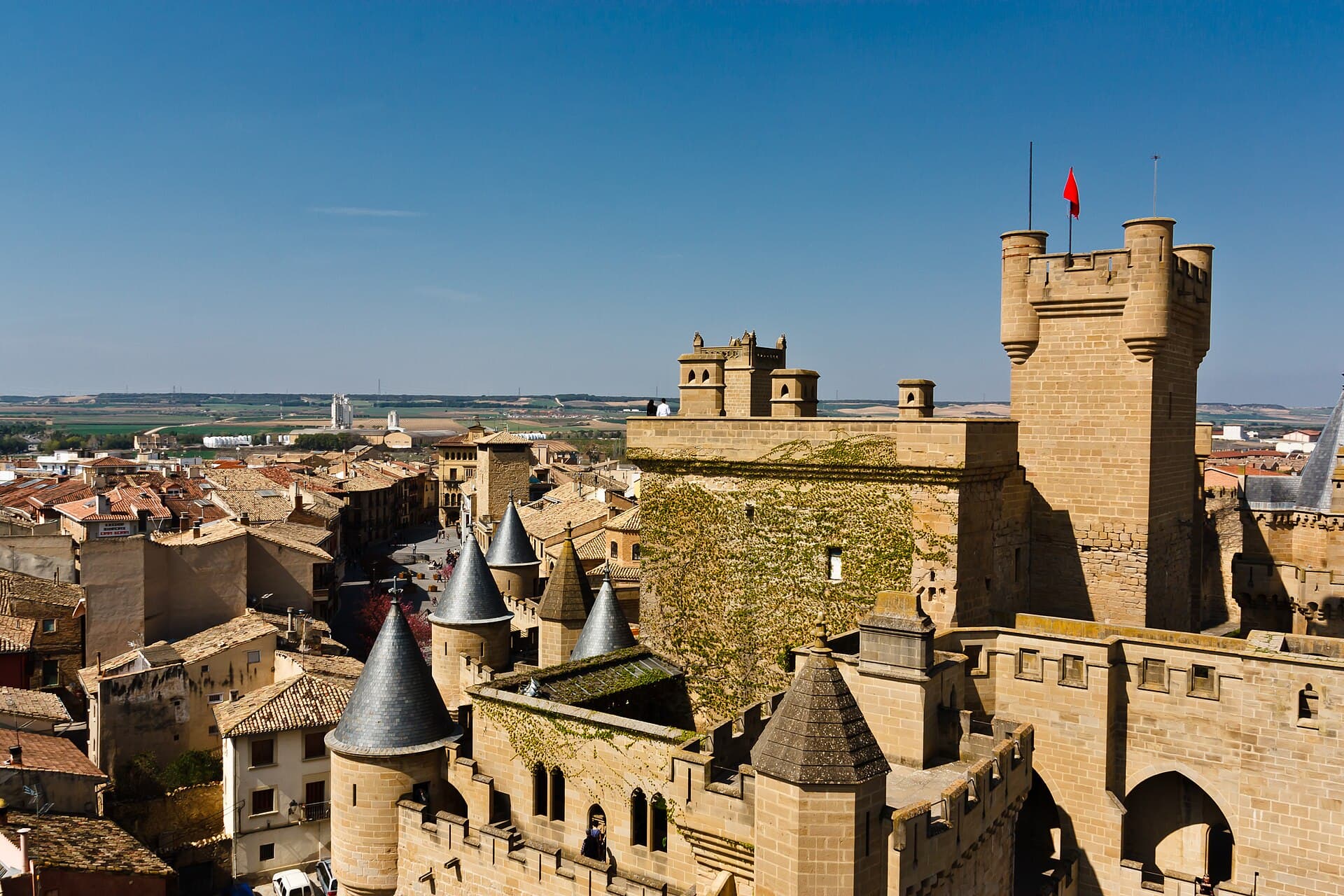 César Viteri Ramirez from Madrid, Spain / CC BY-SA 2.0, via Wikimedia Commons
“Where kings kept lions and vineyards still reign.”
Not the postcards. The stories even locals don't know — whispered in your ear, right where they happened.
Imagine a medieval palace so grand, it contained more rooms than days in a year and sheltered exotic animals.
Before refrigeration, how did a 15th-century palace keep its provisions and beverages cool in the Spanish warmth?
This Gothic church, appearing to be an extension of the Royal Palace, conceals a story behind its impressive façade.
Discover every secret of Olite
Every address, every reveal in full — in your ear, right where it happened.
You pick your stops. You walk. The voice reveals what the others miss.
No tours available yet. Check back soon — we're preparing them.
Olite, known as Erriberri in Basque, is a town in the heart of Navarre, Spain, that transports visitors back to the Middle Ages. This historic-artistic site is dominated by the grand Royal Palace, a former seat of the Kingdom of Navarre. Beyond the palace walls, Olite's allure extends to its narrow passages, stately homes adorned with coats of arms, and ancient churches.
The town is also recognized as the "Wine Capital of Navarre," with a deep connection to viticulture that dates back to Roman times. Surrounded by grapevines, Olite offers ample opportunities for wine tasting and exploring local bodegas. Whether you are a history enthusiast, a wine connoisseur, or simply seeking a scenic escape, Olite provides a blend of historical appeal and local customs.
Olite's strategic location in central Navarre, approximately 35 minutes from Pamplona, makes it an ideal base for exploring the wider region. Its well-preserved medieval character and lively cultural events, such as the annual Medieval Festival, offer an immersive journey into Spain's enduring heritage.
## From Roman Outpost to Royal Seat Olite's origins trace back to the 1st century AD when it was a Roman settlement protected by walls. In 621, the Goth king Suintila refounded the town, naming it Oligicus or Ologite and fortifying it. However, Olite's true significance began in the 12th century when King García IV Ramírez, the Restorer, granted it its first jurisdiction, leading to the town's expansion and offering tax advantages.
By the 13th century, Olite became a favored residence for the kings of Navarre. The Old Palace, a Gothic structure built in the 13th century on Roman remains, served as the royal seat. It was around this time that the town also gained the privilege of hosting a 15-day annual fair.
## The Splendor of Charles III the Noble Olite experienced its golden age in the 15th century under King Charles III the Noble and his wife Leonor of Trastámara. From 1402, Charles III embarked on an ambitious project to expand the existing fortress, transforming it into the lavish Royal Palace of Navarre. This new palace, often referred to as Olite Castle, was conceived more as a courtly residence than a defensive stronghold, reflecting the king's preference for peace over war. The king invested deeply, hiring skilled artisans from Navarre and beyond, including some from Paris, to create a palace of exquisite Gothic art, complete with seven towers, extensive gardens, and opulent decorations. It was considered one of the most luxurious medieval castles in Europe, featuring exotic plants, a zoo, and even a system of hanging gardens.
## Decline, Destruction, and Restoration After Charles III's death in 1425, the palace's fortunes waned. In 1512, Navarre was conquered by Castile, and Olite ceased to be a royal capital. A devastating blow came in 1813 during the Peninsular War when the palace was deliberately set on fire by guerrilla leader Espoz Mina to prevent French troops from fortifying it. The palace was almost completely ruined, and its internal structure largely lost.
In the early 20th century, efforts began to restore the Royal Palace. Declared a National Monument in 1925, the restoration project, undertaken by the Yárnoz brothers, aimed to bring the castle back to its former glory, with significant reconstruction completed by 1967. Today, the New Palace is open to visitors, while the Old Palace houses a Parador hotel, allowing guests to experience its medieval ambiance.
The undisputed highlight of Olite is the Royal Palace of Olite, a sprawling Gothic complex that was once the seat of the Kingdom of Navarre. Explore its numerous towers, including the tallest Homenaje tower, the distinct Tres Coronas tower, and the Cuatro Vientos tower, which offers wide views of the old town and surrounding vineyards. Wander through the royal chambers and imagine the courtly life of King Charles III the Noble. The palace also features an intriguing ice well, a testament to medieval refrigeration.
Adjacent to the Royal Palace is the Church of Santa María la Real, a delicate example of Gothic architecture with an impressive 14th-century façade and a beautiful 15th-century cloister. Its restored polychrome artwork depicts biblical scenes. Another significant church is the Church of San Pedro, the oldest in Olite, featuring a Romanesque façade and cloister.
Beyond the monumental architecture, stroll through Olite's medieval streets, lined with noble houses and inviting plazas like Plaza Carlos III and Plaza de los Teobaldos. Discover the town's deep connection to wine at the Museo del Vino de Navarra (Navarre Wine Museum), housed in a 17th-century palace, which chronicles the region's winemaking history and offers wine tastings. Many local bodegas (wineries) also offer tours and tastings.
The best times to visit Olite are during spring (April to June) and early autumn (September to October) for mild and pleasant weather, and fewer crowds. Daytime temperatures during these months range from 19°C to 28°C (66°F to 82°F). Summer, particularly from mid-June to late September, is also popular for warm-weather activities, though it can be hot, with August seeing average highs of 31°C (88°F). August is when the lively Medieval Festival takes place, transforming the town with parades, markets, and costumed locals. The Grape Harvest Festival is celebrated on the first weekend of September.
Olite is easily accessible by car, located about 35 minutes from Pamplona via the N-121 national road or the AP-15 motorway. The town itself is small and highly walkable, allowing visitors to explore its medieval streets and attractions on foot. The Royal Palace of Olite offers self-guided visits with multilingual audio guides, or guided tours that can be booked in advance. Admission for adults is typically around €4.40, with discounts for seniors and children. Guided tours are around €7.50. Note that the palace is partially accessible for those with reduced mobility, but strollers are not permitted inside.
The Olite/Erriberri Tourist Office provides information on accommodation, restaurants, wineries, and local attractions. Many local wineries offer tours and tastings, though pre-booking is often advisable, especially during high season. Consider staying in the historic center for proximity to hotels, restaurants, and attractions. While Spanish is the primary language, some tours and information may be available in English.