Hans Christian Andersen Museum
The new Hans Christian Andersen Museum offers a deeply immersive experience, but there's a subtle sensory detail that connects you directly to the author's world.
Full story unlocks in the tour
 Unknown author / Public domain, via Wikimedia Commons
“Where fairytales linger in ancient lanes and Viking echoes resound by the river.”
Not the postcards. The stories even locals don't know — whispered in your ear, right where they happened.
The new Hans Christian Andersen Museum offers a deeply immersive experience, but there's a subtle sensory detail that connects you directly to the author's world.
The revitalized Odense Harbour is home to striking modern art, but one particular mural by a world-renowned artist has a curious, almost camouflaged, duality.
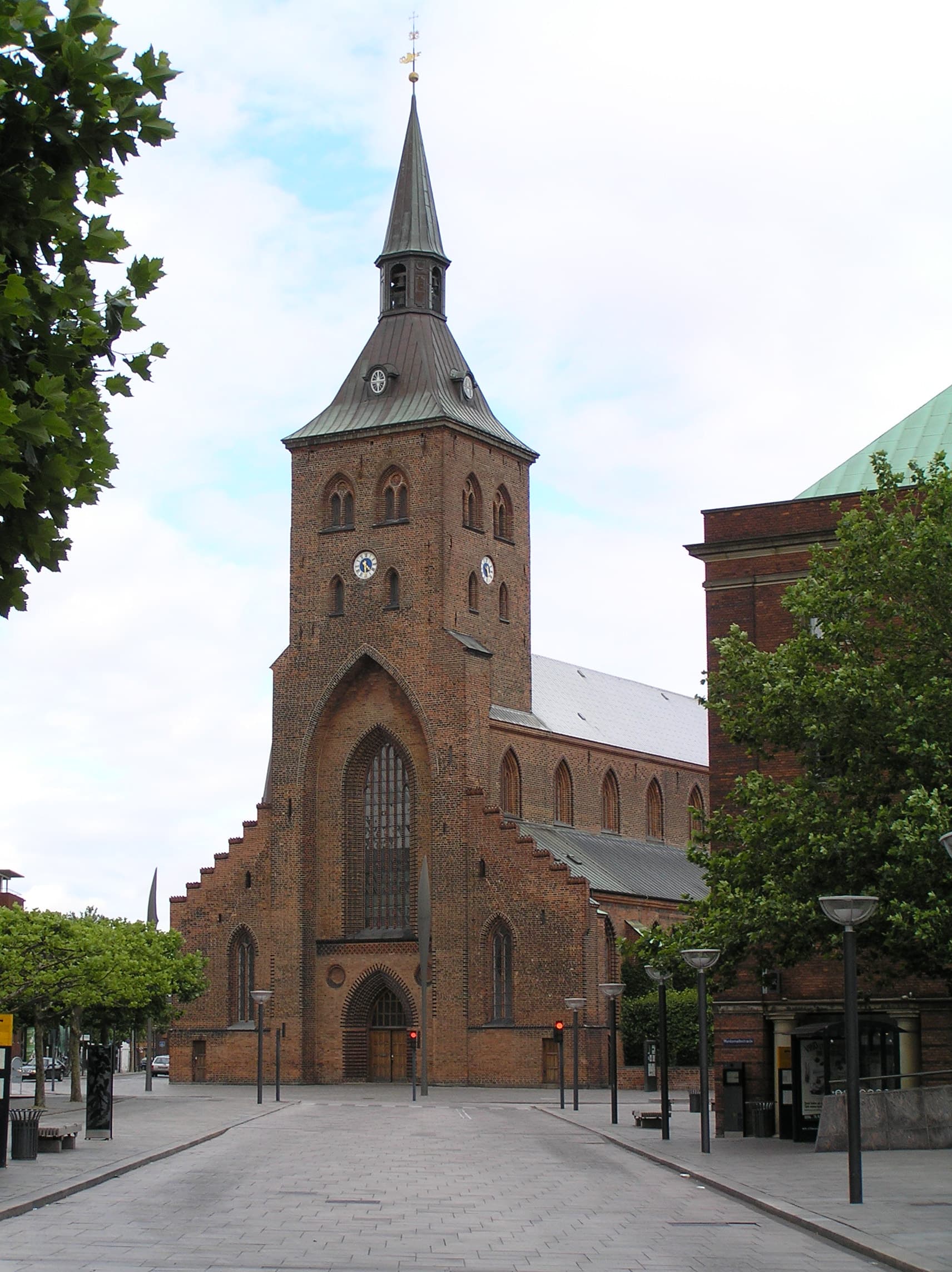
This grand Gothic cathedral holds the remains of a canonized king, but a lesser-known detail in its crypt reveals a surprising historical connection.
Discover every secret of Odense
Every address, every reveal in full — in your ear, right where it happened.
You pick your stops. You walk. The voice reveals what the others miss.
No tours available yet. Check back soon — we're preparing them.
Odense, Denmark's third-largest city, offers a compelling fusion of ancient heritage and contemporary innovation, all while maintaining a relaxed, almost village-like atmosphere. Situated on the island of Funen, it is a city deeply rooted in the Viking Age, with its name even stemming from Odin, the chief god in Norse mythology. Beyond its Viking past, Odense is universally celebrated as the birthplace of Hans Christian Andersen, whose literary fairy tales continue to captivate visitors worldwide.
Today, Odense is undergoing a swift transformation, with a re-envisioned city center, a new light rail system, and a redeveloped harbor area. Despite these modern advancements, the city retains its allure through well-worn lanes, colorful houses, and abundant green spaces, including over 120 parks. It is a city that encourages unhurried exploration, whether cycling along its extensive paths or enjoying a quiet moment by the Odense River.
Odense's narrative extends back over a thousand years, with archaeological evidence suggesting human presence for over 4,000 years, since at least the Stone Age. The earliest community was established on higher ground between the Odense River and the now-dry Naesbyhoved Lake, with a Viking ring fortress, Nonnebakken, positioned south of the river. The city's name, first recorded around 988 AD, is believed to derive from 'Odins Vé,' a sanctuary dedicated to the Norse god Odin.
By 1070, Odense had grown into a substantial Danish city. A pivotal event occurred in 1086 when Canute IV of Denmark, often considered the last Viking king, was assassinated in St. Alban's Priory. He was canonized in 1100, establishing Odense as a center for religious pilgrimages, with his remains now housed in St. Canute's Cathedral. The city endured destruction by fire in 1249 during a royal rivalry but quickly recovered, flourishing as a commercial hub in the Middle Ages. In the 18th century, a modernization plan led to the rebuilding of Odense Palace and the construction of an 8-kilometer canal to the Odense Fjord, significantly boosting trade and population.
The 19th century brought swift expansion, with the city's gates dismantled in 1851 and development extending south of the river. The construction of a railway across Funen in 1865 further solidified Odense's role as a major rail junction. In 1805, Hans Christian Andersen was born in Odense, and his legacy remains a defining aspect of the city's identity. A notable landmark of the 20th century was Odinstårnet (The Odin Tower), built in 1935 as Europe's second-tallest tower, though it was tragically destroyed by Danish Nazis in 1944 and never rebuilt. Today, Odense is recognized as a leading robotics city and a center for innovation, knowledge, and education, with a strong focus on technology and sustainability.
Begin your exploration in the heart of Odense's old town, where worn lanes and historic half-timbered houses create an inviting atmosphere. Here, you can visit the Hans Christian Andersen Museum, an immersive experience that delves into the life and works of the celebrated fairytale author. A short walk away is H.C. Andersen's Childhood Home, offering a more intimate glimpse into his early life.
No visit is complete without seeing St. Canute's Cathedral, a Gothic masterpiece from around 1300, which houses the remains of King Canute the Holy. For a step back in time, The Funen Village (Den Fynske Landsby), an open-air museum, recreates a 17th- to 19th-century Funen village, complete with historical houses and demonstrations of traditional crafts. The revitalized Odense Harbour offers a modern contrast with its appealing eateries and impressive street art, including the "Bird and Fish" mural by ROA on a silo building. For art enthusiasts, Brandts Art Museum, located in a former textile factory, is a compelling cultural destination.
Nature lovers can enjoy Munkemose Park and the Fairytale Garden (Eventyrhaven), which runs along the river and features fairytale sculptures. Do not miss the lively street art scene, particularly along Jernbanestien, a legal wall where creativity thrives with ever-changing murals and graffiti. For a unique perspective, consider a riverboat tour along the Odense River.
The ideal time to visit Odense for warm-weather activities and outdoor events is from late June to late August. During these summer months, the city truly awakens with festivals, lively cafes, and daylight extending until late in the evening. However, be aware that hotel prices may be higher. Late spring (May) and early autumn (September) also offer mild weather, fewer crowds, and pleasant conditions for exploring, with café terraces still open. While winter can be grey, the Christmas markets fill the air with festive cheer and offer a cozy experience.
Odense is well-connected and easy to navigate. While it has its own small Hans Christian Andersen Airport (ODE), located about 9 km north-northwest of the city, most international visitors fly into Copenhagen and take a fast train, which takes just over an hour. The city center is compact and very walkable, with many attractions within easy reach. Odense also cultivates a strong cycling culture, with extensive cycle paths and numerous rental options available.
For public transport, Odense offers a modern light rail system that connects the central train station, city center, university, and hospital, running frequently throughout the day. There are also city buses, including a free city center bus (Route 10) that operates on weekdays and Saturdays, stopping at key locations. Tickets for the light rail and buses can be purchased via QR code at stations, the RejseBillet app, or at Fynbus ticket centers. Danish Krone (DKK) is the local currency. Most locals speak excellent English, making communication straightforward.